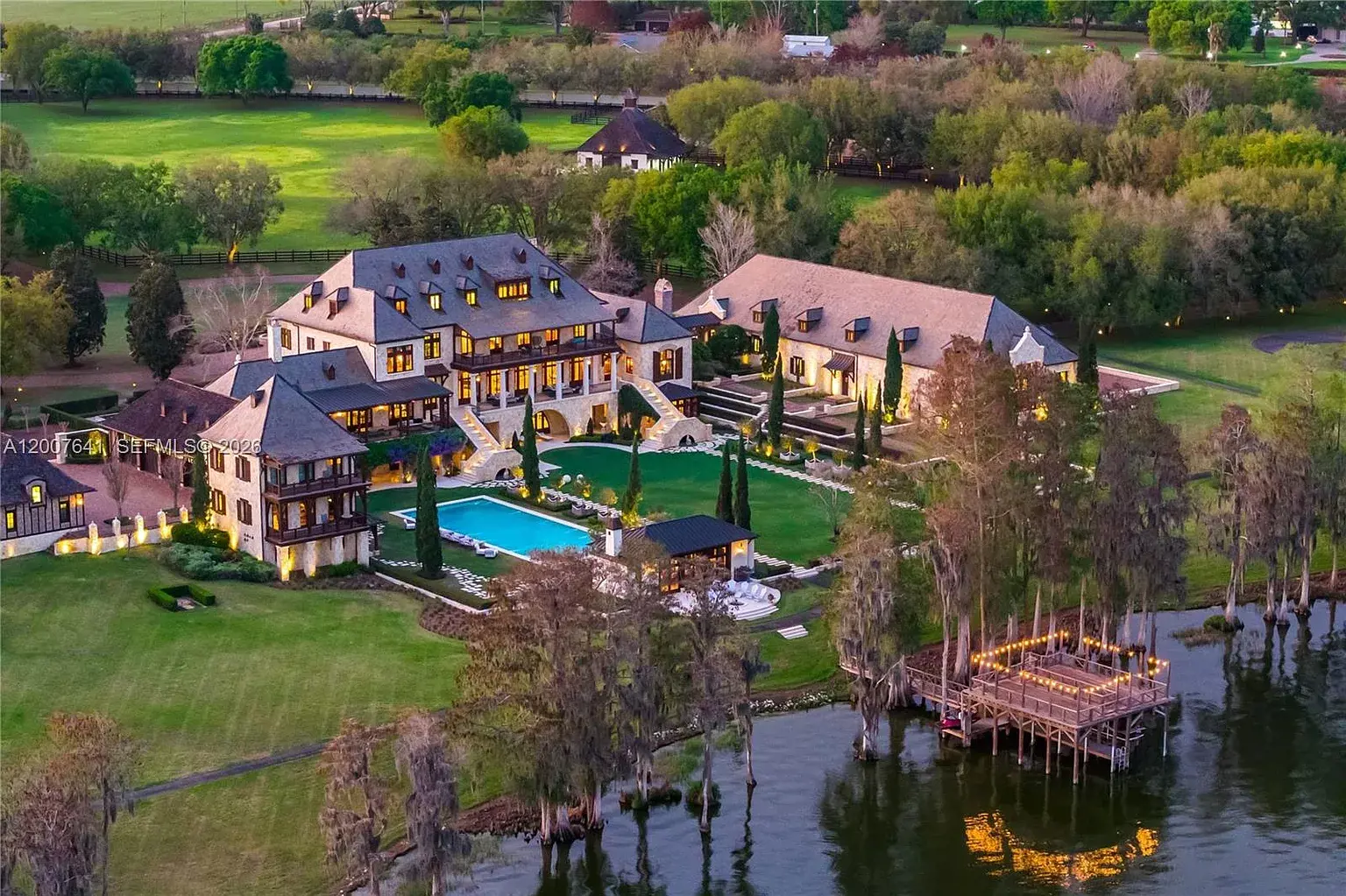
The listing for "Le Palais Royal," a sprawling estate in Hillsboro Beach, Florida, recently hit the market with a staggering $159 million price tag. While headlines focus on the gold leaf and the marble, the real story isn't the opulence—it's the desperate gamble of a property that has morphed into a private theme park to justify its existence. This is no longer a home. It is a massive, illiquid asset class of one, attempting to find a buyer in a global market where "too much" has become a liability.
At this price point, you aren't paying for square footage or a zip code. You are paying for a subterranean entertainment complex that includes the world’s first private IMAX theater, a go-kart track, and an ice skating rink. But beneath the $3 million gold-leafed staircase lies a cold reality of the ultra-high-net-worth real estate market. These properties often sit for years, undergoing price cuts that would bankrupt a small nation, because they are built to the hyper-specific, often eccentric whims of a single individual. When you build a house for everyone, you build it for no one.
The Architecture of Excess
The owner, Robert Pereira, founder of Middlesex Corporation, didn't just build a house; he engaged in a decade-long project of ego-driven engineering. The estate spans over 60,000 square feet. It features six waterfalls, one of which drops 25 feet, and a garage that can hold 30 cars. But the pivot from a French-inspired "Palace of Versailles" replica to a high-tech playground is where the narrative shifts.
Phase two of the construction added a second lot and a massive underground "entertainment complex." This wasn't an organic expansion. It was a calculated move to differentiate the property from the dozen other mega-mansions lining the Florida coast. By adding a bowling alley and a nightclub, the property attempts to solve the "boredom problem" of the super-rich. Yet, it ignores the basic law of real estate value. Every custom feature—like an indoor skating rink in a tropical climate—shrinks the pool of potential buyers. You aren't looking for a billionaire; you’re looking for a billionaire who specifically wants to ice skate in Hillsboro Beach.
The Maintenance Trap
Maintenance on a $159 million asset is a silent killer of value. We are talking about a staff of dozens, electricity bills that rival mid-sized factories, and the constant battle against salt-air corrosion on that $2 million worth of gold leaf.
- Property Taxes: In Florida, these can exceed $1.5 million annually for a property of this scale.
- Staffing: 24/7 security, groundskeepers, and specialized technicians for the IMAX and water systems.
- Insurance: In a hurricane-prone zone, insuring a glass-and-gold palace is a nightmare of underwriting.
Most buyers at this level are looking for "turn-key" luxury. But Le Palais Royal is a machine that requires constant, expensive calibration. It is a liability disguised as a trophy.
Why the $159 Million Price Tag is a Mirage
The number is designed for gravity. It pulls in the press. It creates a "halo effect" for the neighborhood. In the world of high-end brokerage, these prices are often "aspirational," a polite industry term for "wildly unrealistic."
If we look at the historical data for the "Millionaire’s Mile" in Hillsboro Beach, nothing has ever traded at this level. The previous record for the area is a fraction of this ask. To reach $159 million, a buyer has to ignore every comparable sale in the state. They have to decide that the specific combination of a go-kart track and a private dock for a 200-foot yacht is worth a $100 million premium over a standard oceanfront estate.
The smart money in real estate knows that "amenity creep" eventually hits a wall. There is a point where adding more features actually lowers the resale value because the next owner views the go-kart track as a $5 million demolition project.
The Problem with Bespoke Megaproperties
In the 1990s and early 2000s, the goal was size. Today, the global elite are shifting toward privacy, security, and sustainability. A massive, gold-plated palace visible from the road is the opposite of modern luxury. It is loud. It is vulnerable.
Modern billionaires like Jeff Bezos or Ken Griffin spend hundreds of millions on land, but they often choose to build sleek, minimalist compounds or buy multiple adjacent lots to create a buffer of silence. Le Palais Royal, by contrast, is a monument to a previous era of consumption. It screams for attention in a world where the truly powerful are trying to disappear.
The Ghost House Syndrome
There is a high probability this home will become a "ghost house." This happens when a property is so expensive and so specific that it remains empty for years. It becomes a line item on a corporate balance sheet or a stagnant asset in a trust.
When a house doesn't breathe, it dies. Stagnant air affects the finishes. Unused plumbing systems fail. The "theme park" elements—the specialized projectors and racing rigs—become obsolete before a single guest uses them. This is the irony of the $159 million price point. The longer it takes to find a buyer, the less "new" and "luxury" the technology feels. A five-year-old IMAX system in a house that has never been lived in is just an old computer.
Market Saturation and the Global Buyer
The pool of buyers for a $150 million+ home is globally estimated at fewer than 3,000 individuals. Of those, how many want to live in Hillsboro Beach? Most are looking at London, New York, or Saint-Tropez.
Florida’s tax advantages are a draw, certainly. But those advantages are usually realized in properties between $10 million and $40 million. Once you cross the $100 million threshold, the tax savings are overshadowed by the carrying costs of the asset itself. You don't buy this house to save money; you buy it because you have so much money that the "math" no longer matters.
The Construction Industrial Complex
We must also look at the contractors and architects who drive these projects. There is an entire industry built around convincing wealthy individuals to over-build. For a contractor, a $3 million gold-leaf contract is a career-maker. They have no incentive to tell a client that an indoor ice rink is a bad investment.
The "theme park" home is the result of a feedback loop between a client with infinite resources and an industry that profits from complexity. The more complex the build, the higher the fees. By the time the owner realizes they’ve built a white elephant, the builders have moved on to the next project.
Assessing the True Value
If this property were to sell tomorrow, a realistic "clearing price" would likely be 30% to 40% below the asking price. We see this pattern repeatedly with "mega-listings."
- The Launch: A massive, record-breaking price is announced to generate PR.
- The Stagnation: The property sits for 12-18 months with no serious offers.
- The Quiet Cut: The price is lowered, or the listing is taken off-market and "re-launched" with a new brokerage.
- The Reality Sale: The property sells for a price that is never publicly disclosed, or it goes to auction.
The Future of the Mega-Mansion
The "theme park" model of residential real estate is a dying breed. The next generation of wealth is focused on "wellness" and "integration." Think air filtration systems that mimic forest air, circadian lighting, and massive organic gardens. They want "quiet luxury."
Le Palais Royal is the final, loud gasp of the "Gilded Age" of the early 21st century. It represents a time when wealth was measured by how much gold you could stick to a wall. Today, wealth is measured by how much time you can save and how little the world knows about your whereabouts.
A go-kart track doesn't buy you time. It buys you a maintenance schedule. An ice rink doesn't buy you status; it buys you a massive insurance premium. The $159 million tag is a challenge to the market, asking if there is still a buyer who values theater over substance.
If you want to understand the health of the top 0.1%, don't look at the houses they are building. Look at the houses they are trying to sell. When the "theme park" homes start hitting the market, it’s a sign that the owners are looking for an exit from the very monuments they built to themselves.
The smart money isn't buying the palace. The smart money is the one who sold the gold leaf.