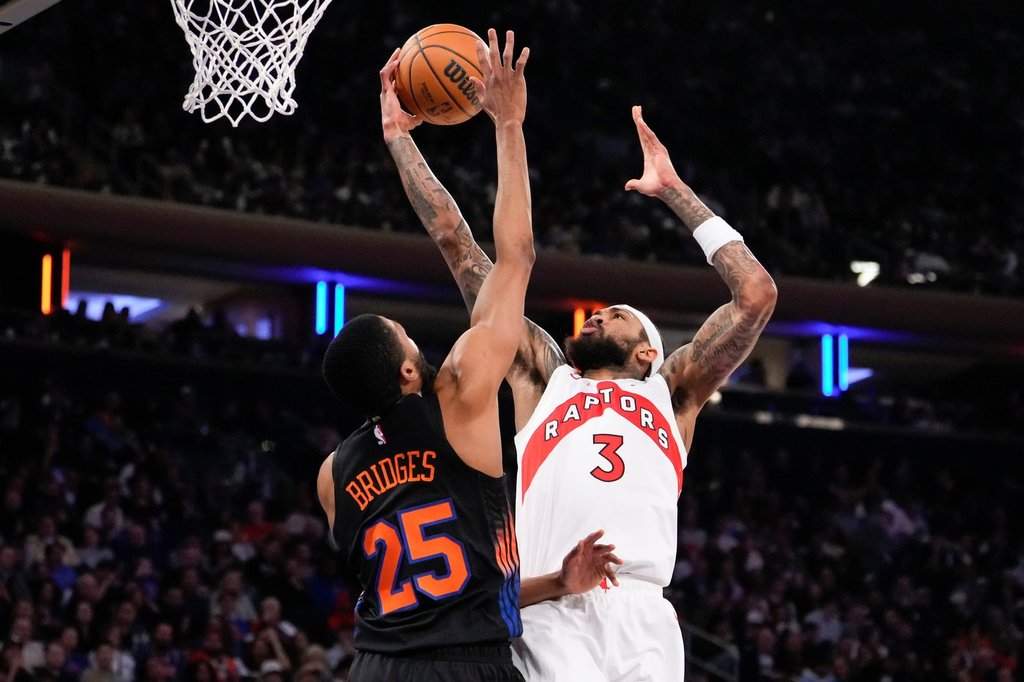
The NBA playoffs do not care about your regular season pedigree. For high-usage stars like Brandon Ingram and Scottie Barnes, the postseason is less of a "chance to shine" and more of a high-pressure diagnostic test that exposes every hairline fracture in a player’s skill set. While surface-level analysis suggests these two are simply waiting for their moment, the reality is far more clinical. The postseason environment strips away the fluff of 82-game rhythms and demands a level of half-court surgical precision that neither player has yet mastered.
Success in April and May requires more than just talent. It requires an answer to the specific defensive adjustments that eliminate a player's primary weapon. For Ingram, that means finding a way to impact the scoreboard when the mid-range jumper isn't falling. For Barnes, it involves proving he can be the alpha creator when the transition lanes vanish. This isn't just about "shining." It is about survival in a league that effectively solves one-dimensional stars in a seven-game series.
The Mid Range Trap and the Ingram Dilemma
Brandon Ingram is a master of the most difficult shot in basketball. He lives in the "inner-third" of the court, elevated above defenders with a release point that remains virtually unblockable. In the regular season, this is a luxury. In the playoffs, it can become a prison.
When the New Orleans Pelicans enter a playoff series, opposing coaches treat Ingram’s mid-range prowess as a math problem they are willing to lose. They drop their big men, concede the 18-foot pull-up, and focus entirely on sealing the rim and the corners. If Ingram hits 52% of those tough twos, he looks like a superstar. If he hits 42%, the Pelicans’ offense dies.
The lack of elite "rim pressure" is the quiet crisis in Ingram's game. To move from a tiered star to a franchise cornerstone who wins series, he must diversify his shot profile.
- Free Throw Rate: Elite wing scorers find their way to the line when the jumper goes cold. Ingram’s whistle often disappears in the physical postseason environment.
- Three Point Volume: Modern defenses will live with a contested mid-range shot all day if it means preventing a catch-and-shoot three.
- Playmaking Under Duress: When the double team comes from the baseline, the skip-pass must be instantaneous.
Ingram isn't just fighting the opposing team; he is fighting the efficiency metrics that govern modern winning. He needs to prove he can bend a defense toward the basket, not just over the top of it.
Scottie Barnes and the Primary Option Burden
In Toronto, the transition from the era of Pascal Siakam to the era of Scottie Barnes shifted the franchise's molecular structure. Barnes is a physical marvel, a point-forward who can theoretically guard five positions and facilitate like a veteran. However, the playoffs demand a specific type of scoring gravity that Barnes is still developing.
The "Barnes Problem" is one of spacing and aggression. In the open floor, he is a freight train. In a bogged-down, half-court playoff set where the defense is "pre-rotated" to stop his drive, his path to the rim becomes a wall of chests.
The Half Court Wall
Without a consistent, high-volume perimeter shot, Barnes allows defenders to "under" every screen. This creates a stagnant environment for his teammates. If the defense doesn't respect the jumper, they don't help off the shooters. If they don't help off the shooters, the passing lanes that Barnes thrives on simply don't exist.
The playoffs are where "versatility" meets "utility." Being able to do everything a little bit is less valuable than being able to do one or two things at an elite, unstoppable level. Barnes must find his "bankable" playoff move—the shot or drive he can go to when the clock hits six seconds and the season is on the line.
Why Technical Growth Trumps Narrative
We often hear that players just need "experience" to succeed in the playoffs. This is a comforting lie. Experience only matters if it leads to technical refinement.
Look at the evolution of players who successfully made the jump. They didn't just play more games; they changed how they played. They shortened their shooting motions, they learned how to manipulate the low-man defender with their eyes, and they mastered the dark art of drawing contact.
For Ingram, the growth must be in the geometry of the court. He needs to stop settling for the shot the defense wants him to take. For Barnes, the growth must be in offensive decisiveness. He cannot afford to spend the first three quarters "feeling out" the game while the deficit grows.
The Financial Stakes of Postseason Failure
The NBA's new Collective Bargaining Agreement (CBA) has turned roster construction into a minefield. The "Second Apron" looms over every front office, making it nearly impossible to keep a core together if they aren't winning.
If Ingram and Barnes don't show they can lead a deep run, their respective front offices face a brutal choice. Do you pay a player the "Supermax" or a standard max extension if they have a proven ceiling in the first round?
- Trade Value Volatility: A poor playoff showing can tank a star's trade value overnight.
- Roster Stagnation: Overpaying for non-transcendent talent prevents the team from adding the necessary pieces around them.
- The Window of Opportunity: In the NBA, windows close faster than they open. One injury or one bad contract can waste three years of a rebuild.
The pressure on these two isn't just about personal glory. It is about the viability of their entire organizations.
The Myth of the "Chance to Shine"
Framing the playoffs as a "chance to shine" ignores the psychological warfare involved. It isn't a stage; it's an interrogation. The opponent spends weeks studying your every tendency—which way you drive after a crossover, which hand you prefer to finish with under pressure, and how you react when a referee misses a blatant foul.
Ingram and Barnes are currently being studied. Their weaknesses are being indexed and filed away for future use. To "shine," they have to break their own patterns. They have to become players they haven't been in the regular season.
Defensive Accountability
You cannot be a playoff star if you are a defensive liability. While Barnes has the tools to be elite, his off-ball focus has been questioned. Ingram, despite his length, can be bullied by stronger wings. In a series, the opponent will "hunt" the weakest link relentlessly.
If you aren't a two-way force, your offensive production has to be historic to compensate. Neither of these players is at that 35-point-per-night threshold yet. Therefore, their defensive engagement becomes the hidden metric of their playoff success.
The Verdict is Coming
There is no room for "potential" once the brackets are set. You either have the game to win at that level, or you don't. The regular season is a marathon of talent, but the playoffs are a sprint of execution.
Brandon Ingram must prove he is more than a beautiful-but-inefficient throwback. Scottie Barnes must prove he is a definitive engine, not just a versatile luxury. If they fail to adapt, they won't just be "stars who struggled"—they will be labeled as regular-season wonders in a league that only remembers the champions.
The lights aren't just bright; they are hot enough to melt anyone who isn't made of the right material. Take the shot or get out of the way.