The Five Nations Club
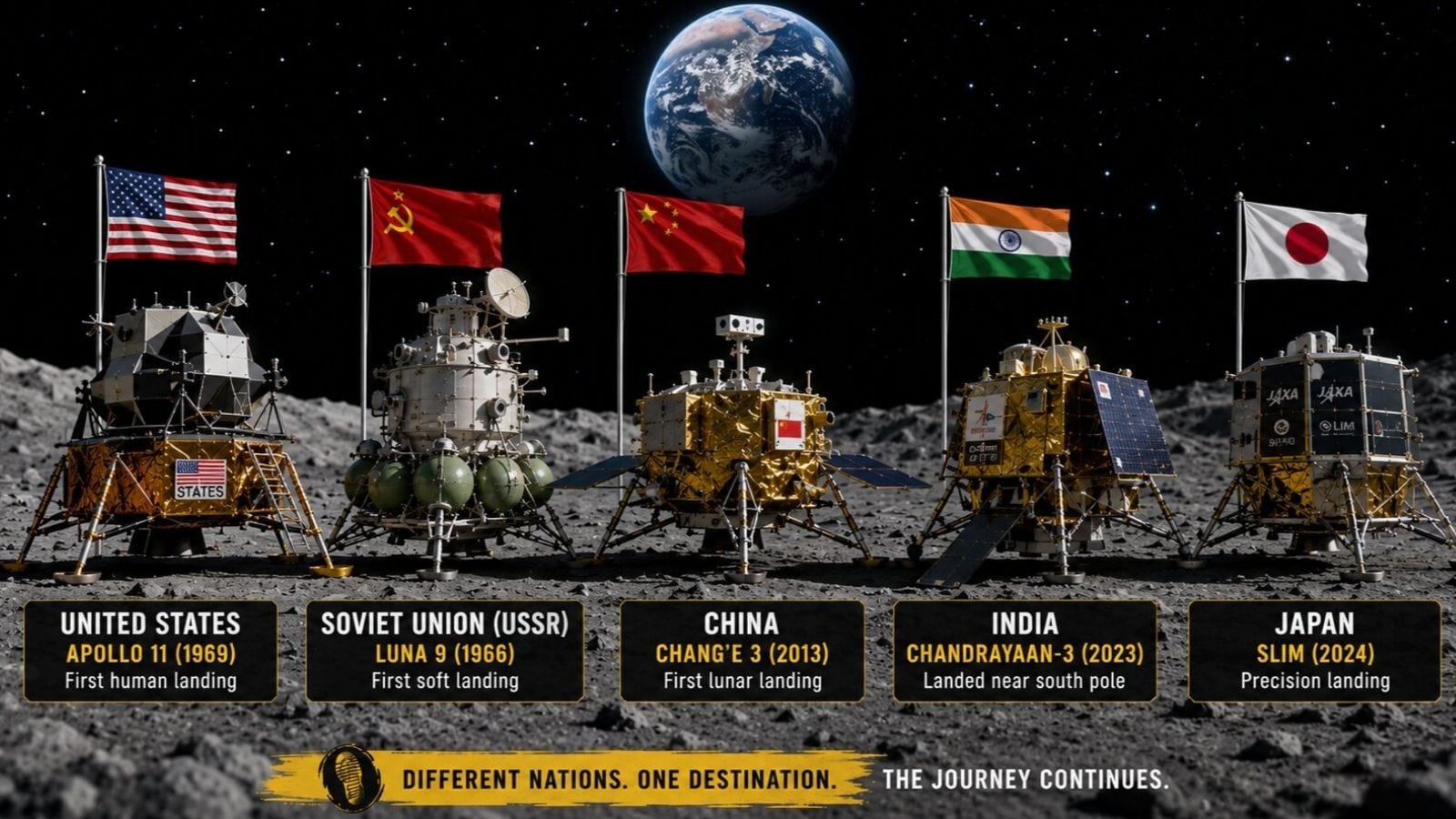
Only five nations in human history have successfully achieved a soft landing on the lunar surface.
The Soviet Union set the precedent in 1966 with Luna 9, followed months later by the United States with Surveyor 1. Decades of silence followed the Cold War space race until China broke the dry spell with Chang'e 3 in 2013. India joined this elite circle in 2023 with Chandrayaan-3, precision-landing near the coveted lunar south pole. Most recently, Japan secured its spot when its Smart Lander for Investigating Moon (SLIM) touched down, proving that hyper-accurate pinpoint maneuvers are possible even when upside down.
Understanding why that list remains ridiculously short requires looking past headlines and examining the brutal physics of atmospheric absence.
The Physics of a Vacuum Descent
Landing on Earth is comparatively forgiving. Earth possesses a dense atmosphere, allowing engineers to rely on heat shields to bleed off orbital velocity and massive parachutes to slow payloads down to a gentle drift.
The Moon offers no such luxury. It is wrapped in a hard vacuum.
Without air to create drag, parachutes are useless. A spacecraft approaching the lunar surface at several thousand kilometers per hour must shed every drop of kinetic energy purely through rocket power. This creates a ruthless mathematical equation: every kilogram of fuel required to slow down the vehicle adds mass that must be carried all the way from Earth, requiring an even larger rocket at launch.
The descent phase is a continuous fight against gravity where a single millisecond of sensor delay or valve lag results in immediate catastrophic destruction.
       [ Descent Phase ]
              │
       1. Thruster Burn  (Slowing down from 1.7 km/s)
              │
       2. Optical Navigation Failure?  ───────────► [ Impact / Crater ]
              │ (No atmospheric drag to help)
       3. Real-Time Terrain Scan
              │
       4. Soft Touchdown / Engine Cutoff
When a lander enters its final powered descent, it operates far beyond the reach of human control. The round-trip radio signal delay between Earth and the Moon ranges between 2.5 to 3 seconds. That delay makes real-time joysticking from a ground station impossible. The entire sequence must be managed by autonomous flight software making split-second decisions based on optical sensors, radar altimeters, and inertial guidance units.
If the software misinterprets a shadow for a flat landing spot, or if regolith dust stirred up by the engine plume blinds the optical sensors during the last ten meters, the spacecraft crashes.
Why Modern Technology Haven't Made It Easy
A common misconception assumes that fifty years of computing progress should make landing on the Moon trivial. Modern smartphones possess vastly more processing power than the mainframes used during the Apollo program, yet contemporary missions crash with surprising regularity.
Israel’s Beresheet lander suffered a main engine command glitch during descent and slammed into the surface. Russia’s Luna 25 lost control during an orbital adjustment burn and crashed. Private attempts have faced similar harsh realities, struggling against sensor dropouts and software misconfigurations.
+-------------------+----------------------------------+------------------------------------+
| Mission           | Key Innovation                   | Failure Point or Challenge         |
+-------------------+----------------------------------+------------------------------------+
| Apollo (USA)      | Human piloting overlay           | Extreme weight and cost scale      |
| Beresheet (ISR)   | Low-cost commercial architecture | Main engine inertial unit glitch   |
| Luna 25 (RUS)     | Modern flight computers          | Anomalous thruster burn duration   |
| SLIM (JPN)        | Pinpoint optical navigation      | Engine nozzle detachment mid-descent|
+-------------------+----------------------------------+------------------------------------+
The difference between past and present lies in risk tolerance and budget scale. The Apollo program operated with thousands of dedicated engineers and functionally unlimited Cold War funding, building massive redundancy into every system.
Modern missions attempt the same gravitational feat on fraction of the budget, using lightweight components pushed to their absolute thermal and mechanical limits. Electronics must survive the extreme radiation environment of cislunar space, where cosmic rays can flip bits in microprocessor memory at critical moments.
The South Pole Cold War
The geopolitical motivations behind lunar landings have shifted dramatically. Early missions targeted flat, equator-adjacent maria chosen primarily because they offered clear radar targets and minimal hazard profiles.
Current exploration centers almost entirely on the lunar south pole.
Radar data and orbital spectroscopy confirm that deep craters at the lunar poles contain permanently shadowed regions that have not seen sunlight in billions of years. Trapped within these super-cold craters are millions of tons of water ice.
[ Solar Rays ] ─────────────────► ┌───────────────────────────┐
                                 │ Illuminated Crater Rim    │ (Solar Power Base)
                                 ├───────────────────────────┤
                                 │ Permanently Shadowed Floor│ (Water Ice Deposits)
                                 └───────────────────────────┘
Water ice changes everything. It provides hydration for long-duration crewed habitats, radiation shielding, and most importantly, the raw materials for rocket propellant. By cracking lunar water into hydrogen and oxygen, spacefaring organizations can create off-planet refueling stations.
Landing at the south pole means targeting tiny, sunlit ridges adjacent to deep, hazardous craters. The terrain is jagged, the lighting conditions create long, deceptive shadows that confuse optical landing systems, and temperatures fluctuate wildly. India’s Chandrayaan-3 success in this region marked a turning point, proving that precision touchdown in polar terrain is achievable with low-cost autonomous targeting.
The Shift to Commercial Payload Systems
National space agencies are no longer the sole players trying to touch down on the surface. NASA's Commercial Lunar Payload Services program deliberately outsources the lander design and operational risk to private aerospace firms.
This structural shift accepts a higher rate of failure in exchange for rapid iteration and lower overall mission costs.
Building a lander capable of managing its own descent vectors, thermal throttling, and hazard avoidance without human intervention remains one of the hardest engineering problems in aerospace. The physics do not care about budget constraints or corporate timelines. Every thruster valve must open on command, every line of autonomous guidance code must execute flawlessly, and the mechanical landing legs must absorb kinetic shock without tipping the payload over.
The barrier to entry for the lunar club remains exceptionally high, defined not by capital, but by relentless orbital mechanics.