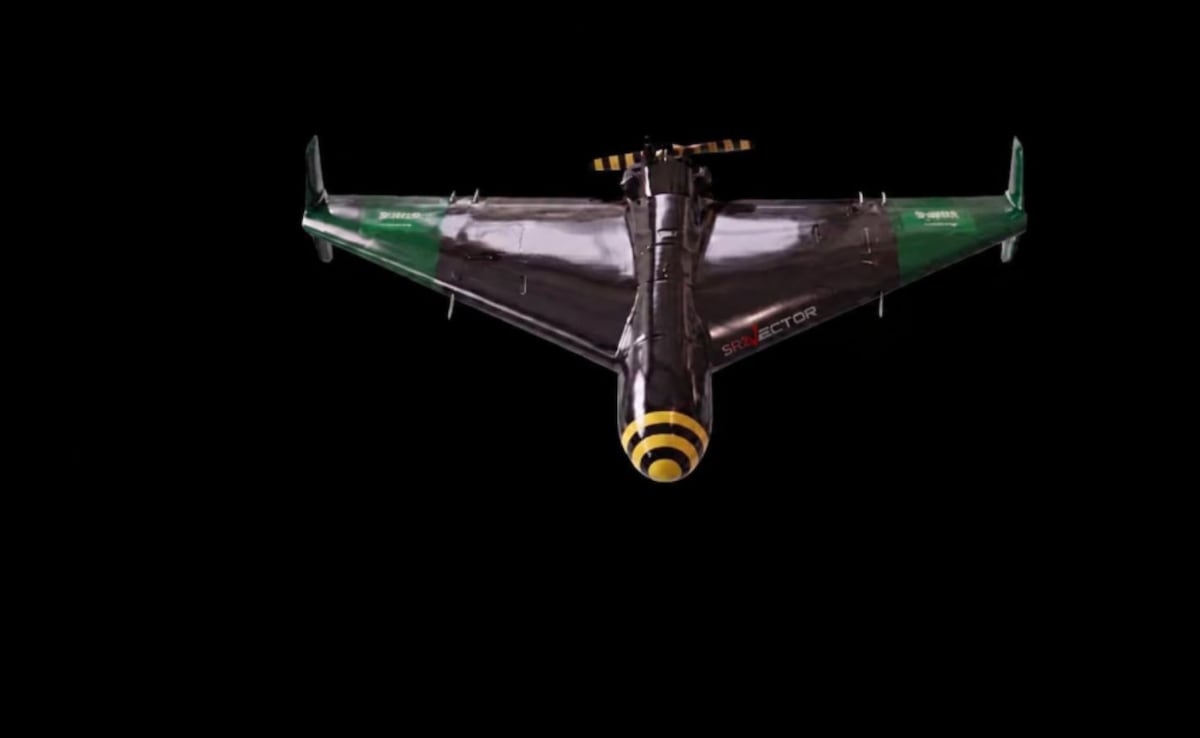
A defense joint venture between Utah-based Vector Defense and Saudi startup SR2 Defense Systems is establishing a production facility near Riyadh to manufacture a new one-way attack drone called SKYWASP. Modeled directly on the mechanics of Iran’s feared Shahed loitering munitions, the drone features a striking range of 1,500 kilometers, allowing it to reach Tehran from the northeastern coast of Saudi Arabia. Driven by the brutal economic asymmetry of recent regional conflicts, this partnership marks a fundamental shift in defense strategy. Western aerospace doctrine, which long prioritized complex, multi-million-dollar stealth platforms, is being forced to adapt to a reality defined by cheap, expendable, and mass-produced attrition weapons.
The venture, operating under the corporate banner SR2Vector, is backed by MASNA Ventures, a specialized defense-technology fund currently being raised to leverage expanding Washington-Riyadh defense coordination following Saudi Arabia’s designation as a major non-NATO ally. By standardizing a weapon heavily inspired by its primary adversary, Riyadh is abandoning pure reliance on Western-supplied interceptor shields in favor of an offensive, volume-based deterrence model. For a more detailed analysis into similar topics, we suggest: this related article.
The Flawed Logic of Defensive Asymmetry
For decades, the standard response to an aerial threat in the Gulf was to buy another American-made Patriot missile battery. That approach has collapsed under the weight of basic math. During recent escalations across West Asia, Iran and its proxies deployed thousands of one-way attack drones to target industrial centers, logistics nodes, and data infrastructure. While regional air defenses successfully neutralized the vast majority of these incoming targets, the financial cost of doing so proved completely unsustainable.
An ordinary Shahed-series kamikaze drone costs its manufacturer between $20,000 and $35,000 to assemble. It relies on commercial-grade GPS components, fiberglass casing, and a basic, loud two-stroke internal combustion engine. To shoot down that $35,000 lawnmower in the sky, defense forces routinely fire interceptor missiles that cost between $1 million and $4 million per shot. For broader information on this development, comprehensive analysis is available on Mashable.
When an adversary launches forty drones simultaneously, they are not expecting forty hits. They are looking to drain the defender's magazines and bankrupt their treasury. This cost-exchange imbalance inevitably breaks the defender. Even with a defense budget as massive as Saudi Arabia's, you cannot indefinitely spend millions to stop thousands.
The operational reality became even harsher for the United States military directly. In the same regional friction, U.S. Central Command faced a severe attrition crisis with its premium assets, losing an estimated 24 to 30 MQ-9 Reaper drones to regional threats, representing a staggering loss of roughly 20 percent of its pre-war inventory. At an estimated replacement cost approaching $1 billion for those lost platforms alone, Washington faced the stark realization that high-end, slow-moving surveillance assets are too fragile and expensive for dense, contested airspace.
Demolishing Western Aerospace Pride
The creation of SKYWASP represents an institutional admission of defeat by Western defense contractors regarding the style of hardware needed for modern attrition warfare. The US military previously tried to solve this problem by introducing its own low-cost combat drone, known as LUCAS (Low-cost Unmanned Combat Attack System), which explicitly mimicked the Shahed's layout and low-overhead philosophy. SKYWASP takes that copycat philosophy and scales it into industrial sovereign manufacturing inside the Kingdom.
This represents an existential pivot for Saudi Arabia's Vision 2030 defense goals. Historically, the Kingdom imported nearly 100 percent of its military hardware, making it the dream client for major Western defense conglomerates. The stated goal under Crown Prince Mohammed bin Salman is to localize 50 percent of all military spending by 2030.
Building a highly advanced, fifth-generation fighter jet or a complex hypersonic missile domestic supply chain from scratch is an industrial impossibility for a nation without an established aerospace manufacturing base. A fiberglass kamikaze drone, however, can be built rapidly in automated factories using localized tooling and commercial workforces.
The Blueprint of the SKYWASP Strategy
The strategic parameters of the SKYWASP platform reveal exactly how Riyadh plans to reshape the balance of power in the Gulf.
- Geographic Reach: The 1,500-kilometer operational envelope is not an arbitrary engineering metric. It is the precise distance required to project direct, unescorted kinetic power from Saudi territory across the Gulf into the heart of Iran's political and military command centers.
- Production Volume Over Precision: While Western weapons emphasize surgical precision, the SR2Vector facility is built around the concept of "operationally relevant volumes." The goal is mass saturation. If a defense system faces a wave of hundreds of SKYWASP units, the defensive matrix will simply lock up or run out of ammunition.
- Export Sovereignty: Unlike purchases of American systems which come with stringent End-User Monitoring certificates and strict political limits on deployment, domestic production allows Saudi Arabia to export these loitering munitions freely to regional allies, establishing an independent network of cheap deterrence across the Middle East.
This is not a project designed for prestige or military parades. It is a cynical, highly pragmatic copy of an enemy's homework because that homework proved effective on the battlefield.
The Hypocrisy of Global Supply Chains
There is a profound irony underlying the entire SR2Vector project. While the geopolitical narrative frames this as the West and Saudi Arabia cloning an "Iranian" innovation, intelligence investigations into captured Shahed platforms have repeatedly revealed that up to 60 percent of the internal microelectronics, signal processors, and voltage regulators inside Iranian drones are manufactured by companies based in the United States and Europe.
Iran bypassed decades of international sanctions by buying dual-use, civilian-grade electronics through front companies in third countries. They proved that you do not need military-grade semiconductors to build a weapon capable of shutting down an oil refinery or damaging a multi-billion-dollar naval asset.
By formalizing this architecture through an American startup like Vector Defense, the Western defense industrial base is essentially skipping the black-market middlemen. They are taking the commercial components they originally manufactured, integrating them into an optimized airframe, and building them legally in a factory near Riyadh.
The Geopolitical Fallout
This industrial pivot introduces major strategic risks that could destabilize the region in unpredictable ways. Drone proliferation is notoriously difficult to contain. Once a factory near Riyadh begins churning out thousands of long-range, cheap strike platforms, the technology will inevitably spill over.
The UAE has already responded to this shifting landscape by launching its own defense-focused free zone to attract foreign weapons firms and accelerate domestic military manufacturing. A highly competitive, localized arms race focused exclusively on cheap, uncrewed, offensive strike platforms is rapidly developing across the Gulf states.
This development completely changes the diplomatic calculus for Washington. While the United States gains a stronger, self-reliant ally capable of pushing back against Iranian influence, it simultaneously loses its most potent form of leverage over Riyadh: the supply chain chokehold. When Saudi Arabia relied exclusively on American technicians to maintain its F-15 fleets and American manufacturers to resupply its Patriot missiles, Washington held an ultimate veto over Saudi military actions.
With a domestic stockpile of thousands of autonomous, long-range SKYWASP drones, Riyadh gains tactical independence. The calculation of deterrence in the Middle East will no longer be decided by diplomatic assurances or the deployment of U.S. carrier strike groups. It will be dictated by who can manufacture the largest pile of cheap, explosive fiberglass.