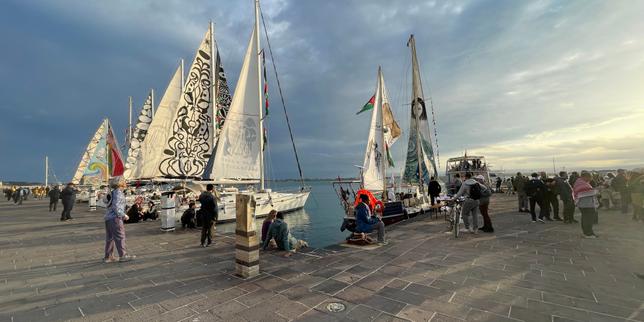
The maritime standoff ended before the first crate of medicine could hit the pier. When Israeli naval commandos boarded the Global Sumud flotilla in international waters, the outcome was a mathematical certainty, not a tactical surprise. This wasn't merely a localized skirmish over humanitarian aid; it was a high-stakes clash of legal doctrines and optics. The activists onboard sought to shatter a blockade they deem illegal under international law, while the Israeli Defense Forces (IDF) acted on a long-standing security mandate that views any unauthorized vessel as a potential breach in a vital defensive perimeter.
The interception occurred miles outside the territorial waters of Gaza. This detail matters. By moving against the vessels in international territory, the IDF triggered a familiar cycle of diplomatic condemnation and legal debate. Yet, for the planners in Tel Aviv, the risk of a diplomatic "black eye" is always secondary to the risk of a "leaking" coastline. Building on this topic, you can also read: The Hollow Sound of Footsteps in Golders Green.
The Mechanics of a Maritime Blockade
Modern blockades are not just about ships and guns. They are about legal precedent. Israel maintains that its naval blockade of the Gaza Strip is a recognized military necessity, aimed at preventing the smuggling of dual-use materials that could be used for weapons manufacturing. Under the San Remo Manual on International Law Applicable to Armed Conflicts at Sea, a blockade is considered legitimate if it is declared, notified, and effectively maintained.
The Global Sumud organizers, however, point to the humanitarian fallout. They argue that because the blockade contributes to collective punishment—a violation of the Fourth Geneva Convention—the blockade itself is void. This creates a recursive legal loop where both parties claim the moral and legal high ground while operating under entirely different frameworks. Analysts at NBC News have shared their thoughts on this situation.
When the commandos boarded, they weren't just seizing a boat. They were enforcing a boundary that exists as much in the minds of international lawyers as it does on a GPS screen.
The Logistics of Activism versus the Reality of Steel
The Global Sumud was part of a broader coalition, a ragtag assembly of retired doctors, journalists, and human rights advocates. Their cargo—tonnes of medical supplies and food—was vetted by third-party NGOs. On paper, it was a purely humanitarian mission. In practice, it was a symbolic provocation.
Organizers knew the ship would likely never dock. The mission’s success wasn't measured in calories delivered to Gazans, but in the number of headlines generated by the interception. The activists utilize a strategy known as "political warfare," where the goal is to force an opponent into an aggressive response that looks disproportionate on camera.
The IDF's response was clinical. Reports indicate the use of "soft" boarding techniques—fast ropes from helicopters and small, high-speed interceptor craft. By avoiding the lethal escalations seen in the 2010 Mavi Marmara incident, the Israeli military has refined the art of the "quiet" arrest. They want to minimize the very footage the activists are desperate to capture.
The Economic Shadow over the Mediterranean
While the world watches the flashes of flashbangs and the shouting on the decks, a quieter battle involves the Eastern Mediterranean gas fields. The waters off the coast of Gaza are not just a transit zone for aid; they sit atop significant energy reserves.
The Marine-1 and Marine-2 gas fields, discovered decades ago, remain largely untapped due to the ongoing conflict. Every flotilla that enters these waters serves as a reminder of the disputed maritime boundaries. Israel’s insistence on total control of the coastline isn't just about preventing rockets from entering Gaza; it is about ensuring that no rival entity—be it Hamas or an international consortium—can develop resources that would shift the regional power balance.
Why the Aid Delivery Mechanism is Broken
If the goal is truly to get food and medicine into Gaza, the sea is currently the least efficient way to do it. The Kerem Shalom and Rafah crossings, despite their bureaucratic bottlenecks and frequent closures, handle significantly more volume than a dozen flotillas could ever carry.
The insistence on sea routes is a rejection of the Israeli-controlled inspection process. To activists, submitting aid to Israeli land-based inspectors is a form of complicity with the occupation. To Israel, allowing unvetted cargo to bypass its ports is a non-starter. This is the central friction point that ensures these maritime confrontations will continue.
We see a pattern where humanitarian needs are used as a battering ram against security policies. It is a grim reality where the people of Gaza are the backdrop for a global PR war. The supplies seized from the Global Sumud will likely be offloaded at the Port of Ashdod, inspected for "dual-use" items, and eventually trucked into Gaza through the very channels the activists were trying to circumvent.
The Cost of Neutrality
International observers often call for "restraint," a term that has become functionally meaningless in this theater. The European Union and various UN agencies find themselves in a precarious position. They fund the aid that the flotillas carry, yet they rely on Israeli cooperation to maintain their own permanent humanitarian corridors.
This creates a paradox of funded resistance. Governments provide the grants that allow NGOs to purchase these ships, knowing full well they will be confiscated. It is a costly form of signaling that does little to alter the structural reality on the ground.
The Global Sumud is now another hull sitting in an Israeli harbor. The crews will be deported, the cargo will be processed, and the legal teams will begin the long process of filing paperwork that will be ignored by both sides.
The cycle repeats because it serves a purpose for everyone involved except the civilians waiting for the medicine. For the activists, it is proof of "siege." For the IDF, it is proof of "vigilance." For the politicians, it is another day of managed chaos.
Until there is a fundamental shift in how maritime sovereignty is defined in the Levant, the Mediterranean will remain a stage for this choreographed violence. The sea does not offer a bypass to the conflict; it merely provides a wider lens through which to view its intractability.
The Global Sumud did not fail because it was intercepted. It performed exactly as the physics of the region dictated it would. The cargo was never the point. The confrontation was. As long as the "why" remains rooted in political theater rather than logistical reality, the next flotilla is already being bought and paid for.
The water remains contested, the gas remains buried, and the pier remains empty.