The room was likely quiet, but the silence carried the weight of a multi-billion-dollar divorce. In the beginning, there was a shared prayer. Sam Altman and Elon Musk sat together in 2015, fueled by a specific, shimmering fear: that artificial intelligence would eventually wake up, look at its creators, and decide they were obsolete. They framed their mission as a rescue operation for humanity. They called it OpenAI. It was meant to be a non-profit shield, a laboratory where the secrets of the gods would be shared with everyone for free, ensuring no single corporation—specifically Google—could monopolize the future of consciousness.
Now, that prayer has turned into a summons.
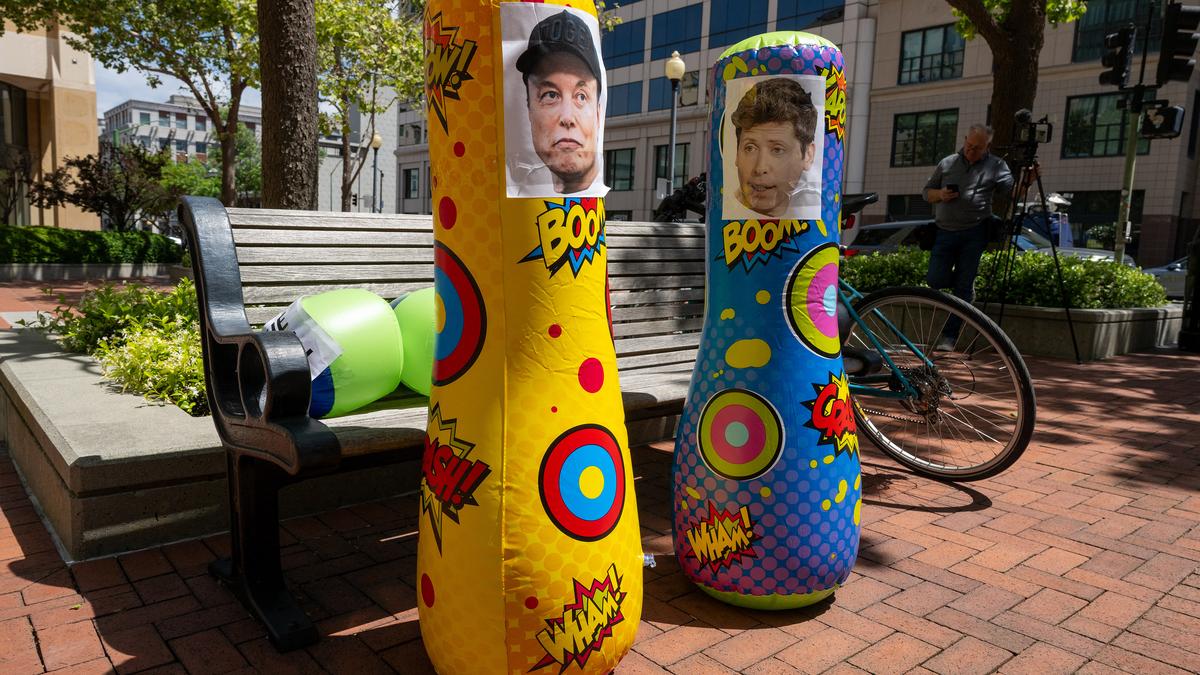
The legal battle currently playing out in a San Francisco courtroom isn't just about breach of contract or fiduciary duties. It is a fight over the soul of the most consequential technology ever built. Musk looks at the company he helped birth and sees a "closed-source de facto Microsoft subsidiary." Altman looks at the world and sees a necessity for scale that only massive capital can provide. Between them lies the wreckage of a friendship and the shifting definition of what it means to "benefit humanity."
The Original Sin of OpenAI
To understand the fury behind Musk’s lawsuit, you have to look at the founding contract—not just the digital one, but the ideological one. In 2015, the Silicon Valley elite were terrified. DeepMind had been acquired by Google, and the prospect of a private company owning the first "Artificial General Intelligence" (AGI) felt like a digital monarchy in the making.
Musk provided the initial spark and a massive chunk of the funding—reportedly around $44 million in the early years. The deal was simple. OpenAI would be a non-profit. Its code would be open to the public. It would prioritize safety over profit. It was a cathedral built for the public good.
But building a god is expensive.
As the years passed, the researchers at OpenAI realized that "good intentions" weren't a currency accepted by Nvidia. They needed chips. Tens of thousands of them. They needed electricity levels that could power small cities. The non-profit model, while noble, was a pedal-car trying to win a Formula 1 race. In 2019, under Altman’s leadership, the company underwent a radical metamorphosis. It created a "capped-profit" arm to attract the billions of dollars required to actually build the models we use today.
Musk views this as the ultimate betrayal. He argues that he was sold a non-profit vision and ended up inadvertently funding a for-profit juggernaut that shifted its mission from "saving the world" to "optimizing the bottom line."
A Tale of Two Founders
Consider the archetypes at play.
On one side, you have Elon Musk: the scorched-earth visionary. For him, the risk of AI is existential. He has spent a decade warning that we are "summoning the demon." To Musk, the fact that OpenAI is now a closed system—where the weights and inner workings of GPT-4 are a trade secret—is a violation of the very safety net he tried to build. If the "demon" is going to be summoned, he believes the world needs to see how the ritual is being performed.
On the other side, you have Sam Altman: the ultimate pragmatist. Altman is a man who operates on the logic of the inevitable. He argues that you cannot protect humanity with a tool that doesn't exist. If it takes $13 billion from Microsoft to reach the finish line, then that is the price of progress. He views the open-source requirement as a liability in a world where bad actors could use powerful AI to create biological weapons or collapse financial systems.
The friction between them is visceral.
The lawsuit highlights emails from years ago, digital ghosts of a time when they were allies. Musk once suggested that OpenAI should "attach itself to Tesla" to solve its funding issues—a proposal Altman and the other founders rejected. This detail is a jagged pill for the defense; it suggests that Musk wasn’t always obsessed with the non-profit status, so long as he was the one at the helm.
The Microsoft Shadow
The real protagonist—or antagonist, depending on your perspective—is the $13 billion investment from Microsoft. This partnership changed the gravity of the industry.
When you use ChatGPT today, you aren't just using a tool built by a group of idealistic researchers. You are using a product deeply intertwined with one of the largest corporate entities in human history. Musk’s legal team argues that OpenAI has effectively become an "open kitchen" that only cooks for Microsoft.
The legal technicality at the center of the storm is the definition of AGI.
OpenAI’s license with Microsoft only covers "pre-AGI" technology. Once the company achieves AGI—a machine that can perform any intellectual task a human can—the rights to that technology are supposed to revert back to the mission of benefiting humanity, free from commercial ties. But who gets to decide when the machine has reached that milestone?
Currently, the OpenAI board makes that call.
Musk’s lawsuit alleges that GPT-4 is already a "de facto" AGI, or at least the beginning of one, and that OpenAI is hiding its true capabilities to keep the Microsoft revenue flowing. It is a bizarre, sci-fi twist on a standard business dispute: a billionaire suing to force a company to admit it has created a digital god.
The Human Cost of High Stakes
Imagine being a researcher in that building. You joined a non-profit to change the world. You worked 100-hour weeks because you believed you were building a public utility. Then, almost overnight, your work is locked behind a paywall and your company is valued at $80 billion.
The tension within the office must be suffocating.
We saw a glimpse of this during the five-day coup in late 2023, when the board fired Altman, only to have the entire staff threaten to quit unless he was reinstated. It was a moment of pure, unadulterated human drama that proved one thing: the mission had already changed. The employees weren't loyal to a non-profit charter. They were loyal to the man who could lead them to the frontier.
Musk’s lawsuit is an attempt to claw back that original feeling of 2015. But you cannot un-ring a bell. You cannot turn a $100 billion entity back into a scrappy lab in a converted luggage warehouse.
The Court of Public Consequence
The judge in this case faces an impossible task. If they rule in favor of Musk, it could force OpenAI to open its "black box" to the public. While this would satisfy the open-source community, it could also provide a roadmap for state-sponsored hackers and bad actors to weaponize the most powerful software ever created.
If they rule in favor of Altman and OpenAI, it cements a new precedent: that a non-profit can pivot to a for-profit model whenever the "necessity of scale" demands it, regardless of the promises made to original donors.
It is a choice between transparency and security. Between the idealistic past and the hyper-capitalist future.
The documents filed in court are full of technical jargon about neural networks and transformative architectures. But if you read between the lines, you find a story as old as time. It is a story about two powerful men who both believe they are the only ones capable of saving the world. They are fighting over the steering wheel of a vehicle that hasn't even fully started its engine yet.
Musk is betting that the law will recognize the sanctity of a promise. Altman is betting that the world cares more about the product than the process.
Most of us are just passengers.
We watch the headlines from the backseat, wondering if the drivers will settle their differences before the car reaches a speed we can no longer control. The court may eventually decide who owns the intellectual property, who gets the dividends, and who breached which contract. But no court can decide the ultimate outcome of the technology itself.
The covenant is broken. The church has split. And the machine continues to learn, indifferent to the men who claim to be its master.
In a few years, we may not remember the details of the lawsuit or the specific clauses of the 2015 agreement. We will only know if the shield they promised to build actually held, or if it became the very sword they once feared.
The gavel will fall. The code will run. The world will wait.