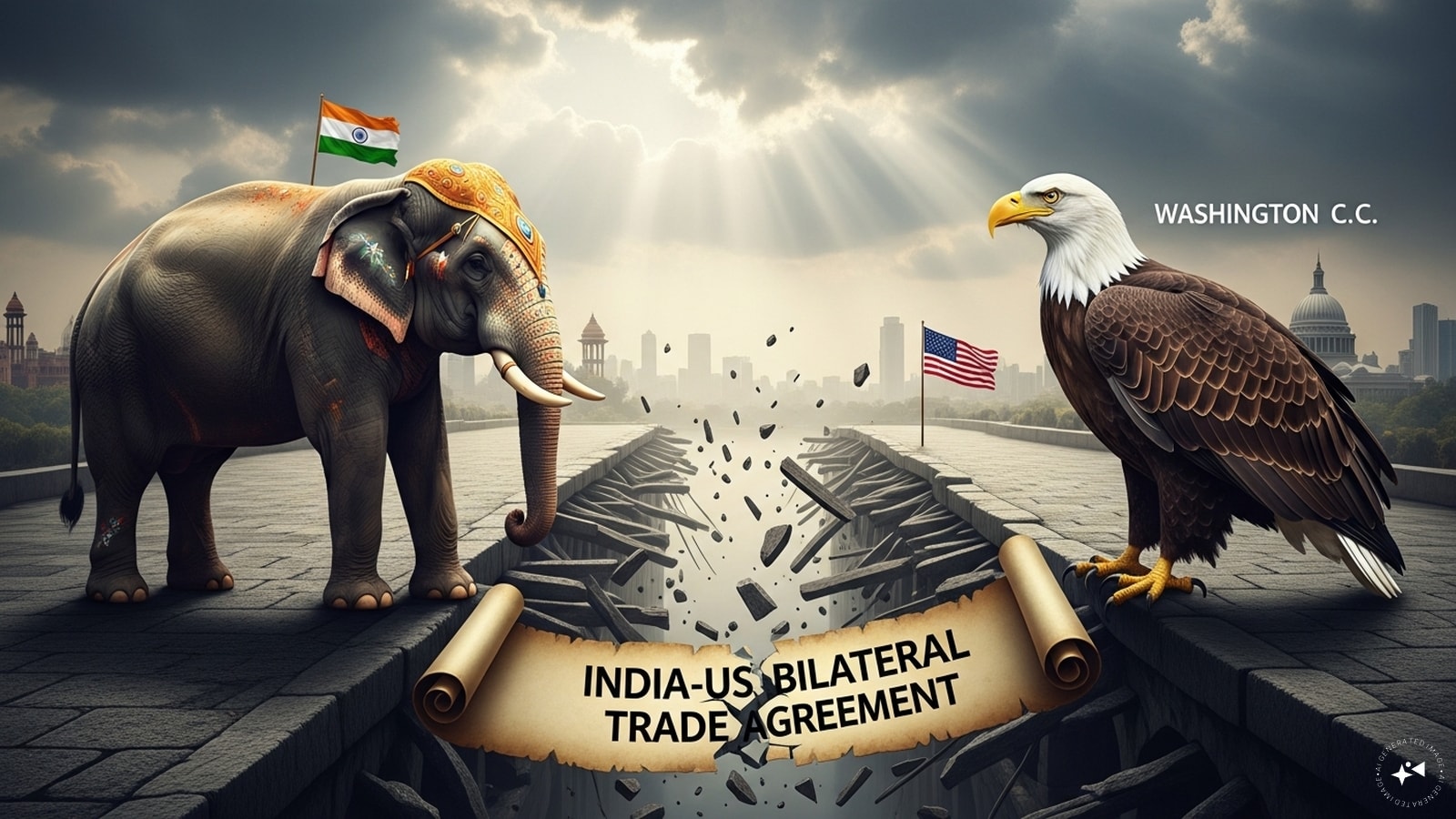
New Delhi is quietly preparing to walk away from a comprehensive trade pact with Washington. While public statements from both capitals point to temporary bureaucratic friction, the reality is far more severe. The negotiation framework has fundamentally collapsed under the weight of misaligned economic priorities and domestic political pressures. India is now shifting its diplomatic capital toward bilateral agreements with the European Union and the United Kingdom, recognizing that the American demand for sweeping regulatory changes is a political non-starter.
For nearly a decade, trade negotiators have chased the illusion of a grand bargain. The premise seemed simple enough. The United States wanted access to India’s massive, emerging middle-class consumer market, particularly in agriculture, dairy, and medical devices. India wanted a restoration of its Generalized System of Preferences (GSP) status, fewer visa restrictions for its tech workers, and a secure seat in the Western supply chain matrix.
It never happened. The talks did not just stall; they hit an ideological wall.
The Tariff Trap and Strategic Delusions
The foundational mistake of the trade talks was the American insistence that India alter its domestic economic architecture. Washington has long viewed Indian tariffs as an existential barrier to trade. Bureaucrats in the office of the United States Trade Representative (USTR) frequently point to India’s average applied tariff rate, which hovers significantly higher than that of most Western nations.
They miss the point entirely.
India’s tariff structure is not a temporary bargaining chip. It is a core pillar of the nation’s domestic survival strategy. The New Delhi establishment views customs duties as a vital shield for hundreds of millions of low-income farmers and small-scale manufacturers who form the backbone of the voting electorate.
Consider the dairy sector. The United States has repeatedly pushed for the relaxation of import controls on American dairy products. To a trade analyst in Washington, this looks like a standard request for market access. To a politician in Uttar Pradesh or Punjab, it looks like economic suicide. India’s dairy industry is driven by small, cooperative farming models involving millions of families who own fewer than five cows each. Flooding the market with heavily subsidized American industrial dairy would trigger an immediate rural depression.
+-----------------------------------+-----------------------------------+
| US Negotiating Demands            | India's Political Red Lines       |
+-----------------------------------+-----------------------------------+
| Zero-tariff access for US dairy   | Protection of smallholder farmers |
| Relaxation of medical price caps  | Affordable healthcare mandates    |
| Strict data localization repeals  | National digital sovereignty      |
+-----------------------------------+-----------------------------------+
The math simply does not work for New Delhi. The political cost of compromising on agriculture outweighs any potential gains in textile or jewelry exports to the American market.
Digital Sovereignty Meets Silicon Valley Lobbying
The friction has intensified beyond traditional commodities. The modern battleground is digital, and the stakes are much higher.
India has systematically built a localized digital ecosystem, anchored by the Unified Payments Interface (UPI) and strict data localization mandates. These rules require foreign financial and technology firms to store data generated by Indian users within the country’s geographic borders.
Silicon Valley hates this. Major American tech conglomerates have spent years lobbying Washington to use trade negotiations as a lever to dismantle India’s digital walls. The USTR complied, making cross-border data flows and the prohibition of local storage requirements a non-negotiable part of their modern trade framework.
This created an insurmountable impasse. India views data as a sovereign national asset, akin to oil or mineral reserves. The government has no intention of allowing foreign corporations to extract, process, and monetize the data of its citizens without oversight from domestic regulators. The rise of national security concerns over data infrastructure has only hardened New Delhi’s resolve. The Ministry of Electronics and Information Technology is not going to rewrite its regulatory code to satisfy a trade mission from Washington.
The Shift to Realistic Bilateralism
Recognizing the dead end in Washington, Indian trade strategists have quietly changed their focus. They are putting their energy into partners willing to negotiate on more pragmatic terms.
The European Union and the United Kingdom have shown a far greater willingness to accept asymmetrical trade realities. While European negotiators are tough on environmental standards and labor laws, they do not demand the total dismantling of India's domestic regulatory state in the way American trade frameworks do.
The British Pivot
Negotiations with London have moved forward precisely because they focus on targeted concessions rather than ideological purity. The UK wants lower tariffs on Scotch whisky and automobiles. India wants streamlined professional mobility for its engineers and doctors. These are transactional, quantifiable terms that can be resolved without restructuring national laws.
The European Alternative
The EU-India talks are admittedly complex, hampered by European carbon border taxes and strict sustainability clauses. Yet, they remain active because Brussels views India as a critical geopolitical counterweight in Asia, making them more amenable to compromises on industrial tariffs.
Washington, by contrast, remains shackled to an all-or-nothing trade doctrine. The American political environment has turned sharply protectionist, making it impossible for any administration to offer India meaningful concessions on visas or tariff reductions. If the US cannot offer market access, it loses the leverage to demand internal reforms from India.
The IP Conflict in Healthcare
Nowhere is the structural divide more evident than in the pharmaceutical sector. India is the pharmacy of the global south, built on a robust generic drug manufacturing engine that thrives on a specific interpretation of patent law.
The US trade agenda is deeply influenced by the domestic pharmaceutical lobby, which demands strict intellectual property protections and long patent extensions. Washington has repeatedly targeted India’s Section 3(d) of the Patents Act, which prevents "evergreening"—the practice of extending a patent by making minor modifications to an existing drug without increasing its therapeutic efficacy.
       [US Pharma Strategy: Patent Evergreening]
                         │
                         ▼ (Clashes with)
                         │
       [Indian Patent Act: Section 3(d) Filter]
                         │
                         ▼ (Results in)
       [Mass Production of Low-Cost Generics]
For India, altering this law is out of the question. Affordable healthcare access is an existential necessity for a population where out-of-pocket medical expenses can push families into poverty. No Indian government will bargain away the right to produce cheap generic cancer medications or cardiovascular drugs to secure a trade deal.
A Legacy of Mismatched Expectations
The current gridlock is the logical result of two decades of mutual misunderstanding. Washington has consistently treated India as a Western-style capitalist democracy that is just a few reforms away from total market liberalization. This misreads the core nature of the Indian state, which remains deeply committed to strategic intervention, social welfare, and economic self-reliance under the banner of Atmanirbhar Bharat.
India, conversely, underestimated the structural shift in American politics. The era of the United States opening its markets to developing nations in exchange for geopolitical loyalty is over. The American electorate has no appetite for deals that can be framed as outsourcing domestic jobs.
The trade talks failed because they were designed for an era that no longer exists. Instead of wasting diplomatic energy on a comprehensive free trade agreement that will never survive domestic political scrutiny in either country, both nations would be better served by focusing on limited, sector-specific agreements in areas like defense co-production, critical minerals, and semiconductor supply chains.
The dream of a sweeping US-India free trade agreement is dead. The sooner both nations acknowledge this reality, the sooner they can build a pragmatic relationship based on what is actually possible, rather than what is ideologically desired.