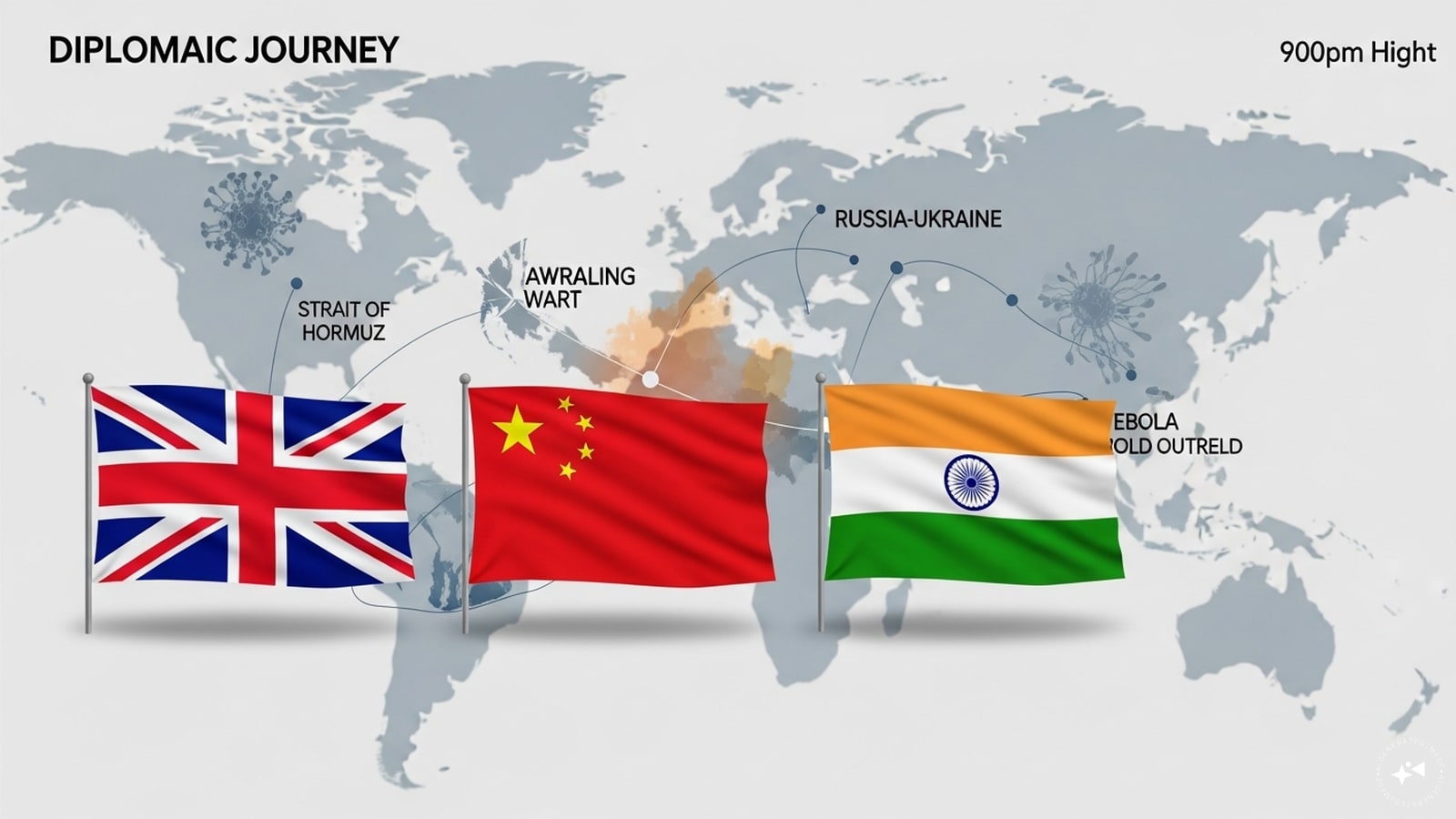
British foreign policy is undergoing an aggressive shakeup. The recent high-level diplomatic push into Beijing and New Delhi signals a massive departure from the rhetoric of the last decade. For years, London treated relations with these Asian giants as secondary to continental squabbles or post-Brexit repositioning. That era is officially over.
The strategy is glaringly obvious. The UK needs money, market access, and a foothold in the regions shaping global security. By sending top diplomats to sit down with Chinese Foreign Minister Wang Yi and Indian Prime Minister Narendra Modi, London is attempting to pull off a delicate double act. It wants to repair trading ties with a hostile superpower while locking down a crucial economic partnership with the world's most populous democracy.
It's a high-stakes gamble. If you look past the standard diplomatic handshakes, you see a British administration desperate to secure its own relevance on the global stage.
The China Dilemma Balancing Cash and Conflict
Dealing with Beijing is a tightrope walk that previous British governments routinely fell off. The current approach tries to separate essential economic cooperation from glaring geopolitical disputes.
British officials made it clear that ignoring a multi-trillion-dollar economy isn't a viable policy. The UK wants British banks like HSBC, Barclays, and Standard Chartered to expand their footprint in Chinese markets. London needs Chinese green tech investment to hit its domestic climate targets.
But the friction points haven't vanished. The British delegation had to directly confront Beijing over its covert support for Russia's defense industrial base. They raised serious alarms about human rights abuses in Xinjiang and the ongoing erosion of freedoms in Hong Kong.
Can you successfully demand better trade terms while lecturing a superpower on its domestic surveillance state? It's a massive contradiction. Beijing expects consistency, yet British policy constantly oscillates between viewing China as an existential threat and treating it as a vital customer. This diplomatic mission was an attempt to establish a predictable baseline, but predictability is hard to achieve when the underlying tension is this high.
Locking Down the India Partnership
If the China track is about managing a threat, the India track is purely about securing growth. The UK-India relationship finally moved past the endless talking phase with major breakthroughs in their Comprehensive Strategic Partnership.
The crown jewel of this diplomatic push is the finalization of the India-UK Free Trade Agreement. This isn't just another dry trade document. It represents the most ambitious economic treaty India has ever signed and the largest post-Brexit deal the UK has managed to secure.
The immediate priorities for British and Indian negotiators now center on specific, high-tech sectors.
- The Technology Security Initiative: A new framework linking government labs, private tech firms, and elite universities to collaborate on artificial intelligence and critical minerals.
- Defense Co-production: Moving away from a simple buyer-seller dynamic toward building military hardware together, specifically aimed at maintaining maritime stability across the Indo-Pacific.
- Migration and Mobility: Smoothing out visa pathways for tech professionals and researchers to work across both borders without the usual bureaucratic nightmares.
India holds all the cards here. New Delhi knows the UK needs this deal far more than India does. While British ministers celebrate the strategic milestone, Indian officials are quietly making sure the terms favor their own domestic manufacturing push.
What the Skeptics Get Wrong About Soft Power
There is a growing domestic narrative that British influence is declining. Critics point to the recent friction surrounding the UK's internal soft power councils as evidence that London has lost its focus. They claim that internal political reshuffles between cabinet ministers have allowed Britain’s cultural and economic leverage to stall.
That view is incredibly short-sighted. True international influence isn't built on elite committees meeting in London offices. It is built through hard-nosed economic statecraft and direct security agreements.
When British diplomats sit down with Indian National Security Adviser Ajit Doval to discuss maritime threats in the Red Sea, or coordinate supply chain resilience with counterparts in Beijing, that is where real power is exercised. The current focus has deliberately shifted away from vague cultural promotion toward concrete economic integration. It's a messy transition, but it's the only one that yields actual results.
The Indo Pacific Reality Check
The real driver behind these diplomatic voyages is the deteriorating security environment in the Indo-Pacific. The UK can no longer pretend that Asian security doesn't impact British high streets.
Consider the direct economic fallout from recent disruptions in international waterways. India remains one of the few nations to lose merchant mariners to targeted attacks on commercial shipping lanes. The UK's energy security is directly tied to the freedom of navigation through these very routes.
London is trying to position itself as a reliable security partner in the region. By deepening defense ties with India and keeping open lines of communication with China, the UK hopes to prevent total polarization. It's an uphill battle. The region is rapidly carving itself into competing blocs, and Britain's military capacity is stretched thin.
Practical Steps for Businesses Navigating the Shift
If you run a business looking to capitalize on this shifting geopolitical landscape, stop waiting for perfect political alignment. The ground is moving right now.
First, audit your supply chain for exposure to sudden regulatory shifts between Western markets and China. The era of frictionless global trade with Beijing is dead; you need contingency plans for critical components.
Second, look closely at the new legal frameworks emerging from the UK-India Tech Security Initiative. If your firm deals in semiconductor design, green tech, or AI, new funding pools and fast-tracked joint ventures are opening up. Connect with the Department for Business and Trade to get ahead of the compliance curve before these bilateral initiatives become overcrowded.
The policy has shifted from vague global idealism to transactional realism. Businesses that adapt to this defensive economic posture will thrive, while those relying on old globalist assumptions will get caught in the crossfire.


