Silence.
That is the thing nobody tells you about doing two hundred miles an hour in the rain, sitting three inches off the asphalt in a carbon-fiber coffin strapped to a roaring hybrid engine, while forty million people watch your hands twitch on a steering wheel worth more than a suburban house. If you enjoyed this article, you should look at: this related article.
From the grandstands, it is a violent, ear-splitting symphony of screaming turbochargers and the wet hiss of Pirelli tires tearing through standing water. Inside the helmet, once the visor clicks shut and the radio goes dead, there is only the rhythmic, heavy thud of your own pulse against your eardrums and the thin, terrifying whistle of wind rushing past your chin.
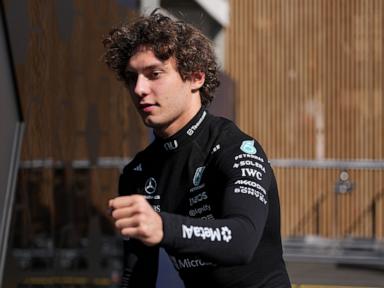
On a damp Sunday afternoon in late 2026, Andrea Kimi Antonelli sat inside that silence. He was twenty years old. For another look on this story, check out the latest coverage from Bleacher Report.
Most twenty-year-olds are trying to figure out how to pay rent on a studio apartment or agonizing over a college midterm. Antonelli was trying to keep a thousand-horsepower Mercedes from snapping sideways into a concrete barrier while rewriting seventy-six years of Formula 1 history. When the checkered flag finally dropped, slicing through the mist, the boy from Bologna didn't scream. He didn't thrash his fists against the cockpit. He just let out a long, shuddering breath that fogged the inside of his visor.
He had just become the youngest Formula 1 World Champion in history.
To understand why that quiet exhale matters, you have to forget the trophy for a second. You have to look at the sheer, crushing absurdity of the seat he was sitting in, the ghost he was asked to replace, and the psychological meat-grinder that modern motorsport has become.
The Weight of an Empty Garage
Rewind the clock to early 2024. The motorsport world was still reeling from the seismic shockwave of Lewis Hamilton announcing his departure from Mercedes to Ferrari. For over a decade, Hamilton wasn't just a driver for the Silver Arrows; he was the architecture of the team. Seven world titles. Over a hundred victories. A cultural titan whose shadow stretched across every millimeter of the Brackley factory.
When a king abdicates, the throne doesn't just sit empty. It becomes a trap.
Mercedes team principal Toto Wolff had a choice. He could play it safe, hire a seasoned veteran, and manage a gentle decline while the team rebuilt. Instead, Wolff looked at a seventeen-year-old kid who didn't even have a driver's license to drive a Fiat Panda to the grocery store, and handed him the keys to the most scrutinized seat in global sports.
Think about the cruelty of that opportunity.
Imagine you are a promising young violinist. You've played in regional youth orchestras, and everyone agrees you have a rare, electric gift. Suddenly, Carnegie Hall calls. They tell you that their legendary soloist—the greatest of a generation—just walked out, and you are going on stage tonight to play his signature concerto. Oh, and if you miss a single note, three hundred million people on the internet will dissect your failure in slow motion before you even leave the building.
That was the invisible stake of Kimi Antonelli's promotion. He bypassed Formula 3 entirely, jumped into Formula 2 with the hype of a messiah, and was thrust into Formula 1 in 2025 before his wisdom teeth had even finished coming in.
Consider a hypothetical fan—let's call him Marco—sitting in a crowded café in Modena, Italy, watching Antonelli's rookie season unfold in 2025. Marco has seen this movie before. Italy is a country starved for a Ferrari champion, a nation that has watched brilliant young drivers get chewed up by expectation and spat out into obscurity. When Antonelli crashed out on his very first public practice session at Monza in 2024, hitting the wall at Parabolica after just ten minutes, Marco probably shook his head and muttered into his espresso. Too soon, he would have thought. They are burning the boy alive.
And honestly? For a while, it looked like Marco was right.
The Anatomy of Speed and Fear
To explain what Antonelli actually did over the course of the 2026 season, we need to strip away the engineering jargon that usually makes Formula 1 feel impenetrable. People talk about "downforce," "thermal degradation," and "brake-by-wire" as if these cars are driven by spreadsheets. They aren't. They are driven by nerve endings.
Driving an F1 car on the limit is like trying to balance a broomstick vertically on the palm of your hand while sprinting down a flight of stairs in the dark.
If you react to the broomstick falling, you have already dropped it. You have to feel the microscopic shift in weight before gravity even takes hold. Now, imagine that broomstick weighs eight hundred kilograms, is traveling at the speed of a commercial airliner during takeoff, and has three other drivers trying to shove you off the stairs.
In 2025, his rookie year, Antonelli was dropping the broomstick. He had raw, terrifying speed—the kind of natural pace that makes grizzled engineers stare at telemetry screens in disbelief—but he lacked the scar tissue. He overdrove the tires. He pushed when he should have conserved. He made the kind of frantic, micro-corrections that bleed tenths of a second per lap.
Veterans on the grid—men in their late twenties and thirties like Max Verstappen, Charles Leclerc, and George Russell—watched him with a mixture of respect and predatory patience. They knew that speed without control is just a faster way to hit the wall.
I remember watching a wet-weather qualifying session a few years back, standing just behind the catch-fencing at the exit of a high-speed chicane. The spray thrown up by a single car is thick enough to blind you from twenty feet away. You couldn't see the cars coming; you could only hear the pitch of the engine drop as the driver downshifted, followed by a violent, percussive crack as the floor bottomed out on the curb. Most drivers lifted their right foot for a fraction of a second—a tiny, human concession to self-preservation. One driver didn't. The engine note never dipped. It was a sound that made the hair on my arms stand up, because it defied every instinct a human brain is wired to possess.
That is the specific, terrifying frequency Antonelli tapped into during the 2026 campaign.
Rewriting the Record Books
When the 2026 technical regulations arrived, completely overhauling the aerodynamics and power units of Formula 1, the chessboard was wiped clean. Suddenly, the veteran advantage shrank. Everybody was learning a new language at the exact same time.
And Antonelli spoke it fluently.
By the time the circus rolled into the final stretch of the 2026 season, the narrative had violently inverted. The kid who couldn't legally drive a road car two years prior was now dictating the rhythm of the championship. He wasn't just fast; he was surgical. He had learned the dark art of tire management—knowing precisely how much rubber he could scrub off on lap twelve so he would still have grip left on lap forty-eight.
When he clinched the title at twenty years and a handful of months old, he shattered Sebastian Vettel's long-standing record from 2010, when Vettel won his first title with Red Bull at twenty-three years and 134 days. Before Vettel, it was Lewis Hamilton at twenty-three, and Fernando Alonso at twenty-four.
Notice the pattern? For decades, twenty-three was considered the absolute floor for human maturity in a Grand Prix car. It took that long to build the neck muscles to withstand five Gs of lateral force, to learn the politics of a five-hundred-person engineering team, and to master the emotional regulation required to survive a twenty-four-race global meat-grinder.
Antonelli shaved three full years off that timeline.
To put that into perspective, at the age Antonelli became the undisputed king of global motorsport, Michael Schumacher was still racing sports cars and hadn't even made his Formula 1 debut. Ayrton Senna was still fighting his way through British Formula 3.
The Invisible Cost of Being a Prodigy
It is easy to look at the podium photos—the champagne soaking into the fireproof Nomex suit, the gleaming silver trophy, the blinding flash of a hundred cameras—and think this is a fairy tale. It isn't. Fairy tales don't require teenagers to sacrifice their entire adolescence on the altar of lap times.
Let's be honest about what it takes to produce a twenty-year-old world champion. It is deeply uncomfortable to look at closely.
While other kids were going to high school dances, stumbling through their first heartbreaks, or simply lying on the grass doing nothing at all, Kimi Antonelli was living inside simulators, analyzing data traces with middle-aged engineers, and having his body weight measured to the tenth of a kilogram. His father, Marco Antonelli, a former racing driver himself, put him in a go-kart before he could properly tie his shoelaces.
There is a specific kind of loneliness that comes with extreme, early excellence. You cannot complain about the pressure because you are living the dream millions would kill for. You cannot show weakness in the paddock because your rivals will smell it like sharks in the water. When you are twenty and leading a multi-million-dollar corporate enterprise on wheels, you don't get to have a bad day at the office. A bad day means your name is trending globally for all the wrong reasons.
During the middle of the 2026 season, after a brutal collision in the first corner of a European race cost him a crucial podium, the cameras followed Antonelli all the way back to the Mercedes hospitality unit. He didn't throw his helmet. He didn't yell at the marshals. He walked with his head down, his shoulders slightly hunched, looking suddenly every bit like a kid who just wanted to go home and lock his bedroom door.
That vulnerability is why his triumph resonates so deeply. He didn't win because he was a machine programmed by Mercedes. He won because he was a human being who felt the crushing weight of expectation, buckled under it, and figured out how to stand back up while moving at two hundred miles an hour.
The Shift in the Sport's Soul
Antonelli's championship does more than just update a Wikipedia page; it fundamentally alters the economics and psychology of Formula 1.
For years, team principals were terrified of rookies. With strict testing bans limiting how much track time young drivers could get before their debuts, teams clung to safe, experienced pairs of hands. Why gamble forty million dollars of wind-tunnel development on a teenager who might put the car in the wall?
Toto Wolff's gamble—and Antonelli's ultimate validation of it—just blew that conservative playbook to pieces.
Every team principal on the pit wall, from Maranello to Milton Keynes, is now looking at their junior academies differently. They are no longer looking for "ready-made" drivers in their mid-twenties. They are looking for the next eighteen-year-old phenom who grew up on hyper-realistic racing simulators, whose brain processes visual information at a frame rate older generations simply cannot match.
Consider what happens next across the entire paddock. Veterans in their thirties, drivers who assumed they had another five or six lucrative years left in their careers, suddenly feel the cold breath of obsolescence on the back of their necks. The timeline of an F1 career has been violently compressed. If you haven't proven yourself by twenty-two, you are no longer a "young talent"—you are running out of time.
A New Era in Silver
It is tempting to look at Antonelli's victory and declare the start of a decade-long Mercedes dynasty, a neat continuation of the Hamilton era. That would be a mistake. Formula 1 is too volatile, too cruel, and too unpredictable for guarantees. Rules change. Engines blow up. Rival engineers find a loophole in the floor regulations that suddenly makes your championship-winning car look like a tractor.
Antonelli knows this better than anyone. He watched Mercedes struggle through the ground-effect era from 2022 to 2025. He saw the frustration in the eyes of the mechanics who worked eighteen-hour days only to finish fifth. He understands that a championship isn't a permanent state of grace; it is a temporary lease that has to be renewed every single Sunday.
Late on that championship-clinching evening, long after the podium celebrations had died down and the champagne had dried into sticky patches on the pit lane asphalt, the paddock began to empty out. Mechanics were packing carbon-fiber wings into giant padded flight cases. Journalists were filing their final stories.
Inside the darkened Mercedes garage, the championship-winning car sat stripped of its bodywork, looking less like a sleek silver arrow and more like a complex, exposed nervous system of wires, titanium, and Kevlar.
A lone figure stood near the front wing, still wearing his team polo shirt, quietly scrolling through telemetry data on a tablet while the rest of the world celebrated his name. He looked up for a brief second, caught the reflection of the empty pit lane in the dark glass of the garage wall, and then looked right back down at the numbers, already hunting for the next tenth of a second.


