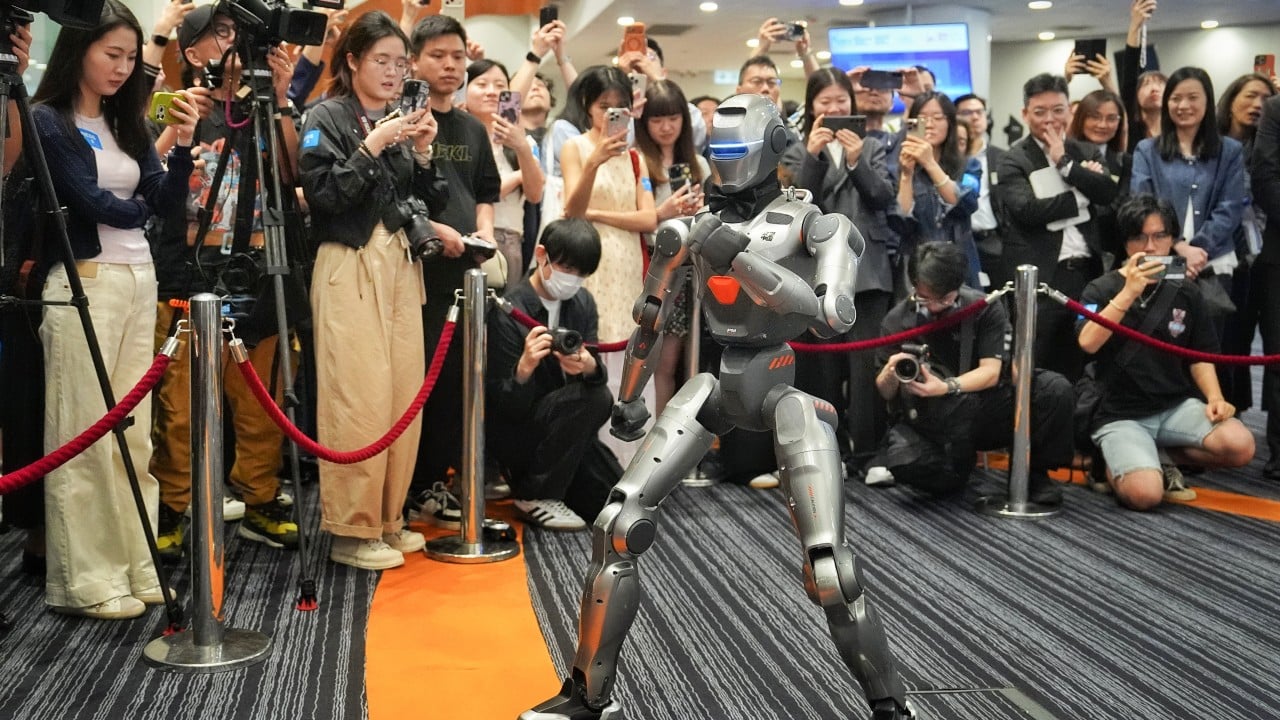
The air in Shenzhen’s Nanshan District smells of ozone and ambition. It is a humid, electric scent that clings to the back of your throat, a constant reminder that you are standing in the world’s hardware heart. Here, a robot isn't a prop from a sci-fi flick. It is a stack of sensors, carbon fiber, and servos that needs a brain to make sense of the chaos.
But brains require a specific kind of fuel. They need the crunching power of high-end chips—the kind that have become increasingly difficult to find on the mainland.
When a robotics company in Shenzhen hits the limits of local computing power, they don't just stop. They look south. They look across the Shenzhen River to the jagged skyline of Hong Kong. This is not just a story about a business move or a stock market ticker. It is a story of survival in a world where the borders of innovation are being redrawn by the hour.
The Thirst for Logic
Imagine a young engineer named Chen. He spends sixteen hours a day teaching a humanoid machine how to navigate a crowded hospital corridor without bumping into a gurney or terrifying a patient. For the robot to "see" and "decide" in real-time, it must process billions of data points every second. This requires GPUs—Graphics Processing Units—that can handle massive parallel workloads.
In the current geopolitical climate, these chips are the new gold. Or perhaps the new water. Essential. Finite. Closely guarded.
Chen watches the progress bar on his monitor. It crawls. The local servers are strained, wheezing under the weight of the massive Large Language Models (LLMs) required to give his robot a voice and a sense of reason. To compete globally, he needs more than what he can get his hands on in the immediate vicinity. He needs a gateway.
Hong Kong has always been that gateway. Historically, it was for tea, silk, and silver. Today, it is for floating-point operations and initial public offerings.
The Invisible Bridge
Hong Kong offers something the mainland currently struggles to provide: a friction-less connection to global high-end computing resources. Because of its unique status, the city sits in a different regulatory pocket. It is the cooling vent for a mainland tech industry that is running dangerously hot.
A Shenzhen robot maker moving its computing needs to Hong Kong isn't just about renting server space. It is a strategic pivot. It’s about tapping into the Nvidia H100s and A100s that are the lifeblood of modern artificial intelligence. Without them, a robot is just a very expensive, very sophisticated paperweight.
Consider the math.
$$P = n \times c$$
If $P$ is the total processing power, $n$ is the number of chips, and $c$ is the capability of each chip, the equation for a Shenzhen firm becomes a desperate hunt to increase both variables. If $c$ is capped by trade restrictions, then $n$ must be massive. But finding space, power, and the right legal framework to house thousands of high-end units is a Herculean task.
Hong Kong provides the "Legal Infrastructure." That sounds boring. It’s not. It is the difference between a project being green-lit or being mothballed. By setting up data centers or partnering with Hong Kong-based providers, these companies bypass the bottlenecks that threaten to turn the "Silicon Valley of the East" into a museum of last-gen hardware.
The Two-Fold Gamble
There is a second reason for the southern migration, and it has nothing to do with silicon. It has everything to do with paper.
Listing on the Hong Kong Stock Exchange (HKEX) is the ultimate signal of legitimacy for a Chinese tech firm. It is the bridge to international capital. While the mainland markets have their own strengths, Hong Kong remains the place where global investors—the ones sitting in London, New York, and Singapore—feel comfortable putting their money.
For a company like a major robot manufacturer, a listing is the "Exit" or the "Expansion" that justifies years of grueling "996" work schedules (9 am to 9 pm, six days a week). It’s the moment the sweat and the lines of code turn into liquid wealth.
But the HKEX is a demanding mistress. It requires transparency. It requires a clear path to profitability. It requires a story that makes sense to a hedge fund manager who doesn't care about the poetry of a robot’s movement, only the efficiency of its bottom line.
The Human Cost of the Crunch
The pressure on these companies is immense. When we talk about "computing power," we often forget the people who have to optimize the code when the power isn't there.
When you have a surplus of chips, your code can be "lazy." You can throw hardware at a problem. But when chips are scarce, every line of Python or C++ must be lean. It must be perfect. The engineers in Shenzhen are currently performing a kind of digital alchemy—trying to squeeze "General Intelligence" out of hardware that was never meant to handle it.
They are tired.
The move to Hong Kong is a pressure valve. It’s a way to tell their staff, "We have the tools you need." It’s a way to tell their investors, "We are not trapped."
The Digital Divide of the Delta
The Greater Bay Area—the cluster of cities including Shenzhen, Hong Kong, and Guangzhou—is meant to be a seamless hub. Yet, the friction is what defines it. There is a "Data Border" that is just as real as the physical customs checkpoint at Lok Ma Chau.
Moving data back and forth is a legal minefield. Personal information, national security data, and proprietary algorithms are all subject to intense scrutiny. The "Robot Maker" isn't just building machines; they are building a legal department that can navigate the shifting sands of data sovereignty.
Imagine a specialized facility in Hong Kong. It’s cold. The fans roar with a deafening, metallic whine. Inside those racks, the "thoughts" of a robot being built 30 kilometers away are being processed. The latency—the delay between a signal being sent and a response received—is the heartbeat of the operation.
If the latency is too high, the robot trips.
If the latency is too high, the robot fails to recognize a human face.
If the latency is too high, the business dies.
The Soul in the Machine
We often speak of these things in terms of "Market Cap" and "Export Controls." We use dry language to describe what is essentially a desperate, human struggle to reach the future first.
The robot maker isn't just looking for "computing power." They are looking for a way to ensure that their vision of the future—one where machines assist the elderly, manufacture our goods, and explore dangerous environments—isn't strangled in its crib by a lack of resources.
Hong Kong is the lifeline. It is the "Offshore" that allows the "Onshore" to breathe.
As the sun sets over the Pearl River Delta, the lights in the office towers of Nanshan stay on. Somewhere, an engineer clicks "Execute," and a command travels through fiber optic cables, under the river, into a high-end server in a Hong Kong industrial building. The server hums. A calculation is made. The command returns.
In the Shenzhen lab, a metallic hand reaches out and closes its fingers with agonizing precision. It is a small movement. It cost millions of dollars and thousands of hours to achieve.
The machine doesn't know it’s in the middle of a trade war. It doesn't know it’s part of a dual-listing strategy. It just knows it has been given the power to act. For the people who built it, that power is everything.
The border is no longer a wall; it is a circuit. And as long as that circuit remains closed, the machines will keep learning, one byte at a time, in the cold, humming rooms of the city by the sea.