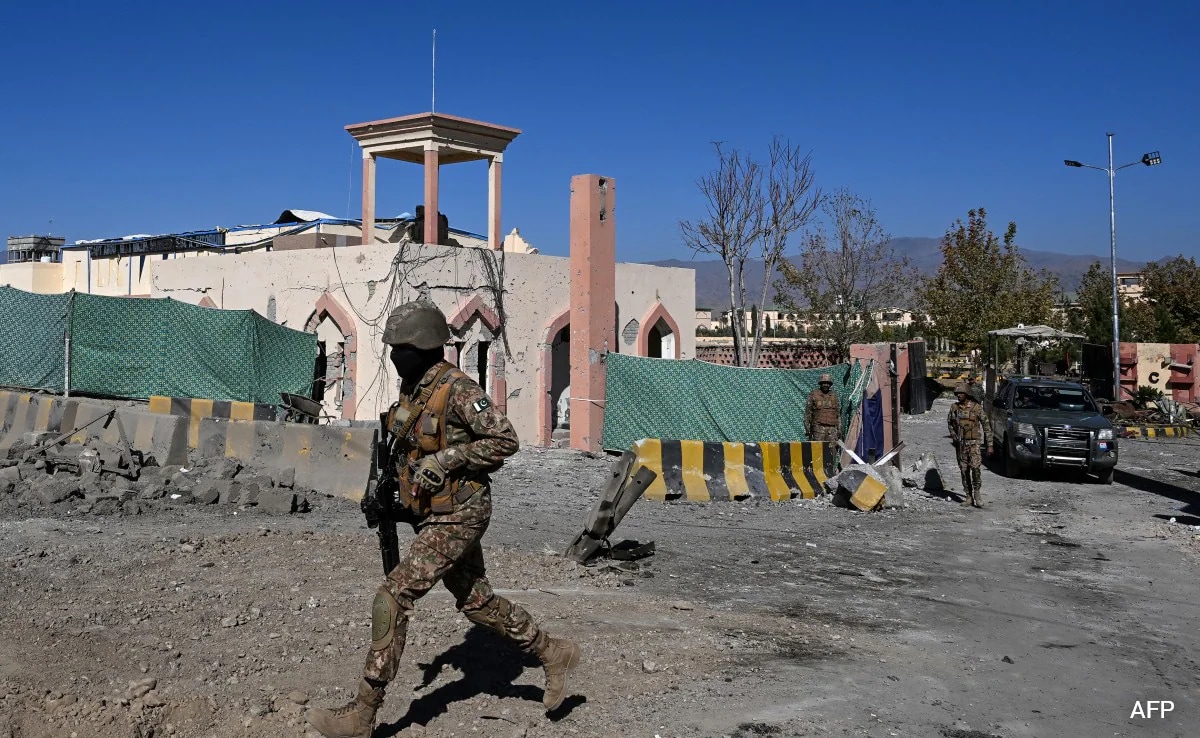
The wind in the Khyber Pass does not care about diplomacy. It whistles through the jagged peaks of the Hindu Kush, carrying the scent of pine, diesel exhaust, and a tension so thick it feels like a physical weight on the chest. For the people living in the shadow of this border, peace is not a signed document. It is the absence of the whistle of an incoming mortar. It is the ability to drink tea without watching the horizon for smoke.
Recently, in a room far removed from the dust of the frontier, a group of men sat around a polished table in Beijing. They spoke of "avoiding escalation" and "regional stability." China, acting as the mediator, announced that Pakistan and Afghanistan have reached a consensus to lower the temperature. On paper, it sounds like a bureaucratic victory. In reality, it is a desperate attempt to keep a simmering pot from boiling over.
The stakes are not abstract.
Consider a farmer in the Durand Line region. Let’s call him Ahmad. Ahmad does not think about "geopolitical pivots." He thinks about his orchard. When the border shuts down because of a skirmish between the Taliban and the Pakistani military, his pomegranates rot in the back of a stationary truck. His livelihood vanishes not because of a bad harvest, but because two neighbors cannot agree on where one’s house ends and the other’s begins. For Ahmad, the news from Beijing is a temporary reprieve, a chance to breathe, but he keeps his bags packed.
This is the human face of a conflict that the world often views through the sterile lens of "terrorism" or "strategic depth."
The Weight of a Handshake
For decades, the relationship between Islamabad and Kabul has been a pendulum swinging between brotherly embrace and bitter betrayal. Since the Taliban returned to power in 2021, the pendulum has been stuck on betrayal. Pakistan, which long sought a friendly government in Kabul to ensure its western flank was secure, found instead a defiant neighbor that refuses to recognize the colonial-era border.
The friction is sparked by a group known as the Tehrik-i-Taliban Pakistan (TTP). They operate from the Afghan side, crossing over to launch attacks that have bled Pakistan for years. When Pakistan demands the Afghan Taliban rein them in, the response is often a shrug or a denial. This led to a cycle of air strikes, border closures, and the mass deportation of Afghan refugees—families who had lived in Pakistan for generations suddenly uprooted and sent into a country they barely recognized.
Beijing’s intervention is not born of altruism. It is born of necessity. China is pouring billions into the China-Pakistan Economic Corridor (CPEC). They are eyeing the vast, untapped mineral wealth of Afghanistan. You cannot build a Silk Road through a war zone.
But can a handshake in a high-rise office stop a gunman in a mountain ravine?
The tragedy of this region is that "de-escalation" is often just a synonym for "reloading." The core issues remain untouched. The border is still a scar across a community that shares the same language, the same faith, and the same tribal ties. To a Pashtun tribesman, the line drawn by a British civil servant in 1893 is an insult; to a Pakistani general, it is the bedrock of national sovereignty.
The Invisible Architecture of Trust
Trust is easy to destroy and agonizingly slow to rebuild. It is like an old bridge in the mountains. One well-placed charge can bring it down in seconds, but to fix it, you have to carry the stones up the slope one by one, by hand, in the cold.
The agreement brokered by China is a single stone.
It addresses the immediate fever. Both sides agreed to keep communication channels open, to use the "Trilateral Direct Communication Mechanism." It sounds clinical. What it actually means is that when a soldier at a remote outpost hears a gunshot, he is supposed to pick up a phone instead of a heavy machine gun. It is an attempt to insert a moment of hesitation between a spark and a fire.
The skepticism on the ground is justified. We have seen this movie before. Agreements are made, photos are taken, and then a suicide bomber hits a mosque in Peshawar or a drone strikes a compound in Khost. The cycle restarts. The rhetoric hardens. The border closes. Ahmad’s pomegranates rot.
The real problem lies in the disconnect between the political elites and the reality of the militants. The Afghan Taliban are not a monolithic entity. There are factions that see the TTP as ideological brothers who cannot be betrayed. On the other side, the Pakistani public is exhausted by a "war on terror" that never seems to end, feeling the sting of inflation and insecurity simultaneously.
The Cost of the Long Game
If you look at a map of the region, you see a tangle of interests. You see the shadow of India, the cautious eyes of the United States, and the heavy hand of China. But the map is lying. The map shows solid lines where there are actually porous membranes of culture and conflict.
The "invisible stakes" of this de-escalation are the children in the border camps. There are thousands of them. They are growing up in a world where the state is an entity that either ignores them or deports them. When Pakistan and Afghanistan "agree to avoid escalation," they are essentially agreeing to give these children another day without a bomb. That is the bare minimum we should expect from a government. Yet, in this part of the world, the bare minimum is a luxury.
We often talk about these countries as if they are players in a grand game. We use words like "leverage" or "assets." We forget that an "asset" is a human being with a mother. We forget that "strategic depth" is a valley where people are trying to grow wheat.
The Chinese mediation is a recognition that the West has largely walked away from the table. The Americans left Kabul in a hurry, leaving behind a vacuum that is now being filled by a different kind of diplomacy—one that values stability over democracy and commerce over human rights. It is a cold, pragmatic peace. It is better than a hot, chaotic war, but it is fragile.
The Silence at the Gate
Imagine standing at the Torkham border crossing. It is one of the busiest arteries of trade in Central Asia. Usually, it is a chaos of colorful trucks, shouting traders, and people carrying everything they own in plastic bags. When the "escalation" happens, that place becomes a ghost town. The silence is terrifying. It is the silence of a held breath.
The agreement aims to keep the gate open.
But the real work isn't happening in Beijing. It has to happen in the madrassas, in the military barracks, and in the village squares. It requires a fundamental shift in how both nations see themselves. Pakistan must decide if it can live with a neighbor it cannot control. The Taliban must decide if they want to be a legitimate state or a sanctuary for global insurgency.
Neither side seems ready to make that choice.
So, we are left with these "consensuses." They are the bandages on a wound that requires major surgery. They stop the bleeding for an hour, maybe a day. They allow the trucks to move. They allow China to continue its construction projects. They allow the diplomats to claim a win.
But as the sun sets over the Hindu Kush, the soldiers on both sides of the wire still sleep with their boots on. They know that a piece of paper in China does not change the history written in blood in the valleys below. They know that peace is not something you "agree" to. It is something you build, stone by agonizing stone, while the wind tries to knock you off the mountain.
The pomegranates are being loaded onto the trucks tonight. The drivers are checking their mirrors, looking at the road ahead, and hoping the phone lines stay open. They are moving toward the border, driving into a future that is as uncertain as the mountain weather, praying that this time, the handshake holds just long enough to get the harvest home.
The mountains are watching. They have seen empires come and go, and they have seen a thousand such agreements turn to dust. In the end, the only thing that matters is whether the silence of the night is the silence of peace or the silence of a fuse.



