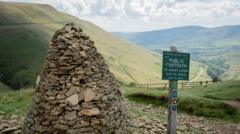
The Peak District did not become a postcard-perfect escape by accident or through the quiet benevolence of the British landed gentry. It was forged through raw class warfare, industrial greed, and a radical movement of urban workers who were willing to go to prison for the right to walk on dirt. While modern tourists flock to Bakewell for tarts or Chatsworth for its gilded frames, the true soul of this region lies in the soot-stained history of the Victorian era. The transition from a private playground for grouse shooters to Britain’s first national park was a brutal, decades-long grind that reshaped the nation's relationship with the outdoors.
To understand the Peak District, you have to look at the grime of 19th-century Manchester and Sheffield. These were the workshops of the world, choked by coal smoke and overcrowded tenements. For the men and women working fourteen-hour shifts in the mills, the dark gritstone edges and rolling limestone dales of the Peaks weren't just scenery. They were oxygen. But there was a problem. The land was locked. Recently making news in related news: The Rato Machindranath Festival is Not a Religious Relic It is a Masterclass in Structural Engineering and Social Risk.
The Iron Road to the Wilderness
The arrival of the railway changed everything. Before the tracks were laid, the high moors were remote and inaccessible to anyone without a carriage and a title. When the London and North Western Railway and the Midland Railway carved through the limestone, they didn't do it to help hikers. They did it to move coal and stone.
However, they inadvertently created a portal. By the mid-1800s, "excursion" trains began dumping thousands of working-class city dwellers into villages like Edale and Castleton. Suddenly, the chimney sweep and the mill girl were standing at the gates of the Great Estates. The friction was immediate. Landowners saw these visitors as a "rabble" that would disturb the grouse. The visitors saw a landscape that had been stolen from the common people through centuries of Enclosure Acts. Additional details regarding the matter are covered by Condé Nast Traveler.
The Kinder Scout Insurrection
If there is one moment that defines the Peak District, it is April 24, 1932. This wasn't a polite protest. It was an act of mass civil disobedience known as the Kinder Scout Mass Trespass.
Led by Benny Rothman, a young communist and gear-cutter from Manchester, hundreds of walkers marched onto the plateau of Kinder Scout. They were met by gamekeepers armed with sticks. Scuffles broke out. The "crime" was simple: walking on uncultivated land. Five of the leaders were arrested and handed prison sentences that even the newspapers of the time deemed "vicious."
But the optics were a disaster for the establishment. The sight of young, working-class men being jailed for walking in the hills galvanized the public. It turned a local dispute into a national crusade for "the right to roam." This wasn't about leisure; it was about the fundamental right to exist in the natural world without being treated as a criminal.
The Myth of the Untouched Wild
We often treat the Peak District as a pristine wilderness. It is anything but. The landscape is an industrial artifact. The "natural" beauty of the dales is a byproduct of centuries of lead mining, quarrying, and sheep farming. The very names that make tourists giggle today—like Mam Tor (the Shivering Mountain) or various "Arses" and "Bottoms" in the local topography—reflect a coarse, earthy history that pre-dates the sanitized version found in gift shops.
The lead mines, specifically, left a permanent scar. Look closely at the ground in Lathkill Dale and you’ll see the humps and hollows of "rakes" where miners extracted ore for centuries. These men lived hard, short lives. The wealth they generated built the stately homes that now charge £25 for parking, yet the miners themselves often died in debt to the same companies that owned the land.
The Business of Leisure
Tourism in the Peaks began as a radical act, but it quickly became a massive commercial machine. The Duke of Devonshire and other landowners eventually realized that there was more money in hospitality than in keeping people out.
The 1949 National Parks and Access to the Countryside Act was the final victory of the trespassers, and in 1951, the Peak District became the UK’s first national park. But victory brought its own set of complications.
Overtourism is the new Enclosure.
In 2026, the park faces a crisis of its own success. With over 13 million visitors annually, the very thing people come to see is being eroded. The "honeypot" villages like Castleton and Bakewell are often paralyzed by traffic. The peat bogs of the high moors, essential for carbon sequestration, are being trampled. The tension has shifted: it is no longer the walker versus the gamekeeper, but the resident versus the tourist.
- Property Prices: Local families are being priced out of their own villages by the explosion of short-term holiday rentals.
- Infrastructure: Victorian-era roads were never designed for thousands of SUVs.
- Ecological Impact: Wildfires, often caused by disposable barbecues, threaten to destroy the fragile moorland ecosystems that the 1932 protesters fought to open up.
The Railway That Disappeared
The story of the Monsal Trail serves as a perfect microcosm for the region’s evolution. Once a controversial railway line that the critic John Ruskin famously despised—he claimed it "destroyed" the valley—it is now one of the most popular walking and cycling routes in England.
When the line was closed in the 1960s as part of the Beeching cuts, it left behind a series of tunnels and viaducts. For decades, these were derelict. Today, they are a primary engine of the local economy. It is a strange irony: the industrial scar that Ruskin hated has become the "natural" escape that modern urbanites crave. It proves that our definition of "nature" is constantly shifting. What one generation considers a desecration, the next considers a heritage site.
A Landscape of Resistance
The Peak District remains a contested space. While the Right to Roam was expanded in 2000, large swathes of the park remain off-limits or under-managed. The ghost of Benny Rothman still haunts these hills, reminding us that access is not a gift—it is a hard-won right that can be eroded by neglect or commercialization.
The "rude names" and quirky landmarks are not just curiosities for a Sunday supplement. They are the linguistic fingerprints of a population that refused to be pushed off the map. When you stand on the summit of Kinder Scout today, you aren't just looking at a view. You are standing on a battlefield.
The future of the Peak District depends on acknowledging this friction. We cannot treat the park as a static museum or a disposable playground. It is a living, breathing tension between the industrial past and an uncertain, crowded future. The challenge for the next century isn't just how we get people into the hills, but how we ensure there is still a hill left to climb once they get there.
The next time you see a "Private Property" sign near a gritstone edge, remember that those signs used to cover the entire horizon. The Peak District is a monument to the fact that when enough people decide a wall shouldn't be there, eventually, the wall comes down.
Leave the gift shops behind. Go find the places where the keepers and the trespassers fought. That is where the real story lives.