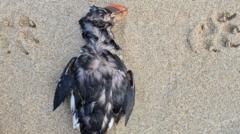
The survival of the Atlantic puffin (Fratercula arctica) is currently dictated by a precarious energy balance that is being systematically dismantled by North Atlantic climatic volatility. While "winter wrecks"—mass mortality events where thousands of seabirds wash ashore—are often framed as tragic anomalies, they are actually the visible terminal phase of a multi-stage bioenergetic failure. The structural integrity of puffin populations depends on their ability to maintain a metabolic steady state during the non-breeding season, a period where their environmental tolerance is pushed to its absolute physiological limit.
The Triad of Metabolic Exhaustion
To understand why puffin populations are surfacing as carcasses on UK shores, one must first deconstruct the three variables that govern their winter survival. This is not a matter of simple "bad weather" but a catastrophic intersection of caloric deficit, thermal leakage, and physical fatigue. Recently making news in related news: Finland Is Not Keeping Calm And The West Is Misreading The Silence.
1. The Foraging Efficiency Threshold
Puffins are "income breeders" and high-frequency foragers. Unlike larger marine mammals that rely on significant blubber reserves, a puffin’s energy storage is limited. They must consume approximately 10% to 15% of their body mass daily in high-lipid prey, such as sandeels and sprats. When winter storms persist for more than 48 to 72 hours, the turbulence of the water column forces prey species deeper or disperses them, making them energetically "expensive" to hunt. If the energy expended in a dive exceeds the caloric return of the catch, the bird enters a state of negative energy flux.
2. Thermal Conductance and Plumage Integrity
Seabirds maintain a core body temperature of roughly 39°C to 41°C. Their primary defense against the heat-sapping North Atlantic is a layer of air trapped beneath waterproof feathers. Extended storm systems involve heavy precipitation and high-velocity winds that can physically compromise this plumage. Once water penetrates to the skin, thermal conductance increases exponentially. The bird must then ramp up its metabolic rate to produce heat through shivering (thermogenesis), which rapidly depletes the remaining glycogen stores in the pectoral muscles. Additional details on this are detailed by NBC News.
3. The Locomotion Penalty
Puffins have high wing-loading—small wings relative to their body mass. This makes them efficient divers but inefficient flyers. They must flap at rates of up to 400 beats per minute to remain airborne. In sustained gale-force winds, the cost of transit between foraging patches becomes prohibitive. Many birds choose to remain on the water to save energy, but this exposes them to the thermal risks mentioned above.
Mechanisms of the Winter Wreck
A "wreck" occurs when these metabolic pressures reach a tipping point across a demographic. It is rarely a single event that kills the bird; it is a cumulative "attrition cycle."
The process typically begins with prey unavailability. Changes in sea surface temperatures (SST) in the North Sea and North Atlantic have shifted the phenology of sandeels. When puffins head into winter, they may already be at a lower-than-optimal body condition due to a poor summer breeding season.
The second phase is forced displacement. Low-pressure systems moving across the Atlantic can trap birds in "unproductive" waters where they have no historical knowledge of prey locations. This spatial disorientation leads to increased searching time, further draining the "battery" of the bird's fat reserves.
The final phase is organ failure. As fat reserves hit zero, the body begins catabolizing muscle tissue, specifically the large flight muscles. This is why wrecked birds are often found at a fraction of their healthy weight, with "knifed" breastbones (prominent sternums) indicating total muscle atrophy. At this point, even if the weather clears, the bird may be too weak to dive or fly, leading to a lingering death by starvation or hypothermia.
The Climate Forcing Variable
The increasing frequency of "consecutive storm days" is the most lethal component of modern North Atlantic winters. A puffin can survive a two-day storm by fasting and sitting on the water. It cannot survive a ten-day sequence of back-to-back depressions.
We must also account for the North Atlantic Oscillation (NAO). A positive NAO phase brings stronger westerlies and more frequent storms to the UK. While this is a natural cycle, the underlying rise in ocean heat content is supercharging these systems. The result is a shift from "high-stress winters" to "lethal-threshold winters."
Quantifying the Demographic Impact
The danger of the winter wreck lies in its lack of selectivity. While natural selection typically removes the weak or the old, a severe wreck can kill healthy, breeding-age adults. In long-lived species like the puffin, which may live 20 years or more, the loss of an adult is far more damaging to the population than the loss of a chick.
- Adult Survival vs. Fledgling Success: A puffin colony can recover from several years of poor breeding success if the adults survive to try again. However, a 10% drop in adult survival can lead to a population collapse that takes decades to reverse.
- The "Sunk Cost" of Maturity: It takes five years for a puffin to reach breeding age. Every adult lost in a winter wreck represents five years of "invested" survival that is suddenly erased from the gene pool.
Limitations of Current Intervention
Conservation efforts often focus on "land-based" protections, such as eradicating invasive rats from nesting islands or limiting human disturbance. While these are necessary, they do nothing to address the offshore metabolic crisis.
There is a fundamental "data gap" regarding where puffins go in the winter. While geolocators have begun to map these movements, the resolution is often too low to predict which specific sub-groups are at risk during a localized storm event. Furthermore, we cannot "feed" wild seabirds during a storm. The only viable levers are indirect:
- Fisheries Management: Implementing a total ban on industrial sandeel fishing in the North Sea to maximize the available caloric density for birds before they enter the winter stress period.
- Marine Protected Areas (MPAs): Shifting the focus of MPAs from static geographic boxes to "dynamic" zones that protect moving prey clusters.
The trajectory of the Atlantic puffin is no longer a question of "if" they will face hardship, but whether the gaps between extreme weather events will be long enough to allow for biological recovery. The current frequency of storms suggests we are entering a period of permanent population contraction.
The immediate strategic priority must be the absolute protection of the sandeel biomass. If the caloric "buffer" is removed from the ocean during the summer and autumn, the puffin has zero contingency for the winter. Policy must pivot from protecting the birds where they nest to protecting the energy source where they hunt. Without a surplus of energy going into the winter, the biological math simply does not add up for the puffin's survival.