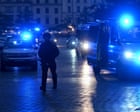
The cobblestones in Kraków remember everything, even when the people walking over them try to forget.
If you have ever stood in the Main Market Square just before dusk, you know the exact rhythm of the city. It is measured in the heavy, rhythmic clatter of horse-drawn carriages, the low murmur of university students spilling out of cellar cafes, and the high, haunting notes of the Hejnał mariacki—the trumpet call played every hour from the tallest tower of St. Mary’s Basilica. For centuries, that melody has broken off mid-phrase, a deliberate musical scar commemorating a thirteenth-century trumpeter shot in the throat while warning the city of an approaching invasion.
Kraków wears its history like a heavy wool coat. People come here to admire resilience, to walk through a medieval core that miraculously survived the bombs of the twentieth century intact. They come because Poland feels, by almost every statistical measure, like one of the safest corners of Europe.
Then the gunfire started.
Six people are dead. More than a dozen others are lying in hospital beds across the Lesser Poland Voivodeship, their bodies suddenly turned into battlegrounds of trauma surgery and whispered prayers. Police confirmed the toll in the clipped, bloodless language of official press briefings, laying out a perimeter of yellow tape that sliced straight through the ordinary evening of a European cultural capital.
Numbers do a terrible job of explaining what happens when violence breaches a place that believes itself immune. Six is a digit on a wire report. Six is a headline you skim while waiting for your morning coffee to brew.
To understand what actually happened in Kraków, you have to strip away the police scanner jargon and look at the space between the shots.
The Architecture of an Ordinary Evening
Consider a hypothetical bystander—let us call her Zofia, a composite drawn from the thousands of residents who move through the city’s center every evening. Zofia is twenty-six, finishing a graduate degree at Jagiellonian University, walking home with a canvas bag full of groceries and a novel she hasn't had time to open.
She is thinking about mundane things. The chill creeping up from the Vistula River. Whether she remembered to lock her bicycle. The price of rent in Kazimierz.
In a city where violent gun crime is so rare it borders on theoretical, the human brain has no filing cabinet for the sound of rapid gunfire. When the first sharp cracks echoed off the limestone facades, people did not immediately hit the pavement. Why would they? You hear a sharp bang in Kraków, and your mind reaches for familiar explanations. Firecrackers left over from a festival. A car backfiring on a narrow side street. Construction scaffolding collapsing in an alleyway.
That hesitation—that brief, fatal gap between hearing a sound and understanding its malice—is where modern urban tragedies live.
By the time the realization landed, the geometry of the street had completely changed. Storefronts that moments earlier glowed with the warm invitation of bakeries and bookstores suddenly became improvised bunkers. Heavy wooden doors were bolted from the inside. Baristas pulled strangers behind espresso machines. Outside, the wide, open plazas that make European cities so intoxicating to walk through turned instantly into exposed corridors with nowhere to hide.
Police units arrived within minutes, tactical teams moving against a tide of sprinting pedestrians. Sirens began to layer over one another, bouncing off centuries-old brickwork until it was impossible to tell which direction the wailing was coming from. Within half an hour, helicopters were thumping low over the terracotta rooftops, their searchlights cutting stark white triangles across streets usually lit by soft amber streetlamps.
The Myth of the Safe Harbor
To grasp why this specific shooting has sent a shockwave far beyond Poland’s borders, you have to look at the numbers that define the country’s daily reality.
Poland maintains some of the strictest firearm regulations in the European Union. Acquiring a gun legally requires psychological evaluations, background checks, medical clearances, and a demonstrable, legally recognized reason for ownership—such as sport shooting, hunting, or verified personal threat. Self-defense permits are notoriously difficult to obtain. As a result, Poland consistently ranks near the bottom of global gun ownership rates, hovering around two to three civilian firearms per one hundred residents.
Compare that to the United States, where the ratio exceeds one hundred and twenty guns per one hundred people, or even to neighboring European nations with higher hunting traditions. In Kraków, you do not walk past pawnshops with rifles in the window. You do not see holsters on hips in the supermarket.
Statistically, Poland’s homicide rate sits below one per one hundred thousand inhabitants—roughly six times lower than the global average. Violent crime involving firearms is an anomaly so stark that when it occurs, it feels less like a crime and more like a tear in the fabric of reality.
This statistical cocoon creates a distinct psychological posture. Having spent years living and reporting in cities where ambient threat is simply part of the background noise, I know the subtle, exhausting tax of hypervigilance—the unconscious habit of sitting with your back to the wall in restaurants, of scanning exits in theaters, of flinching when a metal tray drops in a kitchen.
In Kraków, people do not pay that tax. They walk at midnight with headphones on. They linger on benches until two in the morning. They trust the social contract implicitly because, for decades, that contract has held.
When six people are gunned down in a single incident in a city like this, the damage isn't confined to the victims and their families. The damage is epistemic. It forces an entire population to rewrite its internal rules about what is possible.
What the Police Know—And What Remains in the Dark
In the immediate aftermath of any mass casualty event, information behaves like smoke. It fills every available space, obscures the truth, and chokes out rational analysis before the facts have even been gathered.
Law enforcement officials in Kraków moved quickly to establish a perimeter and secure the scene, confirming the six fatalities and more than a dozen wounded while urging the public to avoid the sector and rely strictly on verified channels. Hospitals across the city activated mass casualty protocols, calling in off-duty surgeons and clearing operating theaters to handle gunshot trauma that many young doctors had previously studied mostly in textbooks.
Yet, as the hours stretched into the night, the inevitable questions began to press against the police cordon. Who pulled the trigger? Was this a targeted attack—a settling of accounts from the shadows of organized crime—or an act of indiscriminate violence aimed at the public at large? How did a weapon capable of inflicting this level of devastation enter a city governed by some of Europe’s tightest gun laws?
Investigators immediately began canvassing the dense web of municipal CCTV cameras that monitor Kraków’s historic core, cross-referencing footage with eyewitness statements and forensic ballistics. In Europe, illicit firearms often trace their lineage back to fractured supply chains—weapons smuggled across porous borders from the remnants of the Balkan wars of the 1990s, converted blank-firing pistols trafficked from neighboring jurisdictions, or dark-web networks exploiting courier routes.
Until ballistics reports and suspect interrogations conclude, certainty remains out of reach. And that uncertainty is its own kind of torture.
If an attack is targeted, a community can tell itself a comforting story: This was about them, not us. We were simply in the wrong place at the wrong time.
If an attack is random, that psychological firewall collapses entirely. Every café table, every tram stop, every evening walk becomes suspect.
The Invisible Aftershocks
We tend to measure tragedies by their immediate physical toll. Six dead. Over a dozen injured. Those numbers sit neatly in headlines and statistical databases. They allow us to categorize the event, file it away, and move on to the next cycle of news.
What never shows up in the police press releases is the long, slow tail of collective trauma.
Imagine the emergency room nurse in Kraków finishing a fourteen-hour shift at dawn, scrubbing dried blood from beneath her fingernails, walking out into the crisp morning air and suddenly feeling her heart hammer against her ribs at the sound of a delivery truck hitting a pothole.
Think about the parents sitting at kitchen tables across the city, trying to explain to an eight-year-old why armed tactical officers are standing outside the bakery where they bought sweet rolls two days ago. How do you explain sudden, lethal malice to a child without shattering their sense that the world is fundamentally predictable?
And consider the more than a dozen survivors currently fighting through surgeries and intensive care. In journalism, "injured" is a soft word. It sounds temporary, like a sprained ankle or a bruised shoulder. In reality, surviving high-velocity gunshot wounds often means years of reconstructive procedures, chronic nerve pain, colostomy bags, prosthetics, and the quiet, suffocating weight of survivor’s guilt. Every survivor becomes a living monument to a moment they never asked to inhabit.
History shows us that cities rarely break under the weight of a single shock, even one as brutal as this. London endured the Blitz and later the transit bombings. Madrid rebuilt its rhythm after Atocha. Paris returned to its sidewalk terraces weeks after November 2015. Human beings possess an almost stubborn capacity to reclaim public space, driven by a refusal to let fear dictate the geography of their lives.
Kraków will do the same. Eventually, the yellow police tape will be rolled up and tossed into the back of a van. Municipal workers will scrub the cobblestones clean. The cafes will unlock their doors, and the chairs will be set back out along the sidewalks.
The Note That Breaks Off
Late tonight, when the streets are finally empty and the last forensic vans have pulled away from the perimeter, the city will grow quiet enough to hear the wind moving through the Planty park that rings the Old Town.
High above the darkened square, inside the brick tower of St. Mary’s Basilica, a firefighter on watch will open a narrow wooden window facing the south. He will raise a brass trumpet to his lips and blow the five-note melody that has floated over these roofs for seven hundred years.
He will play the opening bars clear and strong. And then, right in the middle of the phrase, he will stop.
For centuries, that sudden silence has been a tribute to a watchman who gave his life so the city below could survive. Tonight, as the final note cuts off into the cold Polish air, that silence belongs to six people who simply went out into their city and never came home.