For decades, the death sentence for any satellite was simple: running out of fuel. You could build a spacecraft with flawless solar panels, indestructible computer chips, and state-of-the-art antennas, but the moment its chemical thrusters exhausted their propellant to maintain station-keeping or dodge debris, the multi-million-dollar asset became space junk. Agencies routinely de-orbited or abandoned otherwise healthy hardware simply because the gas tank hit zero.
That paradigm just shattered. Recent disclosures from Chinese researchers detail that a high-orbit BeiDou navigation satellite was successfully refueled in space using storable chemical propellants. If verified at scale, this capability alters the economic and strategic calculus of Earth orbit. It means space is shifting from a static environment of finite assets into a dynamic, active combat zone where hardware can live indefinitely.
The Mechanics of an Orbital Gas Station
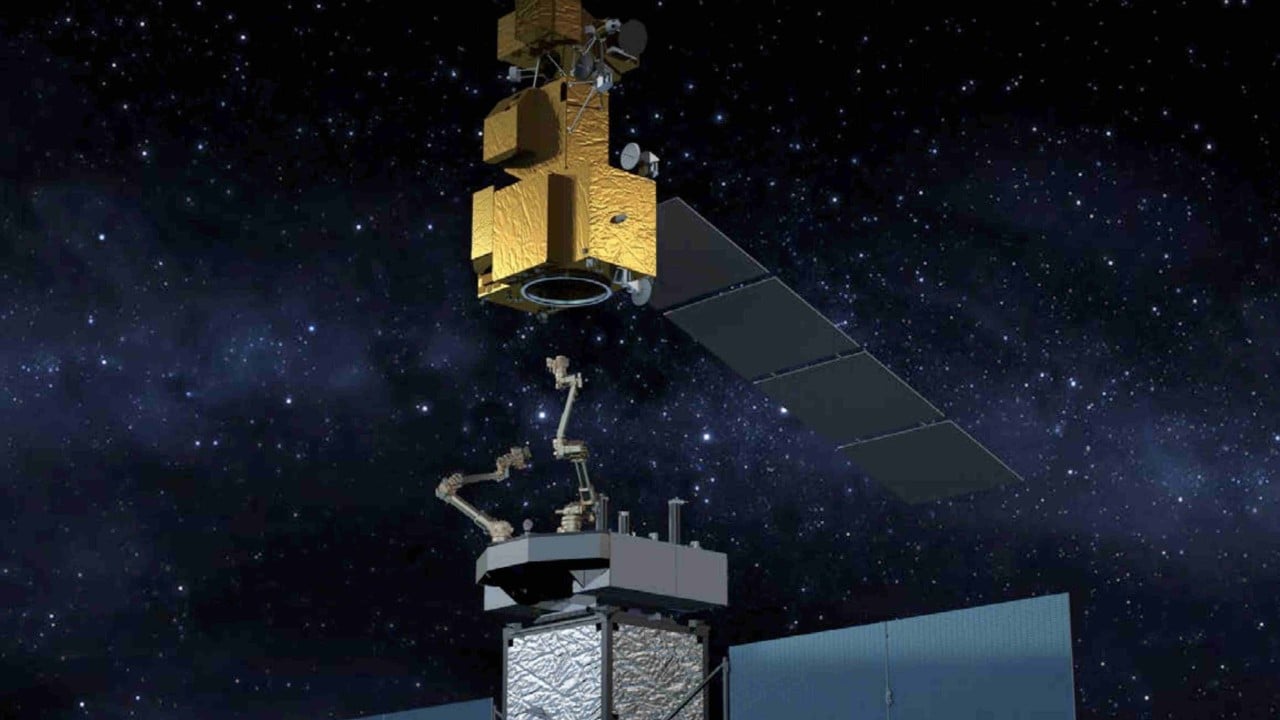
Orbital refueling sounds straightforward on paper, but executing it thousands of miles above Earth in microgravity is an engineering nightmare. According to findings published by researchers at the Deep Space Exploration Laboratory, the operation delivered roughly 142 kilograms of propellant to a high-altitude target.
Unlike rocket stages that rely on cryogenic fuels like liquid hydrogen or oxygen—which require intense, complex cooling apparatuses to prevent boil-off—this mission utilized storable chemical propellants. Storable propellants remain liquid for years without specialized thermal insulation or refrigeration, making the physical transfer process far less volatile.
Even so, matching orbits, docking autonomously at high altitudes, and pumping volatile liquids without blowing up millions of dollars of hardware requires extreme precision. Autonomous proximity operations have long been treated as the holy grail of orbital mechanics. When a servicing vehicle can locate, approach, latch onto, and replenish a non-designed-for-refueling satellite, the operational lifespan of constellations like BeiDou stretches from a standard decade to an indefinite timeline.
Strategic Anxiety and the New Gray Zone
While civilian space agencies love to talk about cost savings and reduced orbital debris, military planners look at the exact same technology and see a dual-use threat vector. The same robotic arm and autonomous guidance system required to dock with a satellite and inject 142 kilograms of fuel can easily be used to grab an adversary's asset, push it out of position, or disable its sensors.
This is why Washington and other Western capitals are tracking these developments with intense scrutiny. Space has become a high-stakes gray zone where the line between routine maintenance and offensive counterspace maneuvering blurs entirely.
Consider the strategic implications for global positioning systems. The BeiDou network forms the backbone of China's global navigation, timing, and military coordination architecture. If those geostationary and inclined geosynchronous satellites can be indefinitely refueled, the network gains unprecedented resilience. An adversary can no longer wait out a constellation's natural lifespan knowing that attrition will eventually degrade coverage. Instead, dead zones become avoidable, and orbital assets become permanent fixtures.
What Comes Next for Deep Space
The researchers behind the BeiDou operation aren't stopping at room-temperature chemical transfers. In their published findings, they emphasized that mastering cryogenic transfer technology is the mandatory next step for heavy spacecraft and upcoming deep-space missions. Pumping super-cooled liquid hydrogen across interplanetary distances is an entirely different beast, required for crewed lunar bases and Mars transits.
By proving that routine maintenance in high Earth orbit is possible, the operational threshold has dropped. The nations that dominate orbital servicing will write the rules of engagement for the next century of space exploration. Dismissing these milestones as minor technical tests is a fast way to get left behind in a race that is no longer about who can launch the most rockets, but who can keep them running forever.