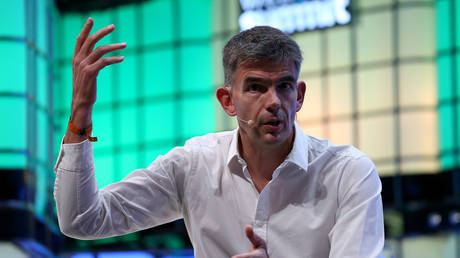
The British Broadcasting Corporation is currently patting itself on the back for "modernizing." By appointing a former Google executive as its new director, the board thinks it has secured a digital lifeline. They believe they’ve hired a visionary who can navigate the pivot from linear television to streaming dominance.
They are dead wrong.
This isn't a bold step into the future. It is a surrender. Bringing a Big Tech titan into the halls of a public service broadcaster is like hiring a shark to manage a nature preserve. The two entities operate on fundamentally incompatible DNA. One exists to serve the public interest through curated, high-quality information; the other exists to maximize "time on device" through addictive, low-effort feedback loops.
The consensus among media analysts is that the BBC needs "tech-first" leadership to survive. That consensus is lazy, dangerous, and ignores the wreckage of every other legacy industry that tried to out-Silicon Valley the Valley.
The Myth of the Neutral Platform
The biggest mistake the BBC’s governors are making is believing that "tech" is just a delivery mechanism. They think you can take the same BBC values—impartiality, depth, cultural relevance—and simply pour them into a more efficient funnel.
It doesn’t work that way.
When you hire from the upper echelons of Google, you aren't just buying technical expertise. You are importing an ideology. That ideology is built on the $A/B$ testing of human attention. In the world of Big Tech, content is "inventory." A documentary about the nuances of the Northern Ireland Protocol is treated with the same algorithmic weight as a video of a cat falling off a sofa, provided they both keep the user scrolling.
If the BBC begins to prioritize the metrics that made Google a trillion-dollar company—click-through rates, dwell time, and viral coefficient—it ceases to be a public service. It becomes a budget version of YouTube funded by a mandatory tax. If the content is dictated by what the algorithm predicts will "perform," the BBC loses the very thing that justifies its existence: the ability to tell people what they need to know, not just what they want to click on.
The Efficiency Trap
The "insider" argument for this hire is that the BBC is a bloated, bureaucratic mess that needs a Silicon Valley "disruptor" to trim the fat.
I’ve seen this play out in dozens of legacy media transitions. A high-priced exec walks in, looks at the balance sheet, and decides that original investigative journalism is "inefficient." Why spend six months and $£200,000$ on a single expose when you can hire twenty "content creators" to aggregate trending topics for a fraction of the cost?
In a tech-driven model, efficiency is the enemy of excellence.
- Public Service: High cost, high friction, high impact.
- Big Tech Model: Low cost, zero friction, massive volume.
By trying to bridge this gap, the BBC will end up in a middle-ground graveyard. It won't have the scale to compete with Netflix or Google on pure data, and it will have gutted the specialized departments that made it unique in the first place. You cannot optimize your way to cultural significance.
Why "Personalization" is a Death Sentence for Impartiality
We are told that the future of the BBC is "Personalized News." The new director will likely push for an iPlayer experience that knows exactly what you want before you do.
This is a direct assault on the BBC's charter.
The entire point of a national broadcaster is to provide a shared reality—a "common square" where a diverse population sees the same facts. Personalization is the architect of the echo chamber. If the BBC’s AI determines that you are a left-leaning urbanite, it will stop showing you content that challenges that worldview because that content causes "churn."
Google’s business model thrives on fragmentation. The BBC’s social contract relies on cohesion. You cannot have both. By leaning into the "User Experience" (UX) playbook, the new leadership is effectively dismantling the mechanism that prevents national polarization.
The Fallacy of the "Data-Driven" Creative
There is a persistent delusion that data can tell you what to create next. It can’t. Data can only tell you what people liked yesterday.
If the BBC had been "data-driven" in the 1970s, they never would have produced Monty Python. The data would have suggested it was confusing and lacked a clear demographic hook. If they were data-driven today, they would cancel every niche radio program on Radio 3 and Radio 4 and replace them with true-crime podcasts and celebrity gossip.
Google executives are trained to worship the data. But in the world of art and journalism, data is a rearview mirror. Leading a creative institution requires a "gut" that is willing to tell the audience they are wrong. It requires the bravery to produce something that fails the initial testing but changes the culture ten years later. Silicon Valley doesn't have the patience for that. They have quarterly targets and "burn rates."
The "Platform" Fallacy
"We aren't a broadcaster; we're a platform." Expect to hear this phrase repeated ad nauseam over the next twelve months.
It sounds sophisticated. It’s actually a white flag. When a media company calls itself a platform, it’s admitting it no longer wants the responsibility of being an editor.
The BBC’s value lies entirely in its editorial judgment. If it becomes a "platform" for third-party creators or a curated aggregator of "content," it becomes redundant. Why would I go to a BBC platform to find what I can already find on my phone, filtered through a better algorithm?
The BBC should be the anti-platform. It should be the place where the noise stops. Instead, they’ve hired someone whose career was built on increasing the volume of the noise.
The Cost of the "Google-fication"
Let's look at the actual mechanics of this transition. To "modernize," the BBC will need to invest billions in cloud infrastructure, data scientists, and proprietary AI models.
Where does that money come from? It comes from the programming budget. It comes from the regional newsrooms. It comes from the foreign bureaus.
You are witnessing a massive transfer of wealth from the creative economy to the tech economy. The BBC will pay millions to tech consultants and software vendors to build a "discovery engine" for content that no longer has the budget to be produced. It’s a Ferrari engine inside a cardboard box.
A Thought Experiment: The Algorithmic Riot
Imagine a scenario where a major civil unrest event occurs.
Under the old BBC model, the editors decide what the lead story is based on its importance to the democratic process. They send reporters to both sides. They provide context, even if that context is "boring" and causes people to tune out.
Under the new "Tech-Led" BBC, the homepage is dynamic. The algorithm notices that videos of the actual violence are getting 10x the engagement of the analytical pieces. To "maximize reach" and "meet the audience where they are," the violent footage is pushed to the top. The nuance is buried. The BBC, in its quest for digital relevance, ends up fueling the very fire it was supposed to document.
This isn't a hypothetical. This is how the platforms the new director comes from actually work.
Stop Trying to "Save" the BBC by Destroying It
The BBC doesn't need to be more like Google. It needs to be less like Google.
In an age of AI-generated slop and algorithmic manipulation, the only competitive advantage left is human-centered, high-integrity, expensive-to-produce journalism. That is a niche that Google cannot fill. That is a space that TikTok cannot occupy.
By hiring for "digital transformation," the BBC is signaling that it is ashamed of its own strengths. It is trying to play an away game on a pitch owned by its competitors.
If the BBC wants to survive, it should be doubling down on the things that don't scale. It should be hiring the most stubborn, difficult, and brilliant editors it can find—not the people who built the systems that made those editors obsolete.
The license fee is already under fire. The public is already skeptical. The moment the BBC starts looking and acting like just another Silicon Valley export is the moment the public stops paying for it. You don't pay a tax for a "platform." You pay a tax for a standard.
The BBC just traded its standard for a seat at a table where it isn't even a guest—it's the meal.
Stop looking for the next digital frontier and start defending the one we already have.