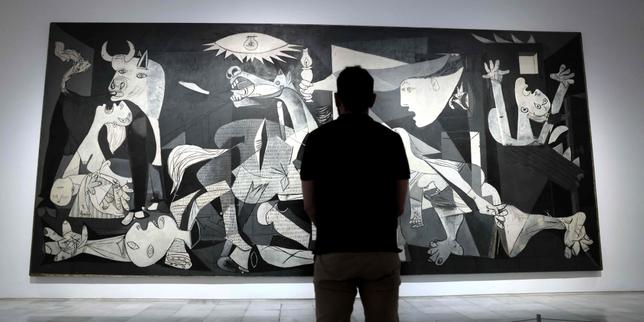
The request from the Basque Government to move Pablo Picasso’s Guernica from Madrid to Gernika is not a simple loan application. It is a political hand grenade. For decades, the Reina Sofía Museum has maintained that the painting is too fragile to travel, citing microscopic cracks in the canvas and the structural risks of rolling a work of this scale. Yet, beneath the technical jargon of art restoration lies a deeper, more volatile truth. The mural is the ultimate symbol of the Spanish Civil War, and where it hangs dictates who controls the narrative of Spain’s darkest hour.
The Basque Country wants the painting in the town that bears its name, the site of the 1937 Nazi aerial bombardment that inspired the work. Madrid refuses to let it go. This is a standoff between the centralized state and a region seeking to reclaim its historical trauma. It is an argument that has survived transitions of power, economic collapses, and the end of domestic terrorism, proving that in Spain, art is never just art. In similar developments, read about: The Invisible Clock and the Ghost of 1973.
The Myth of Permanent Fragility
Museum officials in Madrid frequently point to a 1998 report that labeled the painting "extremely fragile." They argue that any movement could cause irreparable paint loss. It is a convenient shield. While the physical condition of a nearly 90-year-old canvas is a legitimate concern, modern conservation technology has advanced significantly. Global masterpieces of similar age and complexity are moved with meticulous care every year.
The refusal is less about chemistry and more about the Reina Sofía’s status as a national powerhouse. Guernica is the museum's heart. It attracts millions of tourists and serves as the anchor for Spain’s modern art identity. To lose it, even temporarily, would be a blow to the capital’s cultural prestige and its tourism revenue. The Basque authorities know this, which is why their demands have shifted from a permanent transfer to a symbolic, short-term loan. Even that has been met with a wall of silence. USA Today has analyzed this important issue in extensive detail.
A Ghost Town Seeking Its Soul
To understand why this matters, you have to stand in the center of Gernika. The town was rebuilt after the 1937 carpet bombing, but the psychological scars remain. For the Basque people, the painting is a piece of their stolen history. Picasso painted it for the Spanish Republican government in exile, but he specifically intended it to depict the horror visited upon this specific town.
When the painting finally arrived in Spain in 1981, following Picasso’s wish that it only return once democracy was restored, it went to Madrid. The Basque Nationalists saw this as a second theft. They argue that the painting’s "natural home" is the place where the tragedy occurred. By keeping it in Madrid, the Spanish state continues to centralize the memory of the war, stripping it of its local, ethnic, and regional specificity.
The Technical Standoff
The Basque government has offered to build a custom, state-of-the-art pavilion specifically designed to house the mural. They have promised climate control systems that exceed the standards of the Reina Sofía. They have suggested using the same specialized transport crates used for international art exchanges.
Madrid’s response remains a consistent "no." This suggests that no amount of engineering or financial investment will satisfy the central government. The fear is not that the painting will break, but that once it enters the Basque Country, it will never come back. A "temporary loan" could easily turn into a decades-long legal battle over regional heritage rights.
Political Leverage in a Divided Parliament
The timing of the latest push is not accidental. The current Spanish government often relies on the support of Basque nationalist parties to pass legislation. This gives the Basque leadership a rare window of influence. They are no longer just asking; they are bargaining.
However, the Prime Minister faces a trap. Giving in to Basque demands would be viewed by the right-wing opposition as a betrayal of national unity. In the polarized climate of contemporary Spanish politics, Guernica is a symbol of the "One Spain" ideology. To the centralists, the painting belongs to all Spaniards, and therefore must remain in the capital. To the decentralists, this is a lingering shadow of the Franco era, where regional identities were suppressed under the boot of Madrid.
The Shadow of the Artist
Picasso himself never saw the painting in Spain. He died in 1973, two years before the dictator Francisco Franco. His instructions were clear regarding the restoration of democracy, but he was frustratingly vague about the specific geography of its permanent home.
The Reina Sofía interprets his silence as a mandate for the capital. The Basques interpret his subject matter as a mandate for Gernika. This creates a vacuum where both sides project their own desires onto a dead man’s intentions. The result is a stalemate that serves no one but the bureaucrats.
Beyond the Canvas
This conflict mirrors global debates over the restitution of cultural artifacts. From the Elgin Marbles in London to Benin Bronzes in Germany, the world is questioning who has the right to own history. Spain’s struggle is unique because it is internal. It is a fight between the center and the periphery of the same nation.
If the painting were to move, it would signal a massive shift in how Spain views its internal borders. It would be an admission that the regions have a valid claim to national symbols. For now, the mural remains behind thick glass in Madrid, a silent witness to a country that has yet to fully reconcile with its past. The cracks in the paint are real, but they are nothing compared to the cracks in the Spanish state.
Every year, the technical reports are updated. Every year, the Basque representatives make their pilgrimage to the Ministry of Culture. Every year, the answer is the same. The painting stays put. This suggests that the "fragility" of Guernica isn't a matter of canvas and oil, but a reflection of a democracy that still fears its own regional diversity. Until Madrid trusts the Basque Country with its most famous symbol of suffering, the wounds of 1937 will remain open, regardless of how many tourists stand in awe of Picasso's monochromatic nightmare.
Demand a transparent, independent audit of the painting's structural integrity by international experts unaffiliated with the Spanish Ministry of Culture.



