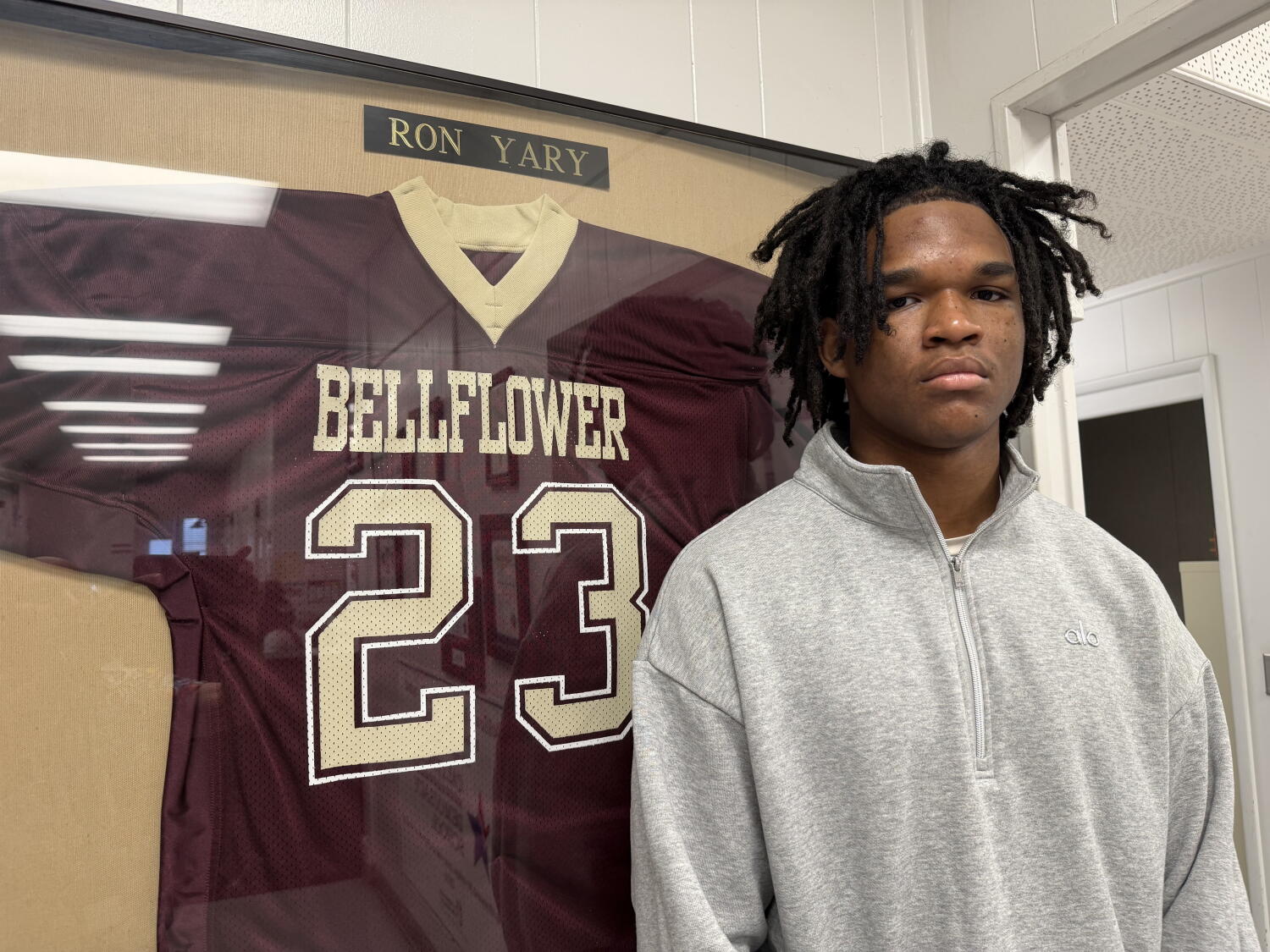
High school football talent acquisition in Southern California operates with the relentless precision of an industrial assembly line. Long before scouts turn their gaze toward Saturday afternoons in the Southeastern Conference or Sundays in the National Football League, prospects are forged on sun-baked fields across Los Angeles, Orange, and Riverside counties. Every few years, a specific program manages to capture the spotlight by producing a pass-catcher who defies conventional evaluation metrics. Bellflower High School's Austin Miller entered the regional consciousness carrying the weight of that exact lineage, positioned not merely as a productive high school target, but as the archetypal Southland wide receiver built for modern offensive systems.
Understanding how a prospect like Miller emerges requires looking past the highlight reels and examining the systemic infrastructure of regional prep football. Southern California operates as an incubator driven by private trainer circuits, seven-on-seven travel teams, and offensive coordinators who abandoned traditional run-heavy philosophies decades ago. Miller represents the convergence of specialized athletic training, evolving passing schemes, and the intense Darwinian pressure cooker that defines elite California divisions. Yet, anointing any teenager as the definitive next great star ignores the volatile transition between Friday night lights and collegiate realities.
The Evolution of the Southern California Perimeter Position
The modern Southland wide receiver looks nothing like the prospects who dominated the recruiting rankings twenty years ago. Yesterday's prototypical outside threat relied primarily on raw vertical speed or a towering frame to win contested jump balls against overmatched cornerbacks. Today's landscape demands much more. Spread offenses implemented from youth leagues onward require pass-catchers to possess advanced route-running geometry, elite spatial awareness against complex zone coverages, and the functional strength to defeat physical press techniques at the line of scrimmage.
Programs in CIF divisions face relentless pressure to adapt or become obsolete. Coordinators script plays that resemble collegiate playbooks, putting the onus on young receivers to decipher disguised coverages before the snap. Miller thrived within this demanding environment by mastering the subtle nuances of pacing routes. Instead of running at a flat, maximum velocity on every single snap, elite modern targets vary their cadence to manipulate defensive backs. They understand how to lean on a defender's hip, create microscopic separation at the break point, and present a reliable target for quarterbacks operating under heavy pass rushes.
This technical sophistication does not happen by accident. The rise of specialized offseason wide receiver academies fundamentally changed how raw athletic traits get converted into polished football skills. Long before players put on shoulder pads for official school practices, they spend countless hours on turf fields breaking down footwork mechanics on high-speed cameras.
The Offseason Industrial Complex
High school football coaching staffs no longer hold a monopoly on player development. The modern recruitment pipeline relies heavily on private trainers and independent seven-on-seven circuits that operate year-round. These environments expose prospects to elite competition from neighboring districts, forcing them to adapt to collegiate-level coverage schemes long before they graduate.
When evaluators assess a riser like Austin Miller, they look closely at how he performs against premier defensive backs in controlled camp settings. These venues strip away the schematic advantages that a high school coaching staff might manufacture through formation cleverness. A receiver must win one-on-one battles purely through technique, hand-eye coordination, and athletic leverage.
- Footwork Precision: Eliminating wasted motion in the initial three steps off the line of scrimmage.
- Catch Radius Extension: Developing the core flexibility to snatch poorly thrown balls away from the frame while maintaining forward momentum.
- Transition Speed: Accelerating out of horizontal cuts without losing stride length.
Critics of the modern seven-on-seven circuit argue that it breeds habits unsuited for traditional tackle football, such as soft blocking or an over-reliance on uncontested receptions. However, the benefits regarding route refinement and hand technique are undeniable. A prospect who survives the physical and mental grind of the Southern California summer circuit enters his senior campaign with a sophisticated understanding of defensive leverage that older generations only acquired during their freshman year in college.
The Recruiting Machine and Media Hyperbole
Public attention surrounding high school athletes creates an immense psychological hurdle. Media outlets, scouting services, and social media aggregators race to attach labels like "generational" or "elite" to teenagers who have barely filled out their physical frames. This constant digital noise alters how young players view their own progression, often rewarding flash over foundational substance.
Recruiting analysts face a difficult balancing act. Projecting a 17-year-old wide receiver onto a future Sunday roster requires separating legitimate physical traits from system-inflated statistics. A high school offense might target a primary playmaker fifteen times a game through designed quick screens and bubble routes, inflating reception totals without demonstrating the ability to win downfield against complex Cover-4 shells.
+---------------------------+     +----------------------------+     +---------------------------+
|   Raw Athletic Trait      | --> |   Specialized Academy/7v7  | --> |   Collegiate Transition   |
|   (Speed, Size, Fluidity) |     |   (Route & Hands Mastery)  |     |   (Physical & Mental Wall)|
+---------------------------+     +----------------------------+     +---------------------------+
When breaking down Miller's film, the most encouraging indicators are not the explosive touchdowns against overmatched secondary units. The real value lies in the routine plays. How does he block when the play goes to the opposite side of the field? Does he run his route with the same intensity when he knows he is merely a decoy? These intangible traits separate players who merely accumulate statistics from those who earn immediate playing time at the NCAA Division I level.
The Collegiate Reality Check
The jump from Southern California prep football to major college competition is arguably the most jarring transition in American sports. A prospect who routinely dominated games against local rivals suddenly finds himself matched against seasoned cornerbacks who possess equal speed, superior strength, and defensive playbooks thicker than a dictionary.
Many highly touted regional receivers hit a developmental wall during their first collegiate autumn. The physical demands of blocking defensive ends in the run game, combined with the mental burden of learning complex protections and route adjustments, frequently leads to redshirt seasons or quiet depth-chart relegation.
- Physical Adaptation: Adjusting to the speed and violence of collegiate collisions over a grueling twelve-game schedule.
- Playbook Complexity: Mastering multiple receiver positions rather than staying anchored to a single side of the formation.
- Trust Building: Earning the confidence of a new quarterback who cannot afford mental errors on third-down conversions.
Programs that recruit the Southland heavily understand these developmental hurdles. They look for prospects who possess not only the physical tools to stretch the field, but the internal drive to grind through the monotonous hours of film study and rehabilitation.
Beyond the Hype Cycle
The journey of Austin Miller serves as a lens through which the broader ecosystem of modern football development comes into sharp focus. The factory lines of Southern California will continue to churn out elite perimeter talent year after year, fueled by year-round training, intense local competition, and sophisticated offensive schemes.
Yet, the label of being the next great receiver carries an expiration date. Once the high school stadium lights power down and the recruiting letters are signed, the real test begins in empty film rooms and freezing winter weight rooms where potential finally meets execution.