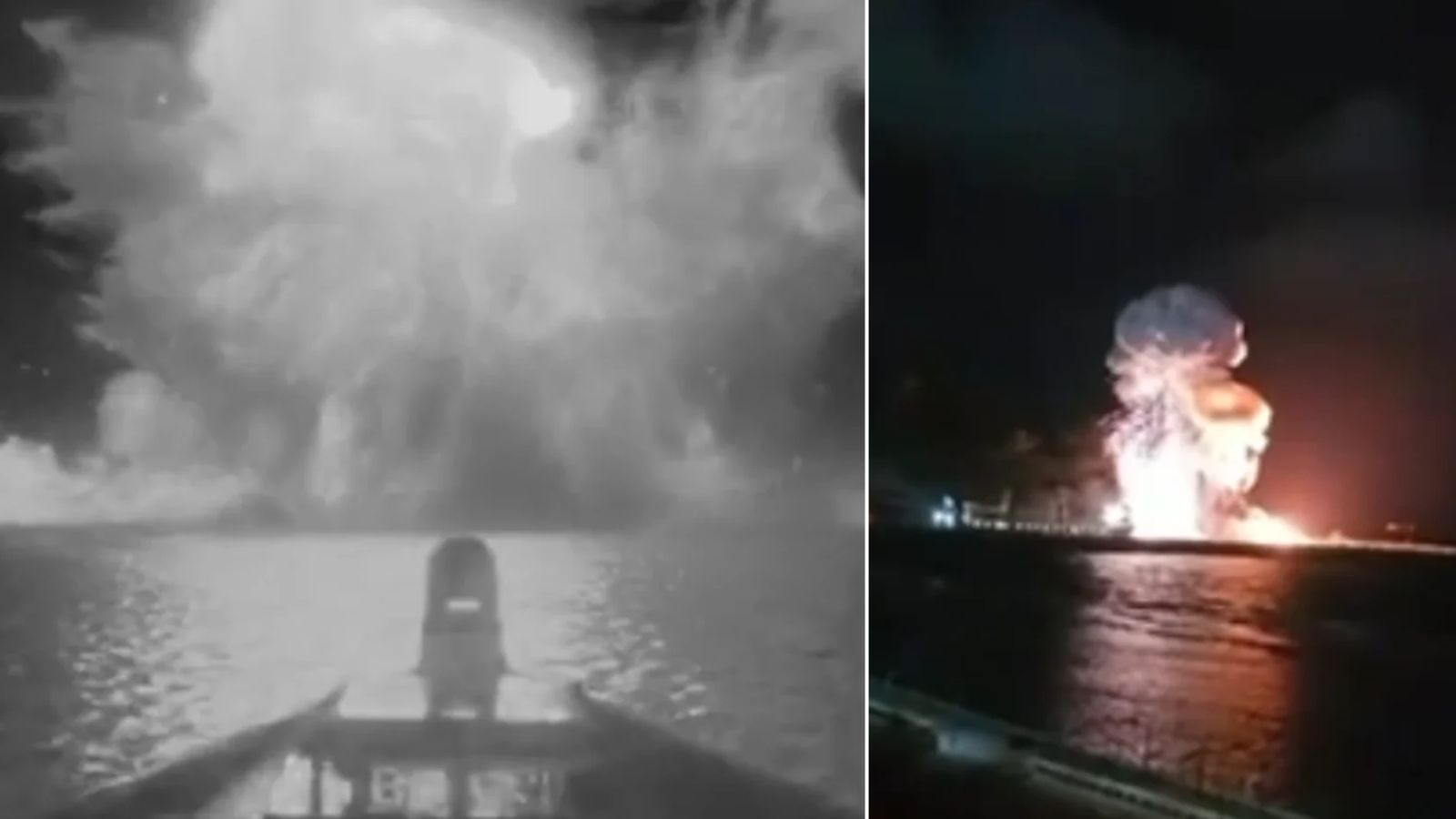
Claiming a maritime drone strike against a Russian naval vessel off the coast of Libya marks a structural shift from regional sea denial to globalized asymmetric power projection. For over two years, Ukrainian unmanned surface vessels (USVs) systematically dismantled the operational freedom of Russia’s Black Sea Fleet within a confined, semi-enclosed basin. Extending that operational envelope into the Central Mediterranean alters the strategic calculus of naval logistics, force protection, and geopolitical deterrence far beyond the immediate theater of war.
To evaluate the operational reality and strategic impact of such an operation, analysts must separate unverified tactical claims from established technological capabilities and maritime geography. A rigorous assessment requires breaking down the mechanics of long-range USV deployment, the vulnerabilities of expeditionary naval assets, and the broader economic and military consequences for Russian logistics in Africa and the Mediterranean.
The Geography of Expeditionary Vulnerability
The operational environment of the Black Sea differs fundamentally from the Mediterranean Sea. In the Black Sea, Ukrainian forces operate from domestic littoral infrastructure, launching USVs across distances ranging from 200 to 800 kilometers. The geography is constrained, predictable, and adjacent to Ukrainian intelligence, surveillance, and reconnaissance (ISR) networks.
The Central Mediterranean presents an entirely different set of physical and logistical variables. The straight-line distance from Odesa to the Libyan coast—specifically ports like Tobruk or Benghazi, where Russian logistical activity has concentrated—exceeds 2,000 kilometers, passing through the heavily monitored Bosporus and Dardanelles straits, the Aegean Sea, and open Mediterranean waters.
This geographic reality forces two distinct operational hypotheses regarding how a strike in Libyan waters could occur:
- Expeditionary Launch Platforms: Rather than transiting from Ukrainian ports, USVs are containerized, transported via commercial maritime or overland routes to friendly or permissive staging areas, and deployed from a covert mothership—such as a modified merchant vessel or fishing trawler—within operational range of the target.
- Clandestine Special Operations Staging: Small, modular USV components are smuggled into North Africa or a nearby Mediterranean littoral state, assembled locally by covert operatives, and launched from unmonitored coastal stretches.
Both models eliminate the need for trans-Mediterranean fuel endurance while bypassing Turkish naval inspections under the Montreux Convention. Under Article 19 of the Montreux Convention, Turkey closed the Turkish Straits to belligerent warships, effectively locking both Russian reinforcements out of the Black Sea and Ukrainian naval vessels inside it. Commercial vessels carrying containerized components, however, operate under standard maritime transit rights, creating a regulatory blind spot that asymmetric forces can exploit.
The Three Pillars of Long-Range USV Operations
Executing a precision maritime strike thousands of kilometers from a home port requires solving three sequential engineering and operational bottlenecks: propulsion endurance, beyond-line-of-sight communications, and terminal target acquisition.
1. Propulsion and Hydrodynamic Endurance
Standard Ukrainian USVs, such as the Magura V5 or Sea Baby, rely on internal combustion engines driving waterjets. While effective for high-speed terminal sprints (exceeding 40 knots) in the Black Sea, waterjet propulsion suffers from high fuel consumption relative to displacement. Extending operational range without a mothership requires either significant hull enlargement to accommodate larger fuel bladders—which increases radar cross-section (RCS) and visual detectability—or a hybrid operational profile. A hybrid profile utilizes low-RPM cruising speeds to maximize hydrodynamic efficiency over long transits, reserving high-output fuel burn strictly for the final penetration of a target’s defensive perimeter.
2. Beyond-Line-of-Sight Command and Control
Surface vessels operate near the water's surface, severely restricting radio-frequency line-of-sight due to the curvature of the Earth. At sea level, direct radio communication drops off within 20 to 40 kilometers. Operating off Libya requires uninterrupted satellite communications (SATCOM) capable of transmitting low-latency, high-bandwidth video feeds back to an operator while receiving precise steering commands.
Reliance on commercial SATCOM constellations introduces a critical single point of failure. Geofencing policies, terminal hardware restrictions, and localized electronic warfare (EW) jamming can sever the control link. To mitigate link loss, advanced USVs incorporate autonomous waypoint navigation using inertial navigation systems (INS) paired with multi-constellation Global Navigation Satellite Systems (GNSS). If communications are jammed in the terminal phase, onboard optical recognition algorithms must lock onto the target's silhouette and execute the final attack vector independently.
3. Terminal Lethality and Warhead Design
Sinking or mission-killing a modern naval vessel requires more than surface contact. Warships are built with compartmentalized hulls, damage control systems, and reinforced bulkheads. A surface detonation dissipates a substantial portion of its kinetic and thermal energy into the open air rather than into the hull structure.
To achieve catastrophic hull breach, USVs utilize shaped charges or explosively formed penetrators (EFPs) angled slightly downward to strike at or just below the waterline. The primary destructive mechanism is not the initial blast, but the subsequent progressive flooding that overwhelms the vessel’s pumping capacity and compromises longitudinal stability.
The Cost Function of Asymmetric Maritime Attrition
The economic asymmetry between unmanned surface platforms and traditional naval vessels remains the primary driver of modern maritime warfare. Constructing, equipping, and crewing a blue-water corvette, frigate, or amphibious landing ship requires hundreds of millions of dollars and years of industrial shipyard capacity. By contrast, an expendable USV costs between $250,000 and $500,000 and can be assembled in distributed, non-traditional manufacturing facilities within weeks.
This disparity creates an unsustainable exchange ratio for the defending navy:
- Capital Asymmetry: The attacker risks less than half a million dollars per unit; the defender risks an asset worth two to three orders of magnitude more, alongside highly trained naval personnel who cannot be rapidly replaced.
- Defensive Munition Economics: Intercepting a swarm of low-profile USVs using naval surface-to-air missiles in surface-attack mode or precision-guided munitions often expends defensive interceptors that cost more than the incoming drone itself.
- Maintenance and Dry-Dock Bottlenecks: Even when a USV fails to sink a warship, a hull breach requires dry-docking for structural repair. In the Mediterranean, Russia lacks secure, sovereign deep-water repair facilities. The Tartus naval facility in Syria offers limited maintenance infrastructure compared to Sevastopol, meaning a damaged Russian warship in the Mediterranean faces a perilous, unescorted transit back to the Baltic or Northern Fleets for major repairs.
Strategic Impact on Russia’s Mediterranean and African Posture
Russia’s naval presence in the Mediterranean—historically organized around the permanent Mediterranean Task Force—serves two critical strategic functions: projecting power along NATO’s southern flank and sustaining the logistical pipeline for Russian paramilitary and state operations across Africa (formerly the Wagner Group, now restructured under the Africa Corps).
Ports in eastern Libya, particularly Tobruk, have become vital transshipment hubs for moving heavy military hardware, ammunition, and personnel into Sudan, Mali, Burkina Faso, and the Central African Republic. Because heavy airlift capacity is constrained and expensive, Russia relies heavily on Ropucha-class landing ships and auxiliary cargo vessels operating out of the Mediterranean to sustain these landlocked African operations.
Introducing a credible USV threat to the Libyan littoral disrupts this logistical architecture in three immediate ways:
The Force Protection Tax
Russian warships and auxiliary vessels in the Mediterranean can no longer treat transit and port calls in North Africa as benign administrative movements. Every vessel must maintain high-readiness watch rotations, deploy dedicated small-caliber machine gun teams on deck, and keep electro-optical and radar sensors active continuously. This constant state of alert accelerates crew fatigue and mechanical wear on propulsion and sensor systems.
Port Vulnerability and Berthing Denial
Warships are most vulnerable when stationary or maneuvering at low speeds in confined port approaches. At anchor or moored alongside a pier, a ship loses its primary defensive advantage: maneuverability. If Libyan ports cannot guarantee perimeter security against low-profile surface drones, Russian commanders must keep vessels underway in open water, drastically increasing fuel consumption and complicating cargo offloading operations.
Intelligence and Attribution Ambiguity
Unlike the Black Sea, where any maritime strike is unambiguously attributed to Ukrainian state forces, the Central Mediterranean is a congested operational theater populated by NATO naval patrols, Libyan faction militias, commercial shipping, and intelligence vessels from multiple nations. Operating from covert maritime platforms creates intentional attribution ambiguity. Even when Kyiv claims responsibility to maximize psychological and political impact, the physical mechanism of deployment leaves adversaries uncertain about which commercial ships, ports, or regional actors facilitated the strike.
Operational Limitations and Countermeasures
While the prospect of globalized USV warfare presents severe challenges for conventional navies, unmanned surface platforms are not invulnerable. Their operational effectiveness degrades rapidly when confronted with specific environmental conditions and layered defensive doctrines.
First, sea state remains the ultimate physical constraint. Small USVs typically range from 5 to 8 meters in length with minimal freeboard. In sea states above 3 or 4 (wave heights exceeding 1.25 to 2.5 meters), hydrodynamic drag increases sharply, fuel efficiency plummets, and wave crests routinely obscure the vessel's electro-optical sensors and satellite antennas. Heavy weather in the open Mediterranean can neutralize a USV operation before it reaches its target zone.
Second, layered defense-in-depth neutralizes single-axis drone attacks. When conventional navies adapt their tactics, USV attrition rates climb steeply:
- Airborne ISR Integration: Maritime patrol aircraft and unmanned aerial vehicles equipped with synthetic aperture radar (SAR) can detect the wakes of small surface craft from high altitudes, stripping away the element of surprise.
- Rotary-Wing Interdiction: Shipborne helicopters armed with heavy machine guns or lightweight air-to-surface missiles remain the most effective counter-USV platform. A helicopter operates outside the drone's engagement envelope and possesses the speed and elevated vantage point required to track and destroy low-profile targets in cluttered sea states.
- Acoustic and Electro-Optical Barriers: Deploying floating physical booms around stationary vessels in port, combined with cooled thermal imaging cameras that detect the heat signatures of internal combustion engines against cold seawater, provides reliable terminal warning.
The Strategic Trajectory of Maritime Denial
Whether a specific strike off the Libyan coast represents a fully realized expeditionary capability or an isolated covert operation, the underlying trajectory of naval warfare is unmistakable. The proliferation of commercial satellite communications, off-the-shelf marine propulsion, and autonomous terminal guidance has decoupled naval strike power from traditional naval industrial bases.
A state no longer needs a blue-water navy, overseas military bases, or secure straits to threaten adversary warships in distant seas. By containerizing strike assets and utilizing commercial maritime routes as covert launch corridors, an asymmetric actor can impose a global force-protection tax on a superior naval power.
For naval planners and maritime security operators, the required adaptation is clear: fleet defense can no longer be bounded by regional conflict zones. Force protection protocols, port security standards, and counter-unmanned surface warfare (C-USV) doctrines must be applied universally across all expeditionary theaters, treating every commercial shipping lane and unmonitored littoral as a potential launch vector.



