The Caribbean Sea does not care about your legends. It swallows hulls, dissolves canvas, and grinds bone to fine white sand. For three centuries, the popular memory of piracy has been filtered through the lens of Hollywood romanticism—all flowing linen, witty banter, and clean, cinematic deaths.
The mud of a shallow Bahamian mangrove creek tells a brutal, different story.
It is a story written in charcoal and deformed lead.
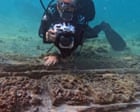
Marine archaeologists recently pulled the physical reality of the Golden Age of Piracy out of the muck of a remote island in the Bahamas. They did not find a chest overflowing with pristine Spanish doubloons. They found a scorched timber hull, scattered musket balls, and the utilitarian debris of desperate men. This was not a monument to adventure. It was a crime scene, preserved by the oxygen-starved silt of the tropics.
To understand what these artifacts mean, you have to scrape away the fiction of the swashbuckler. You have to stand in the suffocating heat of a 1720 mangrove swamp, swatting at sandflies, smelling the stench of rotting vegetation and your own unwashed skin, knowing that a Royal Navy frigate is hunting you down like a dog.
The Anatomy of a Panic
Consider the position of a sailor in the early eighteenth century. The War of the Spanish Succession had ended. Thousands of privateers—men legally commissioned by European monarchs to plunder enemy shipping—suddenly found themselves unemployed. The empires had used them, chewed them up, and spit them out into a peace-time economy that had no place for them.
They possessed exactly one marketable skill: violence.
The transition from state-sanctioned privateer to outlaw pirate was not a leap of ideological rebellion. It was a matter of survival. When Nassau became a pirate republic in the early 1700s, it was less a utopian collective and more a sprawling, chaotic refugee camp for the dispossessed of the Atlantic world.
The newly discovered wreck, located in a treacherous, shallow channel that larger naval vessels could never hope to navigate, reveals the exact tactical reality of this existence.
Pirates did not sail massive, multi-decked galleons. Blackbeard’s Queen Anne’s Revenge was the exception, a vanity project that eventually ran aground. The typical pirate vessel was small, fast, and shallow-drafted. A sloop. A schooner. Something that could skim over a sandbar where a thirty-gun British man-of-war would rip its keel out.
The Bahamas, with its labyrinth of over seven hundred islands and thousands of cays, was the perfect hideout. But it was also a trap.
Imagine the perspective of a young man on that unnamed ship. Let us call him Thomas. He is twenty-four, his teeth are loose from scurvy, and his back bears the permanent scars of a merchant captain’s cat-o'-nine-tails. For Thomas, this ship is not a vehicle of freedom; it is his only sanctuary. If he is caught, there will be no trial of his peers. There will be a short walk up a wooden gallows in Kingston or London, a thick hemp rope around his neck, and a corpse left to rot in an iron cage as a warning to other mariners.
The stakes were absolute.
The Evidence in the Muck
The archaeological team working the Bahamian site did not find the grand architecture of a ship. They found the bottom of the bucket.
When a vessel is burned to the waterline, the heavy elements sink straight down into the seabed, creating a footprint of the final moments. The presence of numerous musket balls scattered across the site indicates a ship prepared for close-quarters combat. These were not the standardized munitions of a disciplined imperial military. They were often hand-cast, irregular, and meant to shred flesh at short range.
Piracy was a business of intimidation, not artillery duels.
A pirate did not want to sink a prize; they wanted to capture it intact. The cannons were for show. The real work was done with muskets, pistols, and cutlasses on a blood-slicked deck. The concentration of ammunition on this wreck suggests a crew that lived in a constant state of tactical readiness. They knew they were being hunted.
Then there is the charcoal.
The hull timbers show unmistakable signs of intense burning. In the lore of the sea, ships catch fire by accident during battle, or through careless handling of black powder. The reality of the Bahamian mangroves suggests something far more calculated.
When a pirate ship was cornered, or when it became too fouled with barnacles and shipworms to be useful, it was often intentionally destroyed. A process called "breaming" involved burning off the weed and barnacles from the bottom of a wooden ship, a dangerous maintenance chore that could easily get out of hand. Alternatively, if a crew realized the Royal Navy had blocked the mouth of their creek, they would set fire to their own vessel.
Why? To deny the enemy the prize, and to destroy the evidence.
Imagine Thomas watching the flames consume the only home he had left. The smoke rises thick and black into the blue Caribbean sky, smelling of pine tar, oak, and burning salt. He and his shipmates are retreating inland, into the impenetrable wall of the mangroves, carrying nothing but their weapons and whatever rum they could salvage.
The ship sinks into the shallow water, hissed to sleep by the tide. The hunt is now on foot.
The Illusion of the Code
We have been told stories of the "Pirate Code"—the democratic articles signed by crew members that guaranteed equal shares of plunder and compensation for lost limbs. We want to believe that these men were early democrats, creating a proto-republic on the fringes of an oppressive world.
The artifacts tell a story of desperate improvisation, not political philosophy.
The material culture recovered from these shallow wrecks is remarkably spartan. It consists of cheap clay pipes, fragments of coarse ceramic storage jars, and the iron fittings of everyday maritime life. There is an absence of luxury. Even the most successful pirates spent the majority of their time hungry, wet, and terrified of disease.
A single wound from one of those recovered lead musket balls did not usually kill through immediate trauma. It killed through gangrene. A shattered bone meant a dirty hacksaw wielded by a shipmate on a grease-stained mess table, with nothing but a swig of high-proof spirits to numb the agony.
The transition from a functioning society to the life of a maritime outlaw was a descent into isolation. Once you crossed that line, you could never go home. You could never write a letter to your mother in Devon or your wife in Boston without risking her arrest for harboring a felon. You were dead to the world before you ever swung from the gibbet.
The Bahamian wreck reminds us that the Golden Age of Piracy was incredibly short. It lasted barely thirty years, peaking between 1716 and 1726. It was not a sustainable movement; it was a flash fire. The British Empire, realizing that international trade was the lifeblood of its rising global dominance, deployed the full, crushing weight of the Royal Navy to extinguish the threat.
They did not negotiate. They did not offer rehabilitation. They cleared the creeks.
The Weight of the Unseen
When you look at the photographs of the artifacts recovered from the Bahamas, it is easy to see just old metal and stained wood. You have to train your eyes to see the human hand that held them.
Someone cast that musket ball in an iron ladle over a smoky fire, wondering if it would be the one to pierce the chest of a British marine—or if a similar ball would find them first. Someone steered that ship into the shallow creek, desperate to hide from the sails on the horizon, praying the tide would hold.
The true value of this discovery is not that it validates our legends, but that it destroys them. It replaces the theatrical villain with a real, terrified human being who made a series of terrible choices in a world that offered him no good options.
The mangrove creek remains quiet now. The tourists drink cocktails on beaches just a few miles away, oblivious to the history buried in the mud beneath the roots. The water is clear, blue, and beautiful.
But if you dig deep enough into the silt, the water turns black with ash.