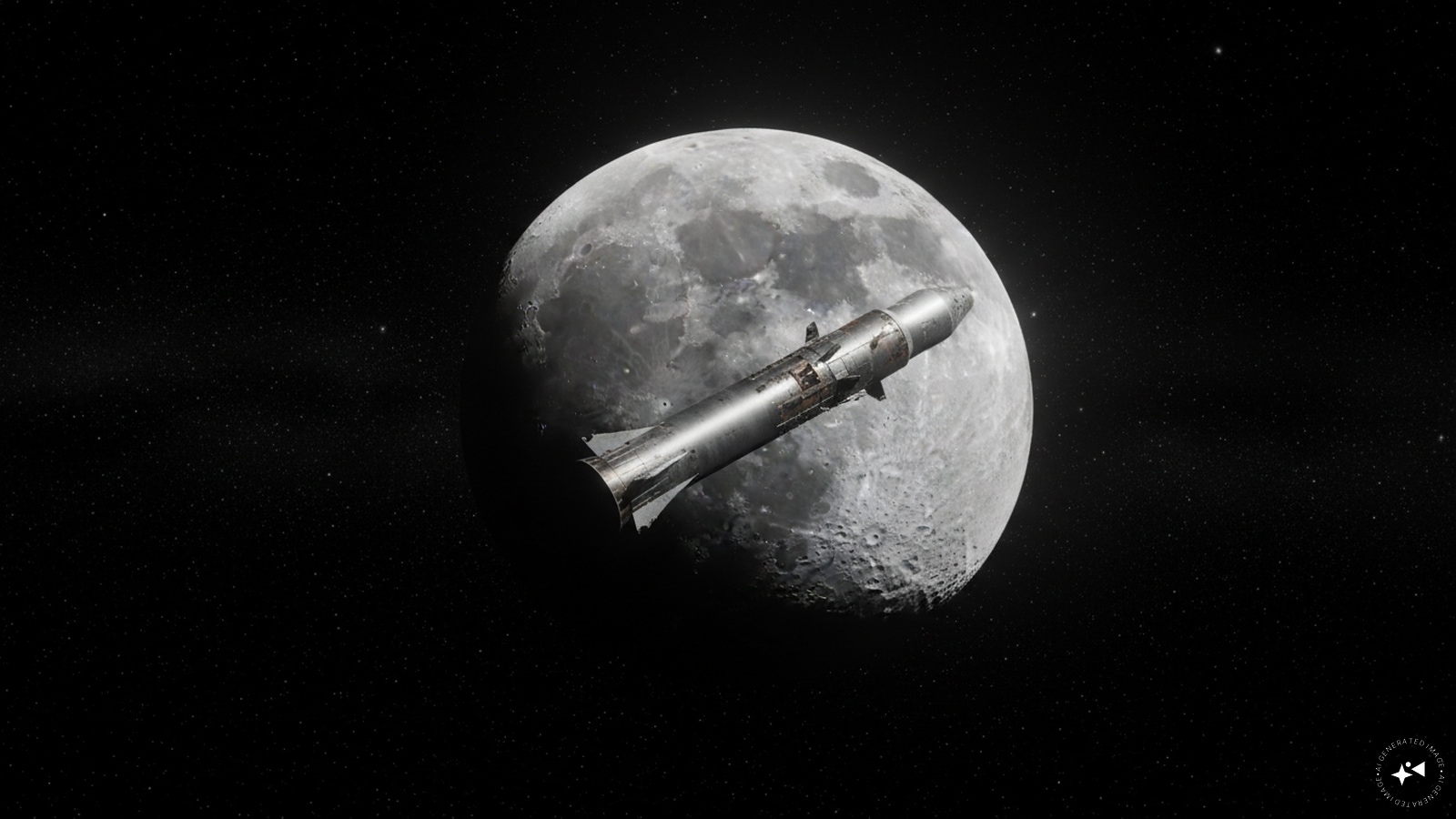
We are being sold a massive lie wrapped in shiny white thermal blankets.
The media wants you to watch the countdown clock. They want you to get misty-eyed over the crew selection. They want you to believe that sending four humans to loop around the moon and immediately come right back is a giant leap for humanity. For a more detailed analysis into this area, we recommend: this related article.
It is not. It is a wildly expensive, technically stagnant exercise in nostalgia.
The lazy consensus in aerospace reporting right now is a joke. Journalists are copy-pasting press releases about "paving the way to Mars." They treat the Space Launch System (SLS) and the Orion capsule as the pinnacle of human achievement. For further details on the matter, extensive coverage can also be found at Mashable.
They are ignoring the math. They are ignoring the economics. Worst of all, they are ignoring the actual path to becoming a multi-planetary species.
I have watched aerospace primes burn through billions of taxpayer dollars for over a decade, delivering hardware that belongs in a museum, not on a launchpad. If we do not call out the fundamental flaws of the Artemis program now, we are going to trap human spaceflight in another fifty-year cul-de-sac.
Let's dismantle the myth.
The SLS is an Astronomical Sunk Cost Fallacy
To understand why Artemis II is a step backward, you have to look at the rocket pushing it into the sky.
The Space Launch System is billed as our ticket back to the deep space arena. In reality, it is a Frankenstein's monster of legacy hardware designed to keep specific Congressional districts employed.
Let's look at the propulsion. The core stage uses RS-25 engines. If that sounds familiar, it should. Those are the exact same engines that powered the Space Shuttle. They are fantastic pieces of engineering, but they were designed in the 1970s to be reusable.
What are we doing with them now? We are throwing them into the ocean after every single launch.
Imagine buying a brand new Ferrari, driving it once from New York to Philadelphia, and then driving it off a cliff. That is the operational model of the SLS.
Here is the data that the cheerleaders do not want to talk about:
- Cost per launch: Conservative estimates place the cost of a single SLS launch at over $2 billion. Some independent audits push that closer to $4 billion when you factor in the overhead.
- Cadence: We can barely produce one of these rockets a year. You cannot build a sustainable off-world economy or even a permanent base on a launch cadence that slow.
- Performance: For all that cash, we get a heavy-lift vehicle that is entirely expendable.
The defense often thrown around is that we need this massive lift capacity and that private industry is not ready. That is a lie.
While NASA was spending twenty years trying to figure out how to stack Shuttle solid rocket boosters and stretch a tank, the private sector proved that vertical propulsive landing of orbital class boosters was not only possible but highly profitable.
By tying the return to the moon to a non-reusable, government-owned rocket, we are guaranteeing that the program will eventually be canceled when the public realizes just how much cash we are lighting on fire.
Orion is Too Heavy and Too Late
Now let's look at the capsule. The Orion Multi-Purpose Crew Vehicle is another exercise in compromise.
It is designed to keep astronauts alive for up to 21 days on its own, or longer when docked. Sounds great on paper. But because it had to be designed to survive the insane radiation environments of deep space while being light enough for the SLS to actually push, it has become a master of none.
It is too heavy for efficient cislunar transport. It relies on a European Service Module that has its own set of complex integration challenges.
More importantly, the architecture of Artemis II makes no sense for actual exploration.
The mission plan is a hybrid trajectory. Orion will go into a high Earth orbit to test systems, then burn for the moon, do a free-return trajectory around the far side, and fall back to Earth.
Notice what is missing? They are not landing. They are not even going into orbit around the moon.
We did this in 1968. Apollo 8 proved that humans could fly to the moon, orbit it, and come home. Apollo 13 used a free-return trajectory as a lifeboat maneuver. We are spending billions of dollars in the 2020s to replicate missions we aced before the invention of the microchip.
The nuance that the mainstream press misses is that risk reduction is not the same as progress. Yes, Artemis II reduces risk for Artemis III (the actual landing mission). But it does so at such a massive financial cost that it starves funding from the technologies we actually need.
What People Also Ask (And Why the Answers are Wrong)
If you look at public forums and search queries, people are asking the wrong questions because they have been fed the wrong narrative. Let's correct the record.
Is Artemis II necessary to test the heat shield?
The Establishment Answer: Yes, we need to test the Orion heat shield at lunar reentry speeds with humans on board to ensure safety.
The Truth: Testing a heat shield at lunar return velocities does not require a crew. We have sent uncrewed vehicles into high-energy atmospheric entries for decades. Risking a crew on a $4 billion orbital flight just to see if the glue holds on the Avcoat tiles is a failure of imagination, not a requirement of engineering.
Why can't we just use Starship or New Glenn?
The Establishment Answer: They are not flight-proven for human deep space transport yet, and the SLS is ready now.
The Truth: The SLS is "ready" only in the sense that it has flown once. It is a dead end. Starship is actively iterating. Even if private heavy-lift systems take another two years to fully dial in human rating, their cost architecture is orders of magnitude superior. We are sticking with SLS because of political inertia, not technical superiority.
Is going back to the moon worth the money?
The Establishment Answer: Yes, for science and to inspire the next generation.
The Truth: Going back to the moon is absolutely worth it, but not like this. We should be focusing on infrastructure. If we spent that $4 billion per launch on developing orbital fuel depots, lunar power grids, and automated resource extraction, we would create a permanent presence. Artemis is a flags-and-footprints campaign disguised as infrastructure.
The Strategy That Actually Works
If we want to actually settle space, we need to abandon the Apollo-style architecture entirely.
The focus of government agencies should not be building the rockets or the capsules. They suck at it. The bureaucracy guarantees that by the time a system is flight-ready, it is obsolete.
Instead, NASA should be the ultimate anchor customer for space commodities.
Imagine a scenario where the government stops building rockets and instead puts out a standing offer: "We will buy liquid oxygen on the lunar surface for $5,000 a kilogram. We will buy megawatt-hours of power on the South Pole of the moon."
Suddenly, you create a market. You leverage the intense competition of private capital.
Here is how you actually build a lunar economy:
Orbital Refueling is the Only Metric That Matters: The tyranny of the rocket equation means that if you launch from Earth with all the fuel you need to get to the moon, land, and come back, your payload is miniscule.
We need to master automated fluid transfer in zero gravity.
If we can launch bulk fuel on cheap, reusable commercial rockets and park it in Low Earth Orbit, any spacecraft can pull up, fill its tanks, and have massive delta-v capability for deep space missions. Artemis ignores this in favor of one big, expensive push.Standardize the Docking and Power Interfaces, Not the Vehicles: The internet succeeded because of TCP/IP, not because the government built all the computers.
NASA should dictate the strict physical and digital protocols for how ships connect, how power is transferred, and how communication happens. Let anyone build the ships, as long as they can plug in.Accept Higher Uncrewed Risk for Faster Iteration: We are terrified of failure because every SLS launch costs a significant percentage of the NASA budget.
If a rocket costs $20 million to build, you can blow up ten of them to find the flaw and still come out billions ahead. We need to stop hand-crafting golden balsa-wood gliders and start mass-producing steel ships.💡 You might also like: DeepSeek V4 Pro just broke the AI economy with its massive price cut
The Brutal Reality of Our Current Path
I am not anti-NASA. I am anti-waste.
The brilliant engineers working on Orion and SLS are doing incredible work within the constraints they have been given. But the constraints are political, not physical.
The downside to my contrarian approach is that it requires patience and a tolerance for visible failure. If a private company's test vehicle explodes on a pad, the media calls it a disaster. Under the current political climate, NASA cannot afford that kind of bad press, so they spend ten years and ten billion dollars analyzing everything on paper to make sure it works the first time.
That process is what kills us. It makes spaceflight so expensive that only governments can do it, which ensures it stays slow and rare.
Artemis II is going to happen. The crew will strap in, the four RS-25s and the solid rocket boosters will produce millions of pounds of thrust, and it will be a spectacular show.
But when the smoke clears and the Orion capsule bobs in the Pacific, ask yourself what we actually bought.
We bought a multi-billion dollar photo-op that does nothing to solve the actual problems of orbital refueling, radiation shielding for long-duration stays, or cost-effective heavy lift.
Stop cheering for the countdown. Demand an architecture that actually scales.