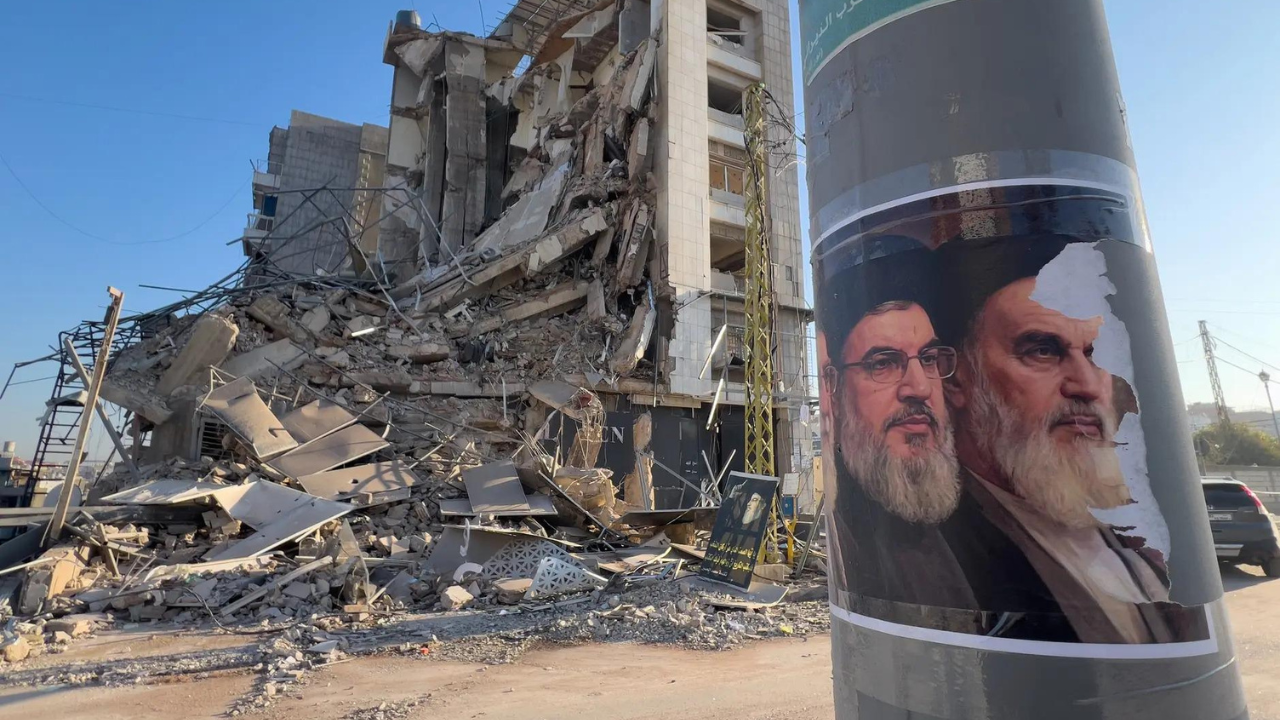
The trilateral framework signed in Washington by representatives of the United States, Israel, and Lebanon establishes a performance-based mechanism designed to systematically dismantle non-state armed infrastructure. By demanding a state monopoly on the use of force, the 14-point document aims to fundamentally alter the security architecture of the Levant. The strategic math governing this agreement relies on a strict sequencing model: the progressive withdrawal of the Israel Defense Forces (IDF) is structurally contingent upon the verified disarmament of all non-state armed groups, primarily Hezbollah, by the Lebanese Armed Forces (LAF).
However, this structural design creates an immediate operational paradox. By decoupling the formal agreement from the political reality of Hezbollah’s domestic veto power, the framework introduces an acute internal friction point. The core strategic challenge is not diplomatic consensus, but the enforcement capability of a weak sovereign state against a heavily armed, institutionalized non-state actor.
The Tri-Centric Strategic Friction Model
To evaluate the probability of execution, the framework must be analyzed through three competing, mutually exclusive operational mandates. Each actor operates under a distinct cost function and strategic baseline.
1. The Israeli Sovereignty Perimeter
The Israeli strategic objective is governed by a policy of strict geographic denial. The establishment of a security zone within the borders of the "Yellow Line" serves as physical leverage. The Israeli state has explicitly tied its military redeployment to a binary verification metric.
- The Baseline Imperative: Eradication of direct kinetic threats to northern communities.
- The Operational Mechanism: Maintaining a military presence in southern Lebanon as an enforcement guarantee until complete infrastructure dismantlement is verified.
- The Constraint Boundary: Rejecting partial pullbacks or timeline-based withdrawals, favoring a performance-based model where territory is exchanged exclusively for verifiable security asset destruction.
2. The Lebanese Sovereign Deficit
The Lebanese state seeks the restoration of its territorial integrity and the influx of conditional international reconstruction aid, including a promised $1.1 billion capital injection.
- The Baseline Imperative: Securing an IDF withdrawal to restore full border sovereignty.
- The Operational Mechanism: Deploying the LAF into designated "pilot zones" near the Yellow Line to assume security responsibility as a proof-of-concept.
- The Constraint Boundary: The structural asymmetry between the LAF’s operational capabilities and Hezbollah's entrenched military apparatus. The state lacks the coercive dominance required to disarm internal factions without risking institutional fragmentation.
3. The Hezbollah Resistance Veto
Hezbollah views total disarmament not as a diplomatic concession, but as existential capitulation. The organization’s rejection of the Washington agreement highlights a calculated defense of its dual-role status as both a political bloc and a parallel military authority.
- The Baseline Imperative: Preservation of armed strategic autonomy and deterrence capabilities.
- The Operational Mechanism: Exploiting its domestic positioning to threaten internal destabilization, explicitly warning that enforcement actions by the state will trigger structural collapse and civil conflict.
- The Constraint Boundary: The structural rejection of any disarmament framework extending beyond the geographic limits of the Litani River, viewing nationwide disarmament as a foreign imposition designed to disrupt its strategic alignment.
The Mechanics of the Pilot Zone Framework
The operational core of the agreement relies on a localized deployment model. Rather than attempting a nationwide security transition, the framework establishes two initial pilot zones adjacent to the Yellow Line. This design seeks to isolate the variables of disarmament and verification within a controlled geographic scope.
[Phase 1: IDF Security Line] ---> [Phase 2: Verified Disarmament of Pilot Zone] ---> [Phase 3: LAF Sovereign Control & IDF Redeployment]
The execution sequence is structured as a linear dependency chain:
- Threat Assessment: The IDF identifies specific non-state infrastructure within the pilot zone.
- Local Disarmament: The LAF is tasked with neutralizing the specified capabilities and establishing a state monopoly on force within that micro-sector.
- Verification: A newly created Military Coordination Group for Lebanon, facilitated by the United States, audits the zone to confirm the total removal of non-state military assets.
- Territorial Handover: Upon verification, the IDF redeploys out of the pilot zone, allowing the LAF to assume exclusive sovereign authority, which triggers targeted international reconstruction funding.
The structural limitation of this model is its vulnerability to a single failure point. If the LAF fails to achieve complete disarmament within the pilot zones due to internal political friction or tactical resistance, the sequence halts. The IDF maintains its security perimeter, international funds remain locked, and the status quo hardens into a permanent partition of authority.
Civil Dissension and the Threat of Fractional Collapse
The primary risk variable ignored by the formal text of the framework is the internal friction of the Lebanese political system. The warning of civil conflict issued by Hezbollah representatives is a rational calculation based on the historical distribution of coercive power in Lebanon.
When a state attempts to enforce a monopoly on violence without possessing a decisive advantage in force correlation, the targeted non-state actor has an incentive to raise the domestic cost of enforcement. Hezbollah’s tactical response relies on activating its domestic leverage points:
Legislative Decoupling
By branding the Washington negotiations as illegitimate and an attempt to bypass parallel regional diplomatic tracks, the group creates an absolute barrier to formal legislative ratification. The walkout of aligned ministers during initial cabinet deliberations underscores the state's inability to forge a legal consensus on disarmament.
Kinetic Deterrence via Civil Unrest
The rapid mobilization of protests and the blocking of critical infrastructure, such as the Beirut airport corridor, function as a signaling mechanism. The tactical message is clear: any attempt to operationalize the LAF against non-state positions will be met with asymmetric disruption in urban centers, shifting the theater of conflict from the southern border to the interior capital.
Structural Fragmentation of the State Military
The LAF is a multi-confessional institution whose internal cohesion depends on avoiding direct engagement in sectarian conflicts. Forcing the military to disarm a major domestic faction creates a high probability of institutional fracturing along confessional lines, replicating the mechanics of historical collapses.
Strategic Recommendation: Shifting from Absolute Disarmament to Managed Attrition
The current framework's insistance on absolute, immediate nationwide disarmament introduces a binary failure condition. To achieve a sustainable security equilibrium, the implementation strategy must shift toward a model of managed material attrition and financial isolation.
The United States and its regional partners must enforce a strict financial ring-fence around Lebanese reconstruction capital. The $100 million in immediate humanitarian assistance and subsequent infrastructure funding must be managed through an independent external escrow mechanism. This system must explicitly prevent capital leaks to entities or municipalities where non-state armed groups maintain operational influence.
The military strategy within the pilot zones must avoid direct kinetic disarmament confrontations in the near term. Instead, the LAF and the Military Coordination Group should focus on a strategy of geographic containment. By strictly controlling the import and transit of dual-use logistics through state-monitored ports of entry, the framework can structurally degrade the non-state actor's supply chains over time.
The final strategic play requires linking the progress of parallel regional diplomatic tracks directly to the ground realities of the pilot zones. The transition of authority cannot rely solely on the coercive power of the Lebanese state; it requires creating a condition where the external patrons of the non-state actor find the financial and strategic cost of maintaining a parallel military infrastructure in Lebanon higher than the benefits of a stabilized, state-managed border.