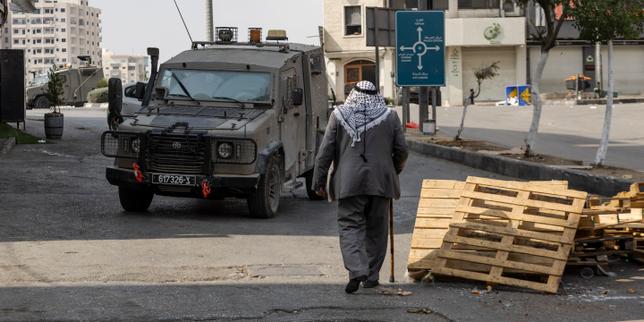
Military barricades in Hebron operate as an asymmetric spatial control system that converts physical infrastructure into an economic and psychological tax on the civilian population. Rather than functioning purely as reactive security perimeters, the checkpoints, concrete blocks, and closed thoroughfares in the West Bank city create a friction-heavy environment where the cost of daily movement escalates exponentially for non-combatants. Understanding the reality on the ground requires moving past anecdotal frustration and analyzing the structural mechanisms—legal, economic, and spatial—that transform localized security measures into what residents and international observers classify as collective punishment.
The Structural Anatomy of Partition in Hebron
Hebron is unique in the occupied West Bank because it is the only city with an Israeli settlement enclave embedded directly inside its historic urban core. This spatial entanglement is governed by the 1997 Hebron Protocol, which bifurcated the municipality into two distinct administrative and security zones.
- H1 (Palestinian Authority Control): Comprising roughly 80 percent of the city, this sector houses the majority of the Palestinian population and operates under Palestinian civil and security administration, though it remains subject to external perimeter closures and military incursions.
- H2 (Israeli Military Control): Encompassing the remaining 20 percent, including the Old City and the Ibrahimi Mosque (Cave of the Patriarchs), this sector is home to approximately 35,000 Palestinians and several hundred Israeli settlers protected by a dense deployment of the Israel Defense Forces (IDF).
This division establishes a nested sovereignty problem. When security incidents occur, or when military commanders assess elevated threat levels, the operational response relies on compartmentalization. Because the protected settler population and the Palestinian majority inhabit overlapping street grids, the military separates them by severing pedestrian and vehicular arteries. The resulting architecture relies on physical barriers—turnstiles, metal detectors, concrete Jersey barriers, and welded-shut storefronts—that permanently alter the urban topology.
The Friction Coefficient of Daily Movement
To evaluate the impact of these barricades, one must measure the friction introduced into routine human logistics. In urban planning, friction of distance refers to the time, cost, and effort required to overcome spatial separation. In H2, military infrastructure artificially inflates this friction to near-infinite levels along specific vectors.
A commute that covers 400 meters in a straight line frequently requires a two-kilometer detour due to "sterile" roads—thoroughfares like Al-Shuhada Street where Palestinian vehicular and pedestrian traffic is strictly prohibited. The second limitation involves temporal unpredictability. Checkpoints do not operate on fixed schedules; they are subject to sudden closures, extended identity checks, and arbitrary delays.
This unpredictability destroys scheduling reliability. A worker cannot guarantee arrival times at a job site; a student cannot reliably reach a university lecture; an ambulance cannot calculate a deterministic route to a hospital. When an infrastructure system introduces high variance into basic transit times, rational actors are forced to abandon activities that depend on punctuality. The barricades do not merely slow down the population; they systematically decouple residents from the regional economy and social services.
Economic Asphyxiation and the Hollowing of the Old City
The commercial impact of spatial fragmentation follows predictable macroeconomic principles. Retail and service economies rely on foot traffic, supply chain fluidity, and low transaction costs. The barricades in Hebron systematically eliminate all three variables within the H2 sector.
- Supply Chain Severance: Commercial vehicles are barred from entering large swaths of the Old City. Merchants must unload goods at perimeter checkpoints and transport inventory manually via handcarts or on foot. This labor-intensive last-mile delivery increases the cost of goods sold (COGS) while simultaneously reducing the volume of inventory a business can maintain.
- Customer Base Evaporation: Because non-resident Palestinians face severe access restrictions and invasive screening to enter H2, the consumer pool shrinks to the immediate, increasingly impoverished local residents. External demand drops to zero.
- Capital Flight and Asset Abandonment: Facing collapsing revenues and rising operational friction, business owners liquidate inventory and shutter operations. Over 1,800 Palestinian commercial establishments in the Old City have closed since the second intifada, either by direct military order or through economic attrition.
This economic hollowing creates a self-reinforcing downward spiral. As shops close, foot traffic decreases further, making the remaining businesses less viable and the streets more isolated. The physical degradation of abandoned storefronts reinforces the perception of a ghost town, accelerating out-migration among families with the financial means to relocate to H1 or other West Bank cities.
The Legal and Psychological Architecture of Collective Punishment
The term "collective punishment," frequently invoked by Hebron residents, carries a specific definition under international humanitarian law. Article 33 of the Fourth Geneva Convention explicitly prohibits punishing protected persons for an offense they have not personally committed.
The core analytical tension lies in the divergence between military intent and civilian outcome:
- The Military Security Doctrine: Israeli defense officials categorize barricades, curfews, and movement restrictions as preventative security measures designed to neutralize asymmetric threats, protect a vulnerable civilian enclave, and maintain operational control over high-friction terrain. Under this framework, civilian disruption is framed as collateral friction necessary to preserve life.
- The Civilian Reality and Legal Critique: Human rights organizations and legal scholars argue that when restrictions are applied indiscriminately across an entire demographic group based on geographic residence rather than individualized suspicion, the measures cross the threshold into collective penalty. When a barricade remains in place for years, outlasting any immediate tactical threat, its function shifts from temporary defense to permanent demographic and spatial restructuring.
Psychologically, this environment induces chronic hypervigilance and learned helplessness. The arbitrary nature of checkpoint enforcement—where passage granted in the morning may be denied in the afternoon without explanation—strips individuals of personal agency. Residents experience a persistent state of low-grade trauma, compounded by the visual dominance of surveillance cameras, watchtowers, and armed patrols overlooking private courtyards and rooftops. The home ceases to function as a private sanctuary, becoming an extension of a monitored perimeter.
The Feedback Loop of Asymmetric Escalation
From a systems-theory perspective, reliance on rigid physical barriers to manage a densely populated urban environment generates counterproductive second-order effects. While barricades successfully reduce immediate tactical exposure for protected enclaves in the short term, they degrade long-term strategic stability through three distinct mechanisms.
First, physical separation eliminates routine, non-conflictual human contact between populations, hardening mutual dehumanization and reducing the space for local de-escalation. Second, the economic devastation of H2 creates a concentrated pocket of acute poverty and youth unemployment—conditions historically correlated with political radicalization and recruitment into militant networks. Third, the visible asymmetry of the infrastructure—where one population uses paved, unobstructed roads while the other navigates caged turnstiles—entrenches generational resentment that outlasts any single political cycle or military operation.
Strategic Imperatives for De-escalation and Structural Reform
Resolving the operational deadlock in Hebron requires dismantling the feedback loops that convert security infrastructure into permanent civilian attrition. Tactical adjustments to checkpoint staffing will not alter the trajectory; the spatial and economic mechanics must be recalibrated.
International mediators, donor agencies, and municipal authorities must bypass stalled macro-political negotiations and target the immediate friction points within H2. Funding and diplomatic capital should be directed toward establishing guaranteed commercial corridors for Palestinian supply vehicles, legally decoupling civilian transit routes from military security perimeters, and subsidizing the rehabilitation of abandoned Old City infrastructure to reverse capital flight. Without restoring basic logistical predictability and economic viability to the urban core, the barricades will continue to manufacture the exact instability they were erected to contain.