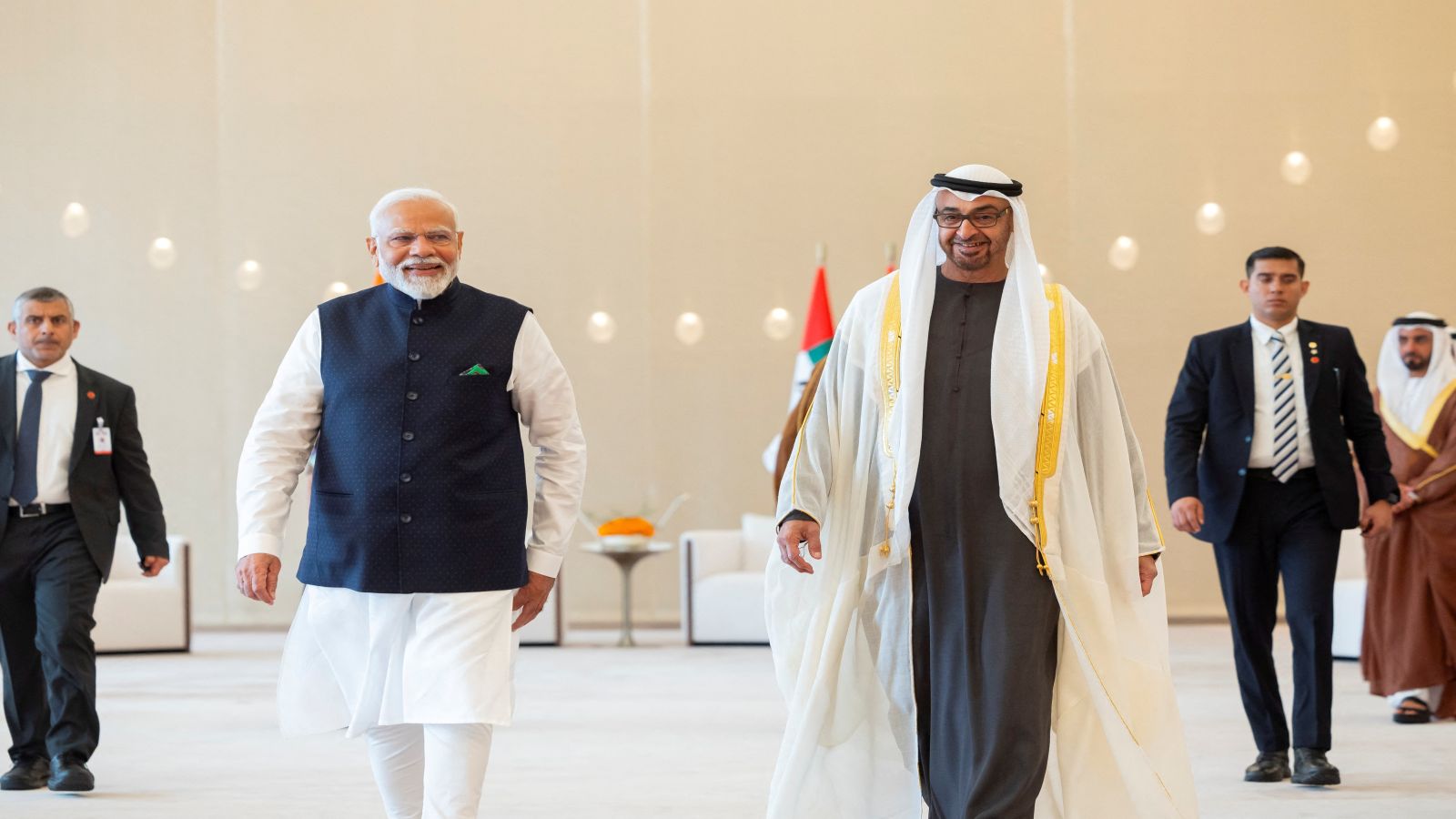
Bilateral statecraft is frequently mischaracterized as a series of isolated transactional triumphs. The $5 billion capital injection, strategic hydrocarbon expansions, and supercomputing frameworks finalized during the mid-2026 diplomatic summit in Abu Dhabi are not merely reactive agreements; they represent a calculated, structurally hedged realignment designed to solve asymmetric domestic vulnerabilities for both India and the United Arab Emirates (UAE). By dissecting the underlying economic mechanisms, the capital deployment architecture, and the geopolitical calculus of this summit, we can map how both nations are converting volatile transactional dependencies into permanent structural equity.
The strategic imperative operates on a two-way transmission mechanism:
+------------------------------------------------------------------------+
|                      THE DUAL TRANSMISSION MECHANISM                    |
+------------------------------------------------------------------------+
|                                                                        |
|  [ INDIA'S STRUCTURAL REQUIREMENT ]   [ UAE'S DEPLOYMENT IMPERATIVE ]  |
|  - De-risk energy import supply      - Convert immediate oil rents     |
|    chains against maritime shocks.     into long-term yield assets.    |
|  - Absorb long-term foreign capital   - Anchor sovereign wealth within  |
|    to fund infrastructure scaling.     the world's fastest-growing     |
|  - Establish sovereign compute        demographic and consumption hub.  |
|    independency (AI sovereignty).                                      |
|                                                                        |
+------------------------------------------------------------------------+
The Hydrocarbon Arbitrage: Converting Rents into Residual Sovereignty
The core of the summit centers on an expanded Memorandum of Understanding between Indian Strategic Petroleum Reserves Limited (ISPRL) and the Abu Dhabi National Oil Company (ADNOC). To evaluate the true weight of this agreement, one must audit the baseline structural vulnerabilities of India's energy architecture.
During the 2024–2025 fiscal period, the UAE functioned as India’s fourth-largest crude supplier, accounting for roughly 11% of total imports, and its primary source of Liquefied Petroleum Gas (LPG), fulfilling nearly 40% of aggregate domestic demand. However, pure transactional import models expose the purchasing nation to severe supply-chain shocks, particularly given that the bulk of these volumes must pass through the Strait of Hormuz—a maritime chokepoint highly susceptible to regional geopolitical friction.
The updated ISPRL-ADNOC framework mitigates this vulnerability via an onshore storage expansion model. Under this agreement, ADNOC is slated to store up to 30 million barrels of crude oil within India's strategic underground rock caverns, specifically utilizing the existing facility at Visakhapatnam and upcoming phases in Chandikhol, Odisha.
The transaction architecture operates as a mutual financial and physical hedge:
- The Indian Operational Advantage: India gains immediate, localized physical access to a massive inventory of crude inside its sovereign borders. In a severe maritime blockade or systemic supply disruption, the bureaucratic and logistical lag of cross-ocean transport is erased. This effectively extends India’s strategic fuel runway without requiring the immediate outlay of state capital to purchase the underlying wet volumes.
- The UAE Commercial Advantage: ADNOC avoids the cost of maintaining uncommitted, floating storage while establishing a permanent physical inventory directly inside its fastest-growing demand market. Furthermore, the clause permitting the reciprocal storage of Indian crude reserves at Fujairah grants India an operational staging ground outside the Persian Gulf, decoupling a portion of its emergency supply from the immediate geography of West Asian conflict zones.
Parallel to crude optimization, the strategic collaboration between Indian Oil Corporation Limited (IOCL) and ADNOC to establish long-term LPG and LNG supply frameworks structuralizes what was previously a series of spot and short-term purchase agreements. By locking in a comprehensive sale-and-purchase architecture with ADNOC Gas, India creates a predictable cost function for its domestic energy transition, shielding its manufacturing and residential sectors from macro price spikes.
Capital Dispersal Mechanics: Deconstructing the $5 Billion Facility
The announced $5 billion capital deployment from UAE entities into the Indian market avoids the traditional, volatile avenues of foreign portfolio investment. Instead, it utilizes targeted, institutional deployment vehicles designed to address specific capitalization bottlenecks within the Indian macroeconomic landscape.
+------------------------------------------------------------------------+
|                 $5 BILLION CAPITAL ALLOCATION BREAKDOWN                |
+------------------------------------------------------------------------+
|                                                                        |
|  [ $3.0 BILLION ] --> Emirates New Development Bank (ENDB)            |
|                       Target: RBL Bank / Tier-1 Private Banking        |
|                       Mechanism: Balance Sheet Optimization            |
|                                                                        |
|  [ $1.0 BILLION ] --> Abu Dhabi Investment Authority (ADIA)            |
|                       Target: National Infrastructure & Investment Fund|
|                       Mechanism: Long-Duration Equity Co-Investment   |
|                                                                        |
|  [ $1.0 BILLION ] --> International Wealth & Sovereign Allocation       |
|                       Target: Samman Capital / Specialized Credit      |
|                       Mechanism: Non-Bank Credit & Real Estate Funding |
|                                                                        |
+------------------------------------------------------------------------+
The first component—a $3 billion allocation from the Emirates New Development Bank (ENDB) into India's RBL Bank—is an aggressive play in commercial banking optimization. In rapidly expanding economies, domestic private banks face persistent capital-adequacy pressures as credit demand outpaces local deposit mobilization. By injecting deep, sovereign-backed institutional capital directly into a mid-tier commercial banking node, the UAE alters the credit multiplier equation. This capital infusion expands the bank's lending capacity for mid-market corporate borrowers and capital-intensive domestic enterprises without diluting public equity structures or triggering inflationary domestic debt issuance.
The second component involves a $1 billion co-investment facility structured between the Abu Dhabi Investment Authority (ADIA) and India’s National Infrastructure Investment Fund (NIIF). This allocation addresses the structural duration mismatch that plagues developing infrastructure ecosystems. Infrastructure projects require long-gestation, low-velocity capital characterized by 20-to-30-year payback horizons. Domestic commercial banks, burdened by short-term asset-liability mismatches, cannot safely fund these projects at scale. ADIA’s sovereign wealth, by definition patient and yield-focused over generational timelines, absorbs this specific risk profile. The capital is directly funneled into Greenfield logistics corridors, industrial parks, and the newly finalized maritime ship-repair cluster at Vadinar in Gujarat.
The final $1 billion slice, directed via sovereign vehicles into Samman Capital, targets the specialized credit markets. By anchoring non-banking financial companies (NBFCs), this tranche ensures liquidity filters down to secondary real estate and localized industrial developments that fail to meet the rigid compliance checkboxes of primary state-owned banks. The macro-level consequence of this entire $5 billion architecture is clear: it systematically lowers the cost of capital across multiple tiers of the Indian economy while providing the UAE with diversified, high-yielding yield assets that are completely decoupled from the long-term structural decline of fossil fuel valuations.
Compute Sovereignty and Sovereign AI: The Exaflop Supercomputer Alliance
The agreement to construct an eight-Exaflop Supercomputer Cluster represents a fundamental shift away from simple technological trade toward hard infrastructure codependency. Jointly executed by India's Centre for Development of Advanced Computing (C-DAC) and the UAE’s state-backed technology vanguard, G42, this initiative tackles a profound geoeconomic threat: the monopolization of advanced compute architecture by a handful of Western and East Asian hyperscalers.
In advanced technology, an Exaflop represents the capacity to execute one quintillion ($10^{18}$) calculations per second. By co-developing an eight-Exaflop facility, the partnership creates an independent computational core that serves distinct national objectives for both participants.
For India, this cluster supercharges the national IndiaAI Mission. Compute capacity is currently the primary bottleneck for sovereign large language model development, genomic research, and localized climate modeling. Relying on external cloud infrastructure exposes sovereign data to foreign legislative reach and volatile pricing structures. The C-DAC and G42 collaboration establishes a localized, hardware-independent environment where proprietary models can be trained on domestic data architecture.
For the UAE, partnering with India provides access to a massive engineering and data science workforce that matches its own substantial sovereign capital reserves. Rather than acting as a passive buyer of Western technology stacks, the UAE embeds itself as a co-owner of foundational computing infrastructure. This framework establishes a critical precedent for middle-power tech sovereignty, demonstrating how nations can bypass traditional tech-monopoly chokepoints by pooling capital, data, and specialized human resources.
Maritime Infrastructure and the Vadinar Ship Repair Cluster
The creation of a specialized ship-repair and maritime infrastructure cluster at Vadinar, Gujarat, paired with structured skill development agreements, bridges the gap between domestic manufacturing goals and global logistical realities.
India’s geographic positioning commanding the Indian Ocean sea lines of communication has historically stood in sharp contrast to its limited domestic maritime servicing capabilities. A significant percentage of Indian-owned or Indian-bound commercial vessels are currently forced to utilize dry-dock and maintenance facilities in Singapore, Colombo, or the Middle East due to lack of deep-water repair infrastructure and certified specialized labor at home. This structural leakage drains foreign exchange and creates operational dependencies during maritime crises.
The Vadinar development alters this equation by integrating real estate, capital, and technical upskilling into a singular localized ecosystem. By constructing heavy dry-dock capabilities at a strategic point near major western Indian ports, the project captures the domestic vessel servicing lifecycle.
The inclusion of formal maritime skill-development frameworks ensures that the workforce scales alongside the physical infrastructure, transforming low-yield labor pools into highly certified maritime engineering professionals. This aligns precisely with India's long-term industrial policy to position itself as a resilient alternative hub for global shipbuilding and vessel maintenance, while reinforcing the UAE's broader strategy of owning critical nodes along international trade lanes.
Systemic Risks and Structural Vulnerabilities
To maintain analytical integrity, this strategic partnership must not be evaluated without examining its inherent vulnerabilities. No cross-border economic framework is immune to friction, and the India-UAE axis contains distinct structural vulnerabilities that could disrupt execution metrics:
+------------------------------------------------------------------------+
|                     SYSTEMIC PARTNERSHIP VULNERABILITIES               |
+------------------------------------------------------------------------+
|                                                                        |
|  [ GEOPOLITICAL FRACTURES ] ----------------------------------------+  |
|  - UAE's exposure to direct regional missile and drone threats.      |  |
|  - Conflicting multilateral alignments (e.g., BRICS vs Western ties)|  |
|                                                                        |
|  [ REGULATORY & TRANSLATION RISK ] ---------------------------------+  |
|  - Bureaucratic delays within Indian state-level clearances.          |  |
|  - Local Currency Settlement (LCS) FX volatility challenges.           |  |
|                                                                        |
|  [ COGNITIVE & DATA ASYMMETRY ] ------------------------------------+  |
|  - Divergent national data privacy and sovereign AI governance laws.   |  |
|  - Execution friction between fast UAE capital and slow Indian infra.  |  |
|                                                                        |
+------------------------------------------------------------------------+
First, the geopolitical exposure of the Gulf region remains an unhedged variable. As demonstrated by recent regional tensions, the physical assets of the UAE—including its export terminals and production infrastructure—remain vulnerable to asymmetric regional threats. Should a wider regional crisis close or severely restrict passage through the Strait of Hormuz, the long-term LPG supply agreements could face force majeure declarations, testing the real-world limits of India’s onshore strategic storage caverns.
Second, the execution of large-scale infrastructure investments within India routinely faces bureaucratic hurdles, complex land acquisition laws, and shifting state-level regulatory frameworks. The ADIA-NIIF $1 billion allocation will require highly disciplined project-management governance to avoid the multi-year deployment delays that have historically plagued Indian public-private partnerships.
Finally, the Local Currency Settlement (LCS) system, while designed to de-dollarize bilateral trade, introduces currency conversion and liquidity challenges. If bilateral trade balances tilt too heavily in one direction, the accumulation of non-convertible currency reserves could create structural friction for corporate balance sheets trying to repatriate profits or reallocate capital globally.
The Strategic Recommendation
To maximize the ROI of this geopolitical realignment, corporate planners, treasury managers, and industrial strategists must move beyond treating these announcements as mere policy headlines and execute concrete operational adjustments.
For enterprise energy consumers, the stabilization of the India-UAE hydrocarbon framework dictates an immediate transition away from volatile spot-market pricing toward multi-year procurement contracts. The formalization of the ADNOC-IOCL supply pipeline ensures that domestic infrastructure will have prioritized access to physical volumes during global crunches. Corporate logistics and supply-chain architectures should immediately project the baseline cost of energy inputs using these structured frameworks, utilizing the reduced risk premium to optimize capital expenditures elsewhere.
For technology and enterprise software entities, the establishment of the eight-Exaflop G42-C-DAC cluster signals that sovereign AI infrastructure is transitioning from a theoretical concept to a deployable reality. Technology leaders should immediately audit their long-term data localization strategies and begin building compatibility protocols for sovereign compute clouds.
As the IndiaAI Mission gains hardware independence, reliance on international hyperscalers will present escalating regulatory and compliance hurdles. Early migration of core training architectures to localized, sovereign-backed compute nodes will yield a structural cost and compliance advantage as national data-governance laws tighten across both jurisdictions.
The following broadcast offers an expanded strategic breakdown of how these bilateral agreements are restructuring trade corridors and energy networks across the Indo-Mediterranean axis: India and UAE Deepen Strategic Alliances. This analysis details the exact geopolitical and economic realities driving the deployment of the $5 billion capital package and the physical expansion of India's strategic petroleum reserves.