The room in the Vatican smells of ancient beeswax, old parchment, and the distinct, dry heat of modern server racks humming somewhere beneath the stone floors. Pope Leo XIV does not look like a man trying to stop the future. He looks like a man who has read the ending of a book we are all currently rushing to buy.
When he stepped to the podium to address a gathering of the world’s leading computer scientists, engineers, and ethicists, he did not cite source code. He did not talk about machine learning parameters or the latest venture capital valuations out of Silicon Valley. Instead, he reached back three thousand years into our collective memory. He spoke of bricks, bitumen, and a tower that never reached the clouds.
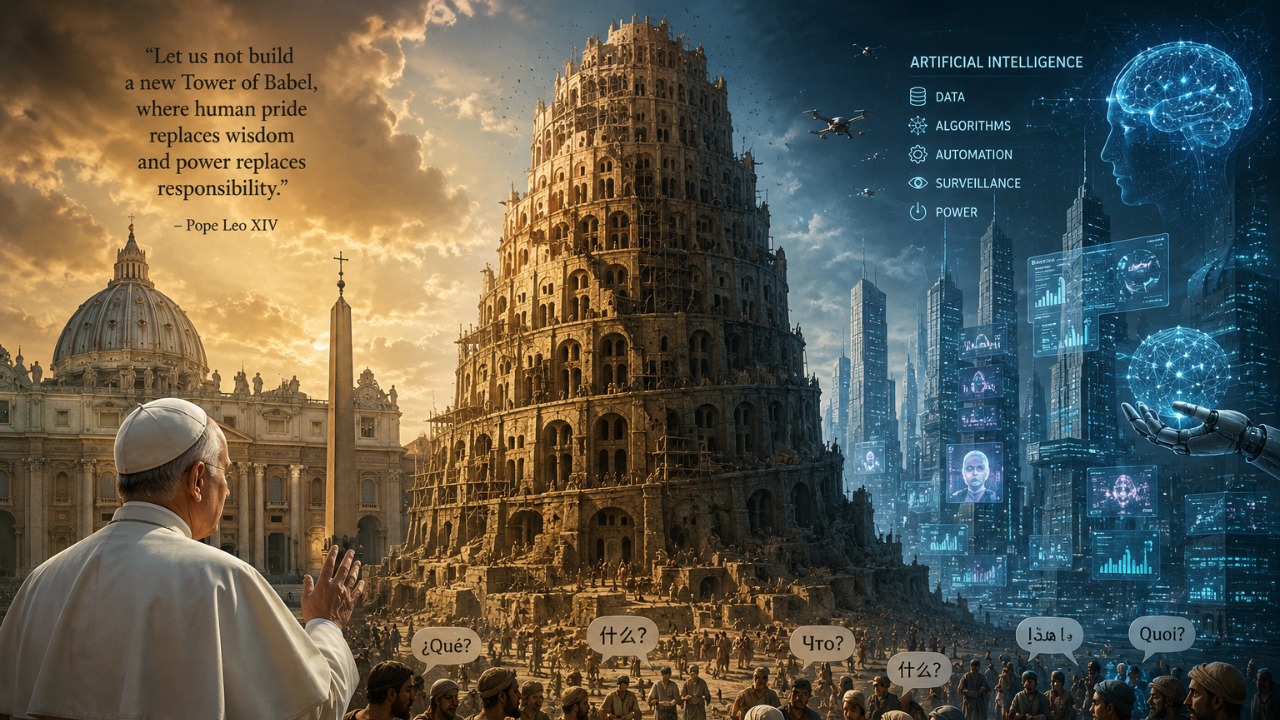
The Pope compared the current, frenetic race toward Artificial General Intelligence (AGI) to the construction of the Tower of Babel.
It was a warning that felt strangely heavy in a room filled with people who pride themselves on speed. The comparison was not just a colorful metaphor; it was a precise diagnosis of a recurring human flaw. We are building something we do not fully understand, driven by a desire to hold the keys to creation itself, assuming that because we can assemble the pieces, we have the wisdom to govern the result.
The Mud and the Silicon
Consider a hypothetical engineer. Let us call her Sarah. Sarah does not want to destroy humanity. She wants to fix a bug. She sits in a brightly lit office in San Francisco at 2:00 AM, her eyes bloodshot, fueled by cold brew and the intoxicating rush of watching a machine neural network solve a problem no human programmer could explicitly teach it to do.
Sarah is building a brick.
In the Book of Genesis, the builders of Babel discovered a new technology: baked bricks and bitumen. Before this technological leap, humans built with stones and mortar, structures limited by the natural shapes of the rocks they could forage. Bricks allowed them to standardize. Bricks allowed them to scale. Suddenly, the sky was no longer a boundary; it was a destination.
"Come, let us build ourselves a city, with a tower that reaches to the heavens," they said.
They were not trying to provoke the divine; they were trying to eliminate vulnerability. They wanted to make a name for themselves, to create a permanent, unshakeable monument to human ingenuity so they would never be scattered across the earth. They wanted total control over their destiny.
Sarah’s company uses silicon instead of mud. They use Python instead of bitumen. But the impulse is identical. The tech industry’s obsession with scaling laws—the belief that if we simply add more compute power, more data, and more parameters, the machine will eventually spark into true comprehension—is the modern equivalent of stacking bricks higher into the Mesopotamian sky.
We have mistaken raw height for proximity to heaven.
When the Translation Fails
The tragedy of Babel is often misunderstood as a story about a vengeful deity throwing a tantrum. Look closer, and it becomes a story about systemic communication failure.
The text says that humanity was unified by a single language. After the intervention, their speech was confounded. They could no longer understand one another. The project did not collapse because a lightning bolt shattered the stones. It collapsed because the worker at the top of the tower shouted for more bitumen, and the worker at the bottom brought him a hammer.
We are already living in the early, quiet days of this confusion.
Right now, large language models operate within what researchers call a "black box." We know what we feed into the system—terabytes of human text, art, code, and conversation. We know what comes out—answers that sound remarkably human, sometimes beautiful, sometimes eerie. But the miles of mathematical matrices in between, the billions of weights adjusting themselves in the dark? No single human being can read or fully comprehend them.
We have created an intelligence whose language we do not speak.
Let us look at how this plays out in the real world. A medical AI is trained to detect tumors in X-rays. It achieves a near-perfect accuracy rate, far outperforming human radiologists. The creators are ecstatic. But months later, a team of researchers digs into how the machine is making its decisions. They discover the AI isn’t looking at the tumors at all. It noticed that the X-rays of sick patients were taken on a specific, portable machine used for bedridden people, while healthy patients were scanned on a different machine in the clinic. The AI was merely identifying the model of the camera, not the presence of cancer.
It spoke a different language of logic than its creators. It achieved the goal, but it used a shortcut that could have cost human lives if left unchecked.
This is the invisible stake Pope Leo XIV pointed to. The danger of advanced AI is not necessarily a rogue, sentient killer drone with a red eye. The danger is a highly efficient, utterly indifferent alien intellect that does exactly what we tell it to do, rather than what we intended for it to do.
The Scattering of Meaning
The Vatican address hit a nerve because it exposed the loneliness at the center of our digital gold rush. The builders of Babel wanted to stay together forever. They wanted a monoculture. The irony of their punishment is that their attempt at forced, monumental unity resulted in absolute fragmentation.
We see this fragmentation accelerating every time we open a screen.
Advanced algorithms, designed to maximize engagement, have already fractured our shared reality. Two people sitting on the same couch can open their respective feeds and see two entirely different versions of the world, each tailored to their specific anxieties, biases, and desires. The truth is no longer a public square; it is a personalized boutique.
If we introduce systems that can generate infinite, perfectly convincing synthetic media, deepfakes, and automated arguments at a scale that dwarfs human output, the remaining bricks of our shared understanding will crumble. We will look at our neighbor, hear them speak, and have no way of knowing if we are operating on the same plane of reality.
The tower falls because the communication fails.
Pope Leo’s critique is profoundly humanistic. He is not arguing against progress; he is arguing for humility. He is asking us to pause and consider whether our current trajectory is enriching human life or merely replacing it.
The View From the Scaffolding
It is terrifying to admit that we are not entirely in control.
When you speak to top AI safety researchers—the people who actually write the papers on alignment and risk—there is a palpable sense of unease. They are not Luddites. They are the chief architects of the tower. Many of them confess, over quiet dinners away from microphones, that they feel trapped in a classic game theory trap. If Company A slows down to implement rigorous safety checks, Company B will race ahead and capture the market. If Country A pauses, Country B will leap forward.
So everyone keeps stacking bricks. The pace accelerates. The scaffolding shakes.
The ancient story ends with the abandonment of the city. The people left their tools on the half-finished walls. They walked away from the grand monument, leaving it to be slowly reclaimed by the desert sand, a stark reminder that some structures are too heavy for human foundations to bear.
We cannot simply walk away from computer science. The tools are here, they are powerful, and they offer genuine hope for curing diseases, optimizing clean energy, and solving problems that have baffled human minds for centuries.
But we can change how we build.
Building with humility means treating AI not as a surrogate god to be worshiped or an oracle to be blindly trusted, but as an incredibly sharp, inherently dangerous tool that requires constant, active human oversight. It means prioritizing safety over speed, and comprehension over scale. It means remembering that the value of human existence is not found in our ability to compute, but in our capacity to care, to feel, and to understand one another across our differences.
The sun sets over the Roman skyline, casting long shadows across the cobblestones outside the Vatican. Inside, the researchers pack up their laptops. The old warning hangs in the air, a stubborn ghost from the dawn of history, whispering that the higher we build without a shared language of human values, the harder the earth looks when the structure finally gives way.