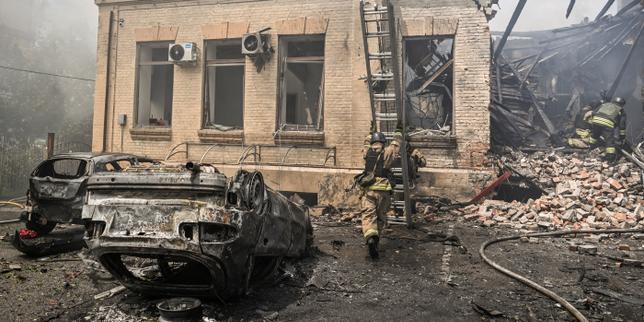
The alarm does not sound like a siren anymore. To those who live in the Zaporizhzhia oblast, the warning system has morphed into something entirely organic. It is a tightening in the throat. It is the sudden, synchronized pause of a dozen shoppers in a grocery aisle, their heads tilting slightly toward the ceiling, tracking a low, rhythmic vibration that travels through the soles of their shoes before it ever registers as sound.
On a standard morning, sixteen is just a number. It is the number of ounces in a pound, the age a teenager gets a driver’s license in some parts of the world, or the number of bread loaves a small bakery slides into the oven before dawn.
But yesterday, sixteen became the tally of human bodies torn, bruised, and buried beneath the pulverized concrete of Ukrainian apartment blocks. Sixteen lives interrupted by a rain of Russian metal.
To read the official dispatches is to consume a diet of cold syntax. Sixteen wounded. Residential buildings damaged. Rescue operations ongoing. These phrases are necessary for archives, but they act as a thick layer of insulation, separating the reader from the sensory reality of a Tuesday morning transformed into a war zone.
To understand what happened in Zaporizhzhia, we have to look past the tally. We have to look at the dust.
The Anatomy of an Echo
When a guided aerial bomb or a heavy missile strikes a residential block, the sound is not a clean, cinematic explosion. It is a dense, deafening thud that collapses the air pressure in the room. Your chest tightens. The oxygen seems to vanish for a split second, sucked into the vortex of the blast.
Consider a woman we will call Iryna. She is a composite of the schoolteachers and pharmacists who inhabit these specific concrete complexes, a necessary lens to view an otherwise overwhelming tragedy. When the shockwave hit her neighborhood, she was doing something aggressively mundane. She was pouring boiling water over a spoonful of instant coffee.
The blast did not shatter her windows; it turned the glass into a high-velocity mist.
This is the hidden tax of modern warfare on civilian populations. The injury report will list Iryna as "lightly wounded" by lacerations. It will not capture the reality of spending three hours with a pair of tweezers, picking microscopic shards of glass out of her forearm, nor will it record the fact that she will jump every time a truck backfires for the next five years.
The physical damage to the infrastructure is instantly quantifiable. Emergency services arrive with their heavy machinery, clearing away the jagged teeth of what used to be a living room wall. But the psychological architecture of the city takes a far deeper hit.
A home is supposed to be a container for vulnerability. It is where you take off your shoes, untie your hair, and sleep with your eyes closed. When Russia targets these residential zones, the objective is not strategic in a military sense. There are no tank factories hidden in the kitchens of Zaporizhzhia. The objective is the systematic erasure of safety. It is an attempt to make the simple act of existing inside a house feel like an extreme sport.
The Arithmetic of Survival
The emergency workers who operate in the oblast have developed a grim expertise. They know exactly how much pressure a human ribcage can withstand before it collapses under a fallen ceiling beam. They can tell by the smell of the smoke whether a strike hit a gas line or an electrical substation.
When the reports filter out to the global press, the focus inevitably lands on the geopolitical chessboard. Analysts debate ammunition supplies, frontline troop movements, and the diplomatic posturing in distant Western capitals.
But on the ground, the perspective is microscopic.
- The first hour: The air is unbreathable. Plaster dust hangs like a thick gray fog, coating the tongues of survivors with the taste of chalk and old lime.
- The second hour: The silence breaks. It is replaced by the ring of mobile phones buried beneath the rubble. Dozens of them, playing different pop tunes and generic ringtones, vibrating against the debris as relatives call from across the city, praying for an answer.
- The third hour: The realization settles. For those sixteen individuals currently lying on thin hospital mattresses, the trajectory of their year has been permanently rewritten. Some will lose limbs. Others will carry the invisible scars of blast-induced concussions, a condition that clouds the mind and turns short-term memory into a sieve.
The local hospitals in Zaporizhzhia operate under a state of permanent improvisation. Doctors who trained to treat chronic illnesses or performing routine appendectomies have become trauma surgeons capable of piecing together shattered bones in the dark. They work with a quiet, furious efficiency. There is no time for panic when the hallways are slick with the mud tracked in by rescue boots.
The Illusion of Distance
It is easy for an outside observer to view the conflict through a lens of inevitability. The war has lasted for years. The headlines begin to blur together. One day it is sixteen wounded in Zaporizhzhia; the next, it is ten dead in Kharkiv. The mind naturally seeks a defense mechanism against this relentless accumulation of misery, often choosing numbness as a shield.
We tell ourselves that these people are somehow different, that they have developed a thick skin, or that they are accustomed to the chaos.
They are not.
A thirty-year-old accountant in Zaporizhzhia enjoys the same things a thirty-year-old accountant in London or New York enjoys. They worry about their electric bills, they stream comedies on their phones to unwind, and they argue about who forgot to buy milk. The terror they experience when a missile tears through their roof is identical to the terror you would feel if the ceiling above you collapsed right now.
The true horror of the situation in southeastern Ukraine is not that life has stopped. It is that life is forced to continue inside a crucible. The markets still open. The street cleaners still sweep up the leaves and the shrapnel alike. Parents still hold their children's hands as they walk past burnt-out vehicle hulls on the way to school.
This resilience is often romanticized in Western media as a beautiful, heroic trait. But if you talk to the residents themselves, they will tell you that resilience is simply another word for having no other choice. You either clean up the glass and go to work, or you let the environment swallow you whole.
The Long Afternoon
By mid-afternoon, the initial chaos of the strike has subsided into a dull, exhausting ache. The heavy cranes have lifted the largest pieces of concrete. The ambulances have long since departed, their sirens fading into the city's background hum.
What remains is the ledger of the day. Sixteen people are missing from their regular routines. Sixteen families are sitting in waiting rooms, staring at the swinging doors of emergency wards, listening to the squeak of medical staff sneakers on linoleum.
Outside the damaged buildings, neighbors gather in small clusters. They do not talk about politics or grand strategy. They talk about the practicalities of plywood. They discuss who has extra plastic sheeting to cover the gaping holes where their windows used to be, ensuring the night wind doesn't freeze the pipes.
They look at the crater in the asphalt, a jagged black scar that marks the spot where an ordinary morning was violently torn open, and they recognize a simple truth.
Tomorrow, the numbers will reset. The sirens will sound again. And the only thing standing between the population of this city and the next update in the casualty column is a few miles of airspace and a tremendous amount of terrible, random luck.


