The United States Air Force faces a structural mismatch between traditional fighter fleet capacity and the exponential cost scaling of crewed stealth platforms. Addressing this resource constraint requires a shift from linear force multiplication to networked autonomous mass. The Collaborative Combat Aircraft program moves uncrewed systems out of permissive environments and embeds them directly into high-end peer conflict. This transformation rests on decoupling airframe hardware from autonomy software via an open systems architecture, altering how military organizations generate operational capacity.
The Economic and Operational Rationale for Affordable Mass
Traditional fighter procurement models suffer from diminishing returns. As fifth-generation platforms such as the F-35 and specialized sixth-generation designs demand extreme low-observable characteristics, advanced sensor fusion, and internal weapons carriage, unit procurement and maintenance costs scale upward. A smaller fleet of exquisite platforms creates strategic vulnerability through concentration risk. If a single airframe represents tens of millions of dollars and years of specialized pilot training, attrition rates in a contested peer conflict become unsustainable.
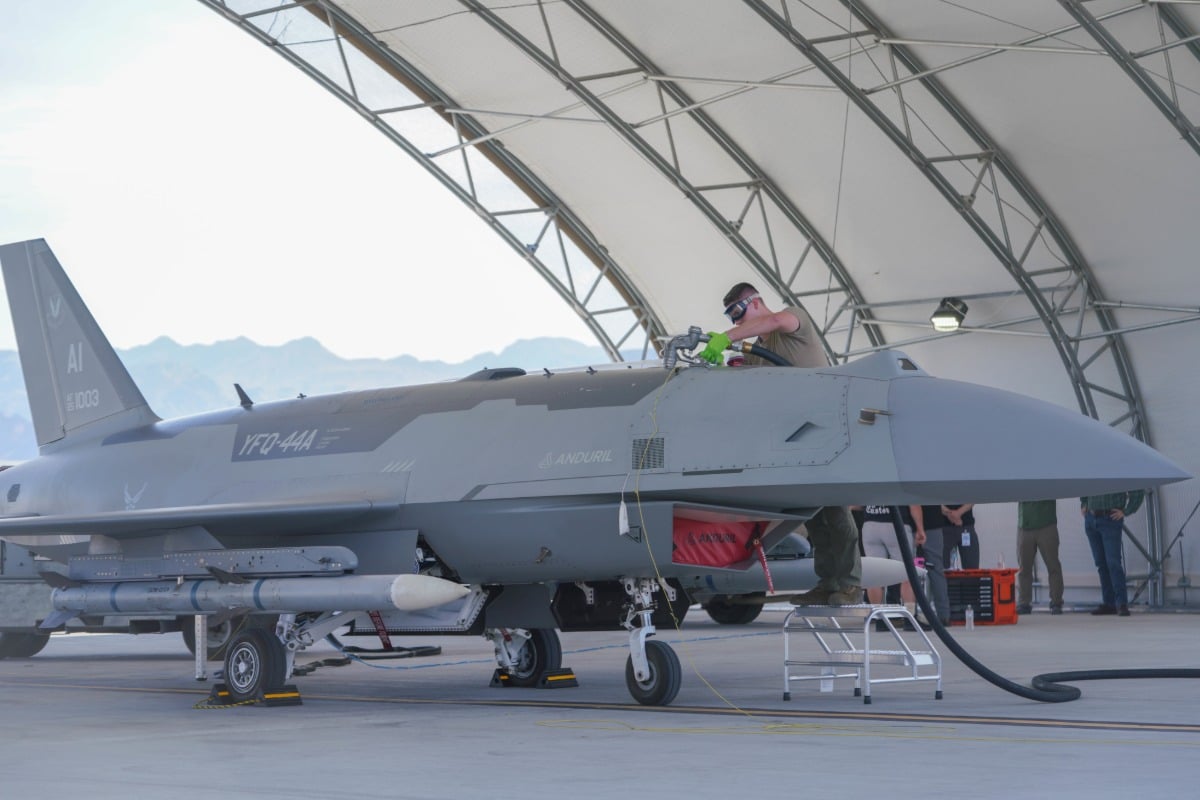
To solve this economic bottleneck, the service relies on the principle of affordable mass. By introducing uncrewed platforms like the General Atomics YFQ-42A Dark Merlin and the Anduril YFQ-44A Fury—designated under Increment 1 of the program—the force achieves numerical parity against adversaries without scaling human exposure or proportional fiscal outlays. These platforms are not designed to substitute for crewed fighters, but to act as distributed nodes that absorb tactical risk, expand sensor footprints, and carry secondary weapons bays.
Decoupled Architecture and Software Portability
A primary vulnerability of legacy military aviation has been proprietary lock-in, where hardware and software upgrades remain tied to a single prime contractor, creating long modernization cycles and inflated costs. The Collaborative Combat Aircraft program subverts this dynamic through a modular open systems architecture.
The technical separation operates across three clear vectors:
- Airframe Physical Layer: The structural chassis, propulsion, fuel fraction, and basic aerodynamic performance designed by competing contractors like General Atomics and Anduril.
- Autonomy Software Layer: The onboard artificial intelligence stack responsible for tactical routing, reactive maneuvering, and cooperative behaviors, developed independently to integrate across multiple airframes.
- Combat Management Layer: The human-machine interface housed within crewed platforms such as the F-35 or F-15EX, which translates pilot intent into task assignments rather than direct flight-control inputs.
This decoupling allows government-owned or third-party autonomy packages to be dropped into competing physical airframes. When software updates alter tactical algorithms, engineers deploy patches without altering aerodynamic structures, shortening the feedback loop between operational testing and software deployment.
Operational Integration and Distributed Execution
Recent evaluations by the Collaborative Combat Aircraft Experimental Operations Unit at Creech Air Force Base validate these frameworks outside sterile test ranges. Operating under Agile Combat Employment doctrines, the focus centers on doctrine generation, sortie generation rates, and decentralized command under communications-denied conditions.
In a distributed combat network, human pilots do not pilot uncrewed wingmen via continuous remote links. Radio silence and electronic jamming prevent reliable high-bandwidth datalinks in contested airspace. Instead, the autonomous platform executes predefined mission intents locally. If an uncrewed asset is assigned to perform Suppression of Enemy Air Defenses, it navigates complex threat rings, identifies radar emitters, and manages weapons release based on onboard sensor processing. The human operator provides high-level authorization parameters, while the machine handles tactical execution variables.
Live-fire milestones, such as the YFQ-44A launching an AIM-120 Advanced Medium-Range Air-to-Air Missile against a beyond-visual-range digital target, demonstrate that the mechanical and weapons-integration loops are closing. These tests prove that uncrewed systems can transition from passive sensor relay nodes to active weapon carriers, doubling the ordnance capacity available to a paired crewed flight lead.
Strategic Deployment and Industrial Scaling
Transitioning from prototype competition to production contracts changes the defense industrial landscape. Rather than selecting a single victor to monopolize production, maintaining dual-source development for Increment 1 stabilizes supply chains and accelerates manufacturing capacity. With the initial tranches targeting over one hundred operational platforms and an eye toward broader fleet integration, the constraint shifts from technological feasibility to operational scaling.
Deploying these systems alongside multinational partners, as seen with interoperability trials involving international uncrewed assets in Pacific exercises, points toward a networked coalition model. Future conflicts will not rely on isolated national platforms, but on shared autonomous architectures where allied assets plug into common tactical networks.
Prioritize the rapid operationalization of software-hardware decoupling by institutionalizing continuous software integration pipelines that bypass traditional multi-year acquisition cycles, ensuring that tactical autonomy algorithms evolve faster than adversary countermeasures.
The USAF's New Fighter Drone Just Fired Its First Missile
This video provides direct analysis and operational context regarding the recent live-fire missile testing milestones achieved by the uncrewed platform architecture within the current program timeline.
http://googleusercontent.com/youtube_content/1