Sand gets everywhere. It clings to the cuffs of your trousers, finds its way into the sealed mechanism of a wristwatch, and coats the windshield of a patrol vehicle until the world outside is nothing more than a hazy, amber smear. Standing on a gravel ridge outside Riyadh years ago, tasting the metallic bite of dust carried by a dry wind, I listened to a veteran diplomat explain the architecture of power in the Middle East. He used a simple phrase: aligned gravity.
Nations do not orbit one another out of affection. They pull together because the mass of shared danger overcomes the friction of old animosities.
For decades, the United States sat at the center of that gravity well. Washington wrote the security guarantees, patrolled the shipping lanes, and mediated the endless, exhausting feuds between capitals separated by only a few hundred miles of desert but centuries of mistrust. American aircraft carriers were the immovable anchors keeping the regional map from tearing apart at the seams. But gravity shifts when the mass at the center begins to waver.
Consider what happens next when local powers look toward Washington and see hesitation. They do not panic. They build.
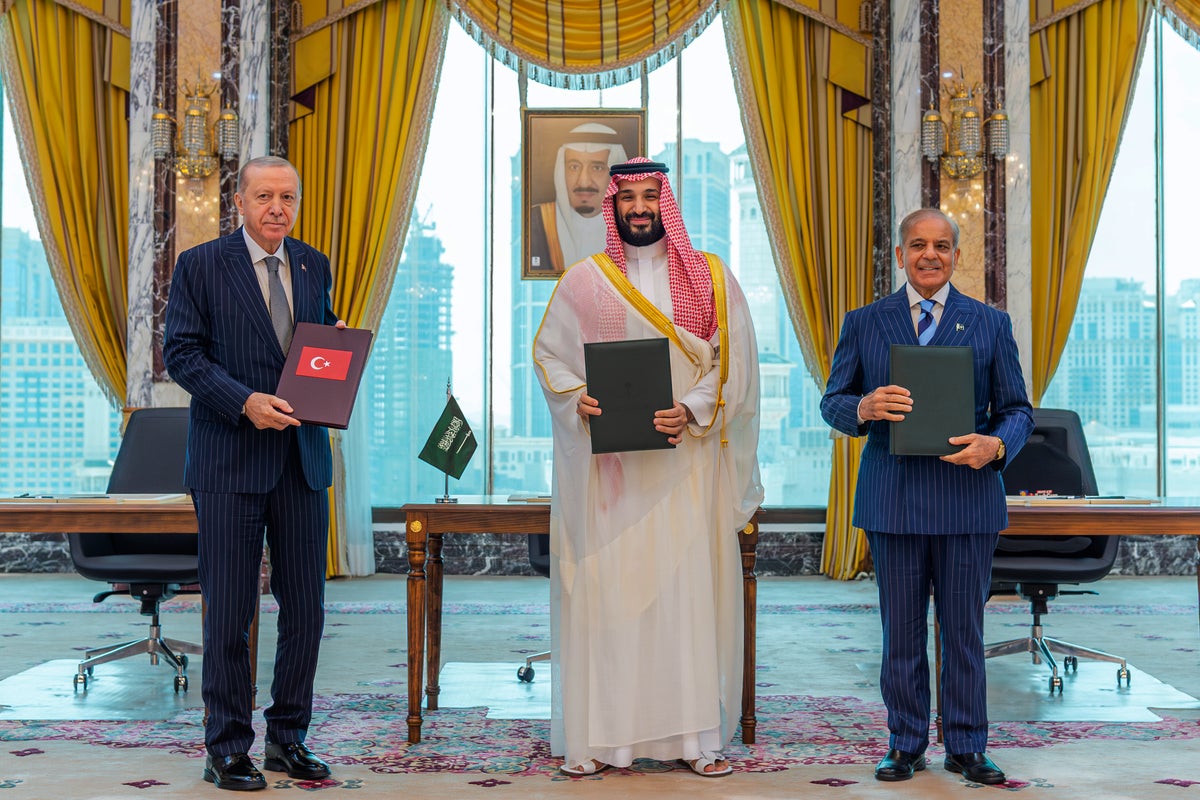
The quiet construction of what observers have shorthand-labeled a Muslim NATO is not a sudden explosion. It is the sound of masonry being laid in the dark, brick by brick, by leaders who have decided they can no longer afford to wait for permission or protection from across an ocean.
To understand this shift, you have to look past the dense press releases and the sterile language of geopolitical analysts. You have to look at the human cost of prolonged uncertainty. Picture a young mother in Amman or a logistics officer in Riyadh waking up to the same quiet dread: the realization that the security umbrella is leaking, and the rain is starting to fall. When external anchors slip, self-reliance ceases to be a political talking point. It becomes a survival strategy.
For generations, the conventional wisdom dictated that Middle Eastern nations could never cooperate deeply among themselves because the historical wounds ran too deep. Sunnis and Shiites, monarchies and republics, mercantile city-states and vast continental kingdoms—the fault lines were assumed to be permanent. But history is a fluid thing, heated by new pressures until old certainties melt.
The pressure this time is multi-directional. It is the receding shadow of American military overextension. It is the relentless advancement of regional missile technology. It is the sobering economic reality of a post-oil future that requires stability above all else to attract foreign investment and build mega-cities out of barren dust.
When you sit across from diplomats in Gulf capitals today, the tone has changed. The frustration is palpable, but it has hardened into resolve. They talk less about what Washington should do and more about what they must do themselves.
This brings us to the core mechanism of the new alignment. Think of it less as a formal treaty modeled on the North Atlantic alliance and more as a dense web of interlocking defense pacts, intelligence-sharing nodes, and joint manufacturing initiatives. It is an operational ecosystem. Drones built in one country are flown by pilots trained in another, backed by financial capital from a third, all designed to create a regional shield that functions independently of any Western capital.
The creation of this security framework is a direct signal to Washington that its grip is loosening. It is not an act of open defiance; it is something far more permanent: a quiet decoupling of dependence.
When a superpower loses its grip, it rarely happens in a sudden, cinematic collapse. There is no single moment where the flags are hauled down and the ambassadors are expelled. Instead, it looks like a series of bilateral meetings that happen without consulting the State Department. It looks like defense contracts signed with alternative partners. It looks like regional adversaries sitting down in quiet hotel rooms in Baghdad or Beijing to hash out their own security arrangements, bypassing the traditional Western mediators entirely.
I remember watching an Emirati trade delegation navigate a complex negotiation years ago. The room was thick with tension, centuries of suspicion hanging heavy in the air conditioning. Yet, as the hours wore on, a pragmatic realization took over. They understood that the cost of continued division was simply too high to sustain in a world where external guarantees were becoming conditional.
That same pragmatic realism is now driving the current security architecture. Leaders who once viewed each other as existential threats are discovering that the true existential threat is isolation.
The implications for global order are profound. For nearly a century, the Pax Americana in the Middle East operated on a simple premise: we provide the shield, you provide the stability. But when a region begins forging its own shield, the relationship transforms from patron-client to something much more transactional and unpredictable.
Washington’s influence is not vanishing overnight. The logistical ties, the legacy equipment, and the deep institutional relationships built over decades cannot be erased with a single signature. But influence is like water; it follows the path of least resistance and greatest utility. If regional capitals believe that collective self-defense is a more reliable insurance policy than an increasingly distracted American electorate, the water will find a new channel.
The desert wind still carries the same dust, blurring the horizon just as it did twenty years ago. But the people walking through those dust storms are no longer looking across the sea for salvation. They are looking at each other, measuring the distance, and laying the foundation for a future they intend to build with their own hands.