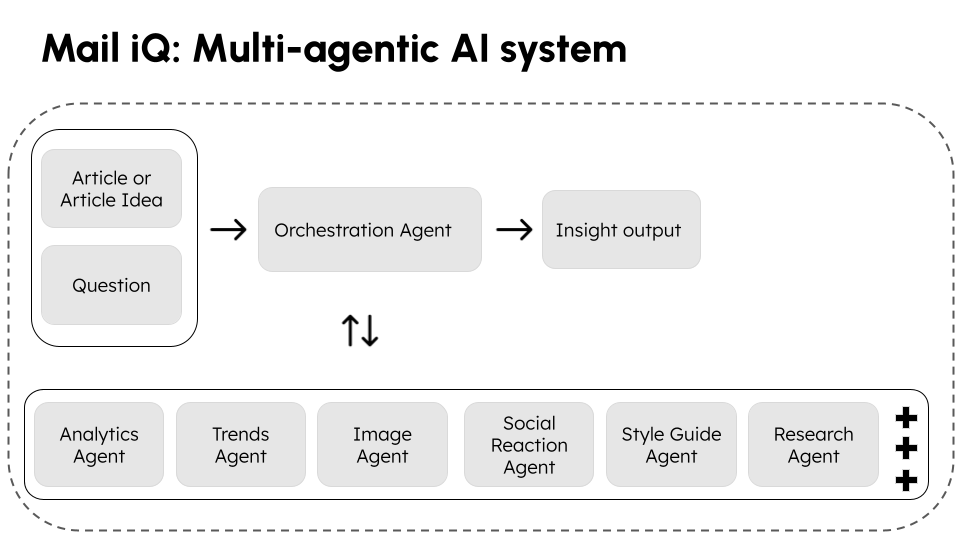
The operational efficiency of a modern newsroom is no longer dictated by editorial intuition but by the latency between raw information ingestion and multi-platform distribution. DMG Media’s shift toward a "foundational layer" for AI represents a move away from fragmented, experimental tools toward a centralized infrastructure. This strategy treats AI not as an external plug-in, but as a core utility—similar to a content management system (CMS) or a cloud database—designed to solve the specific economic problem of the "high-volume, low-margin" digital news cycle. By decoupling the AI logic from individual applications and housing it in a central layer, a media organization can standardize data security, cost management, and prompt engineering across diverse titles like the Daily Mail, Metro, and i.
The Tri-Modular Architecture of Newsroom AI
To understand the DMG model, one must categorize the AI implementation into three distinct functional modules. This replaces the vague notion of "AI integration" with a specific technical hierarchy.
- The Ingestion Engine: This module handles the normalization of disparate data sources. In a newsroom context, this includes wire services, social media feeds, internal archives, and legal databases. The foundational layer acts as a filter, using Large Language Models (LLMs) to perform entity extraction and sentiment analysis before a human editor even sees the lead.
- The Contextual Middleware: This is the "logic" phase. It is where the organization’s specific editorial voice, legal guidelines, and style guides are applied. By using Retrieval-Augmented Generation (RAG), the system anchors the AI’s output to the company’s own verified data, mitigating the hallucination risks inherent in generic models like GPT-4 or Claude.
- The Distribution Interface: The final module adapts the core content for specific platforms. A single investigative piece can be atomized into a 600-word SEO article, a 50-word push notification, and a bulleted script for a short-form video. The foundational layer ensures that while the format changes, the underlying factual data remain consistent.
The Economic Necessity of a Centralized Model
Media companies typically face a "vendor sprawl" problem where different departments purchase separate licenses for various AI tools. This leads to redundant costs and fragmented data silos. A centralized foundational layer addresses three specific economic pressures.
Cost Function Optimization
The cost of running AI at scale is determined by token consumption and API latency. When individual journalists use standalone tools, the organization loses the ability to negotiate enterprise-level rates or to optimize prompts for token efficiency. By routing all requests through a central layer, DMG Media can implement "model routing." This involves sending simple tasks (like spelling correction) to smaller, cheaper models, while reserving high-parameter models for complex tasks like investigative synthesis or legal risk assessment.
Data Sovereignty and IP Protection
Public LLMs are trained on data scraped from the web, often including the very articles media companies are trying to monetize. A foundational layer acts as a "walled garden." When a journalist inputs a sensitive scoop into an internal system, that data is processed within a secure environment and is not used to train the public versions of the models. This preserves the intellectual property (IP) value of the reporting, which is the primary asset of any news organization.
Technical Debt Mitigation
The AI field moves faster than traditional software cycles. If a newsroom builds its entire workflow around a specific version of one model, it risks obsolescence within months. The foundational layer acts as an abstraction. It allows the technical team to swap out the underlying "engine" (moving from GPT-4 to a specialized open-source model like Llama 3, for example) without disrupting the user interface used by the editorial staff.
Structural Bottlenecks in Human-AI Collaboration
Despite the technical sophistication of a foundational layer, the primary constraint remains the "human-in-the-loop" latency. A system can generate a summary in three seconds, but if the legal review takes three hours, the competitive advantage of speed is neutralized.
The DMG strategy focuses on shifting the human role from creation to verification. This creates a new workflow bottleneck: the verification burden. Editors must transition from being writers to being "fact-checkers of the machine." This requires a shift in skill sets, moving toward "prompt literacy" and "algorithmic auditing." If an editor does not understand how a model arrived at a specific conclusion, they cannot effectively vouch for the accuracy of the output.
The Mechanics of RAG in Editorial Accuracy
Retrieval-Augmented Generation (RAG) is the technical cornerstone of the DMG media strategy. Without it, an AI is simply guessing the next most probable word. With it, the AI is searching a specific, trusted database to find the answer.
- Vectorization: Every archived article and legal document is converted into a numerical vector (a list of numbers representing its meaning).
- Query Matching: When a journalist asks a question, the system converts that question into a vector and finds the closest matching "numbers" in the archive.
- Augmentation: The system feeds both the original question and the retrieved text into the LLM, instructing it to answer only using the provided text.
This mechanism solves the primary "People Also Ask" concern regarding AI in journalism: How can we trust that the AI isn't making things up? By restricting the AI's "worldview" to the company’s own verified archives, the foundational layer transforms the LLM from a creative writer into a highly efficient librarian.
Risk Assessment and the Limits of Automation
No foundational layer is a total solution. The DMG approach must account for three specific categories of failure that no amount of engineering can entirely eliminate.
The Echo Chamber Effect
If the AI is trained or grounded primarily on internal archives, there is a risk of reinforcing existing editorial biases. The system may prioritize stories and angles that have performed well in the past, potentially stifling the pursuit of original, counter-intuitive reporting that breaks new ground.
The Homogenization of Voice
As AI tools suggest headlines and lead paragraphs based on "proven" engagement metrics, the distinct "voice" of different publications within a group can begin to blur. If the Metro and the Daily Mail are both using the same foundational layer to optimize for the same SEO keywords, the brand differentiation that justifies their separate existences may erode over time.
The Legal Liability Gap
Current copyright and libel laws are not designed for AI-generated content. If an AI generates a defamatory statement based on a faulty synthesis of true facts, the legal responsibility still rests with the human editor and the publisher. The foundational layer can flag potential risks, but it cannot legally indemnify the organization.
Implementation Roadmap for Scalable Media AI
The transition to a foundational layer requires a phased execution that moves from back-end utility to front-end creative support.
- Phase One: Administrative Automation. Automate the high-volume, low-risk tasks such as meta-tagging, transcription of interviews, and generating social media snippets. This builds trust within the newsroom without risking editorial integrity.
- Phase Two: Research and Synthesis. Deploy RAG-enabled tools to allow journalists to query their own archives. This reduces the time spent on "backgrounding" a story from hours to seconds.
- Phase Three: Assisted Drafting. Introduce AI as a co-pilot for structured data stories, such as financial reports, sports scores, or weather updates. Here, the AI handles the data-to-text conversion, while the human adds the narrative "color."
The ultimate objective of the DMG media foundational layer is not to replace the journalist but to strip away the non-journalistic tasks that occupy 60% of their day. By automating the "plumbing" of the newsroom—formatting, distributing, tagging, and archiving—the organization can reallocate its human capital toward original reporting, which remains the only defensible moat in an AI-saturated market.
The strategic play for media executives is clear: stop buying AI features and start building an AI infrastructure. A company that relies on third-party AI interfaces is a customer; a company that builds its own foundational layer is a platform. The latter is the only position that offers long-term survival in an era where the marginal cost of content is approaching zero.