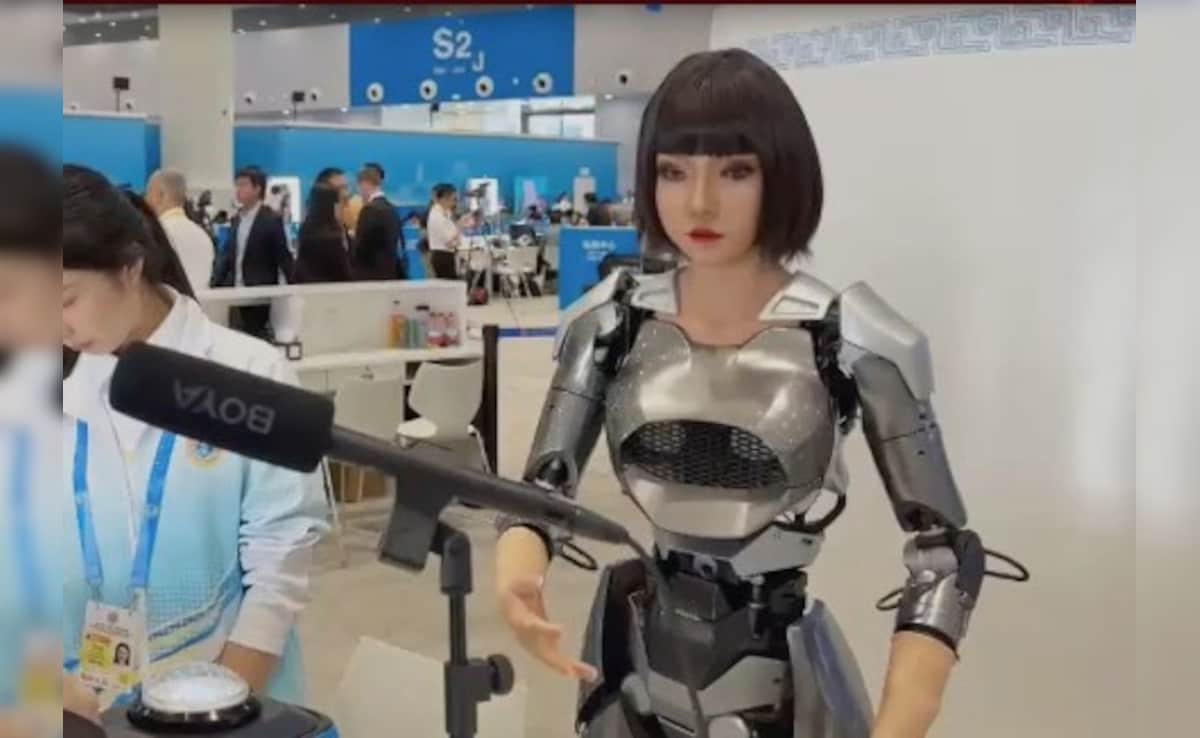
The recent hospitalization of a woman in China following a sudden encounter with a humanoid robot is not an isolated incident of "fright," but a data point revealing a critical failure in human-robot interaction (HRI) design. When a biological system encounters an autonomous machine that mimics human kinematics without the requisite social signaling, the resulting physiological response—often characterized by acute sympathetic nervous system activation—can reach clinical severity. This event exposes the "uncanny valley" not as an aesthetic theory, but as a tangible risk factor in the deployment of general-purpose robotics.
The Triad of Robotic Threat Perception
Human cognitive architecture processes humanoid entities through three distinct filters. When a machine fails to satisfy these filters simultaneously, the brain categorizes the entity as a predatory or existential threat rather than a utility tool.
- Kinematic Mismatch: Humans anticipate fluid, gravity-informed movement. Robotic actuators, while precise, often exhibit "staccato" motion or sudden acceleration profiles that bypass human reactionary windows.
- Visual Ambiguity: The closer a robot looks to a human, the higher the expectation for micro-expressions. If a robot possesses a face but lacks saccadic eye movements or pupillary response, the observer's amygdala triggers a "corpse" or "predator" classification.
- Proximity Violations: The social norms governing personal space (proxemics) are hardcoded. A robot that enters the "intimate zone" (0–18 inches) without audible or visual warning triggers an immediate cortisol spike.
The Physiological Cost of Technical Opacity
In the reported case, the victim suffered from a physical collapse. In clinical terms, this is often a vasovagal response or a hypertensive crisis induced by the "startle reflex." This reflex is the body's fastest integrated response, occurring within 10–50 milliseconds of a stimulus.
The core issue lies in Signal Vacuum. In a standard human-to-human interaction, we provide "pre-intent" signals—a glance, a shift in weight, or a verbal clearing of the throat. Humanoid robots currently operating in public spaces in China and elsewhere often lack these pre-intent indicators. They move from a state of total stillness to maximum torque instantaneously. For a bystander, this creates a "jump scare" effect that the autonomic nervous system treats as a physical assault.
The "Cost Function" of robotic integration must now account for Biomedical Liability. If a robot’s presence requires a human to maintain a state of hyper-vigilance, the efficiency gains of the robot are offset by the cognitive fatigue and health risks imposed on the human workforce or public.
The Architecture of Autonomous Integration
To prevent systemic rejection of humanoid technology, developers must move beyond "looking human" and focus on "behaving predictably." This requires a shift from robotic autonomy to Communicative Autonomy.
1. Intent Signaling Systems (ISS)
Robots must broadcast their pathing and immediate next-actions through non-verbal cues. This includes:
- Directional Lighting: LED arrays that indicate turns before they happen.
- Acoustic Presence: A constant, low-decibel hum or "digital footprint" that prevents the robot from being "silent but mobile."
- Gaze Anchoring: If a robot has eyes, they must lock onto a destination or a person to signal awareness and trajectory.
2. The Acceleration Boundary
The "Hospitalization Event" likely involved a breach of the Acceleration Boundary. Humans have a high tolerance for slow, predictable machines (like automated vacuum cleaners) and a high tolerance for fast machines in predictable tracks (like trains). We have zero biological tolerance for high-acceleration, unconstrained agents in our immediate vicinity. Engineering standards must cap the "Jerk" (the rate of change of acceleration) when a robot is within a three-meter radius of a human.
3. Sensory Load Balancing
The human brain can process a humanoid robot if the sensory input is balanced. If the robot is visually complex (humanoid) but acoustically void (silent motors) and tactically cold, the brain experiences a "sensory mismatch." This mismatch is the primary driver of the Uncanny Valley. The solution is not to make the robot more human, but to make it more obviously a machine.
Structural Risks in Public Deployment
The deployment of humanoid robots in hospitals, malls, and transit hubs assumes a "standard user." This is a fundamental error in strategy. The demographic variance in startle-response sensitivity is vast.
- Age-Dependent Vulnerability: Elderly populations have a more fragile cardiovascular response to sudden stressors.
- Pre-existing Conditions: Individuals with anxiety disorders or PTSD have a hyper-sensitized amygdala, making them highly susceptible to "Robot-Induced Trauma."
- Cultural Proxemics: Different regions have varying "buffer zones." A robot programmed with North American spatial logic may be perceived as aggressive in East Asia, and vice-versa.
The current trend of "Humanoid Maximalism"—making robots look as human as possible—is a marketing-driven decision that ignores these psychological realities. It prioritizes the "wow factor" of a static image over the "functional safety" of a dynamic interaction.
Redefining the Safety Envelope
The industry currently uses "hard safety" metrics: Will the robot hit the person? We must transition to "soft safety" metrics: Will the robot’s presence cause physiological distress?
Establishing a Psychological Safety Integrity Level (P-SIL) would allow regulators to categorize robots based on their impact on human heart rate and cortisol levels during interaction. A robot that causes a 20% increase in heart rate in 10% of the population should be restricted from unsupervised public use.
The Mechanism of Maladaptation
The reason the woman in the hospital collapsed was likely "Expectation Violation." A hospital is a high-stress environment where the brain is already at peak cognitive load. When the robot appeared, her brain could not resolve the identity of the object fast enough to determine if it was a threat. The resulting "processing freeze" forced the nervous system to dump adrenaline, leading to the physical collapse.
The Strategic Path Toward Bio-Compatible Robotics
Organizations must cease the pursuit of "Hyper-Realism" and instead adopt "Functional Legibility." A robot’s form should follow its function in a way that is readable from 10 meters away.
- De-Anthropomorphization: Use humanoid forms for task-specific ergonomics (reaching shelves, using tools) but keep the visual aesthetic distinctly "tech." Clear casings, visible joints, and non-human skin tones reduce the Uncanny Valley effect.
- Auditory Transparency: Implement "Active Acoustic Feedback." If a robot is performing a heavy lift or a fast move, it should emit a sound that correlates to the effort, allowing the human ear to track the intensity of the machine's actions.
- Predictive Pathing Visualization: Use floor-projected lasers to show the robot’s intended path. This removes the "guessing game" for pedestrians and aligns the machine's intent with the human's spatial awareness.
The hospitalization in China is a warning that the "hardware-first" approach to robotics has hit a biological ceiling. We have mastered the mechanics of movement, but we have failed the psychology of presence. The next stage of robotic evolution is not more degrees of freedom in the hand, but a more sophisticated integration into the human sensory landscape.
The strategic imperative for manufacturers is the implementation of a Universal Humanoid Interaction Protocol (UHIP). This protocol must mandate that any autonomous agent over 50kg must provide 500ms of "pre-action signaling" before any movement exceeding 0.5 meters per second. Failure to standardize these signals will result in increasing public hostility, legal liability, and a permanent "innovation brake" on the robotics sector.