History books love drawing hard borders, but the ancient world didn't care about our modern maps. If you need proof, look at a tiny patch of mud in western Thailand. What started as a casual discovery by local farmers digging in a rice field has turned into a massive archaeological breakthrough.
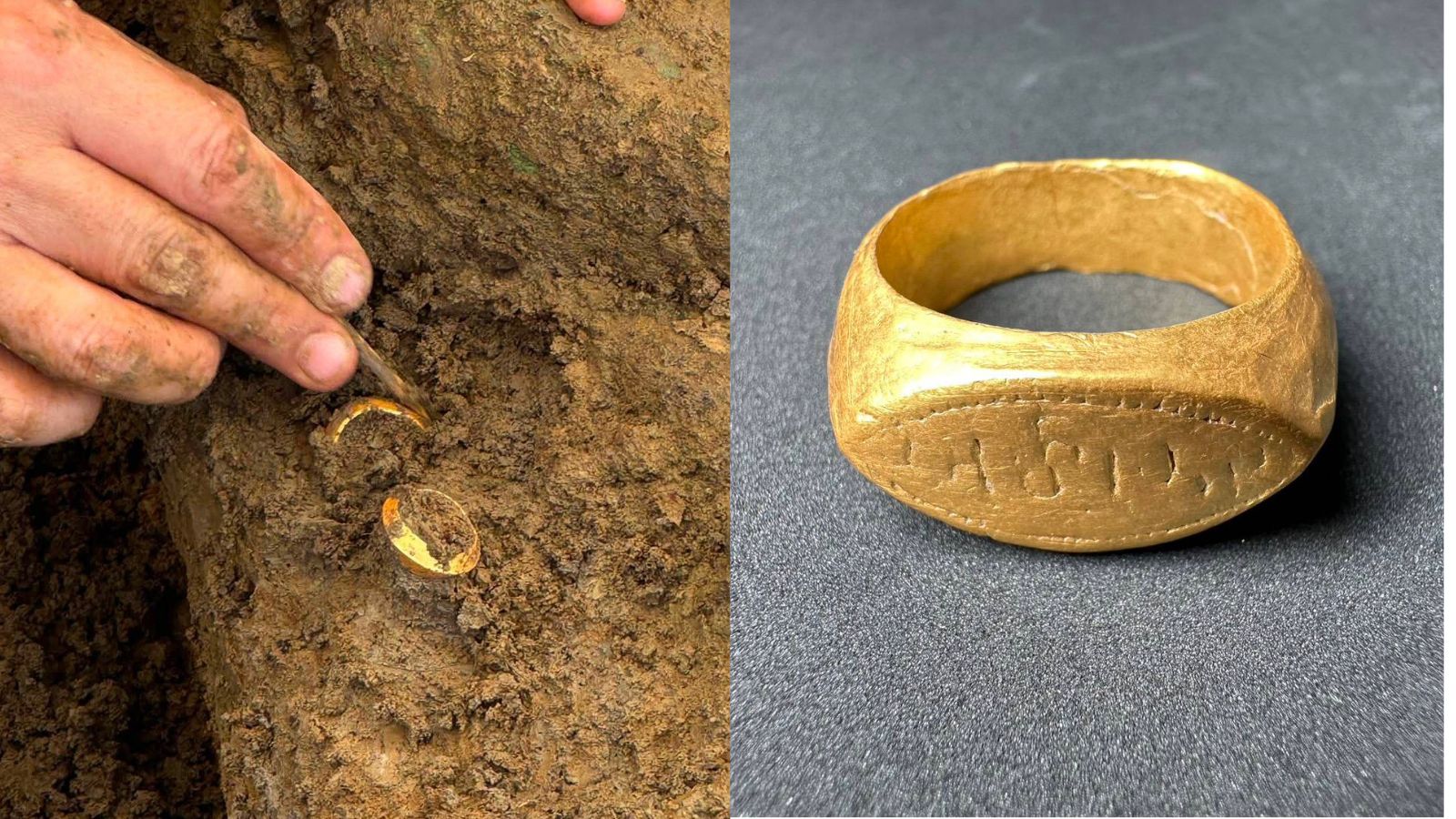
Archaeologists excavating the newly found Don Yai Thong site in Phetchaburi province just pulled two 2,000-year-old gold rings from the earth. They weren't sitting in an isolated treasure chest. They were resting right next to a human skeleton. One ring is a simple, unadorned gold band. The other features an engraving that has completely upended our understanding of early regional trade. Building on this topic, you can also read: The 100 Mile Gap Closing Over the Strait of Malacca.
It contains an inscription written in Brahmi script, one of the oldest writing systems from ancient India.
This isn't just a lost piece of jewelry. It's a physical receipt of a complex, cross-oceanic relationship that was thriving long before modern nations existed. Experts at USA Today have shared their thoughts on this situation.
Decoding the Script
When experts from Thailand's Fine Arts Department cleaned the dirt off the engraved ring, they recognized the distinct characters of the Brahmi script. After a careful initial analysis, linguists and historians translated the text to read pusarakhitasa.
Translated directly, it means "the one protected by Pushya."
If you aren't familiar with ancient Indian astronomy, Pushya is one of the most auspicious lunar mansions, or nakshatras, in the zodiac system. Even today, it holds deep spiritual and religious significance in Hindu traditions, symbolizing luck, protection, and prosperity.
Finding this specific linguistic and religious marker 130 kilometers southwest of Bangkok tells us something crucial. This wasn't a random object traded through secondary hands. The person wearing it, or the person who made it, had an intimate, direct relationship with the culture, language, and spiritual beliefs of the Indian subcontinent.
The Merchant Identity
Who actually wore the ring? Based on the quality of the gold craftsmanship and the specific phrasing of the inscription, researchers strongly suspect the skeleton belongs to an ancient Indian merchant. Specifically, someone from the Vaishya community, the traditional trading and mercantile caste of ancient India.
Imagine the journey. Two millennia ago, during the late prehistoric period or the Iron Age, traveling from India to Southeast Asia wasn't a simple commercial flight. It meant navigating the unpredictable waters of the Bay of Bengal on wooden vessels, relying entirely on monsoon winds.
The Don Yai Thong site dates back somewhere between 1,500 and 2,500 years ago. The presence of this ring, alongside eight human skeletons uncovered since excavations began in February, proves that this location wasn't just a temporary rest stop. It was a highly organized community. The burials were ceremonial, filled with high-value bronze ornaments, intricate pottery, and gold jewelry. This suggests that the people buried here weren't desperate travelers; they were wealthy, high-ranking members of an elite social class who lived, traded, and likely died in present-day Thailand.
Rewriting the Ancient Maritime Highway
For decades, casual history buffs assumed that deep globalization is a modern invention. We think of ancient trade as a slow, localized barter system. This discovery proves otherwise.
Indian merchants had established highly sophisticated maritime highways centuries before the Common Era. They didn't just move spices, textiles, and precious metals. They moved ideas. They brought their writing systems, their astrological beliefs, and their social structures across the ocean.
What makes the Don Yai Thong discovery unique is how it started. Local residents stumbled upon fragments of ancient bronze drums in a rice field earlier this year. Those drums prompted the Fine Arts Department to launch a full-scale excavation. Now, we have definitive proof of an Iron Age trading post that connects directly back to Indian ports.
Check Out the History Yourself
If you're fascinated by how deeply interconnected our world has always been, you won't have to just read about this find in academic journals. The official excavation work at the Don Yai Thong site is scheduled to wrap up within the next month. Following the completion of the dig, Thailand's Fine Arts Department announced plans to preserve, document, and ultimately place these gold rings and accompanying artifacts on public display. Keep an eye on upcoming exhibitions at the national museums in Bangkok and Phetchaburi to see this piece of ancient global history with your own eyes.