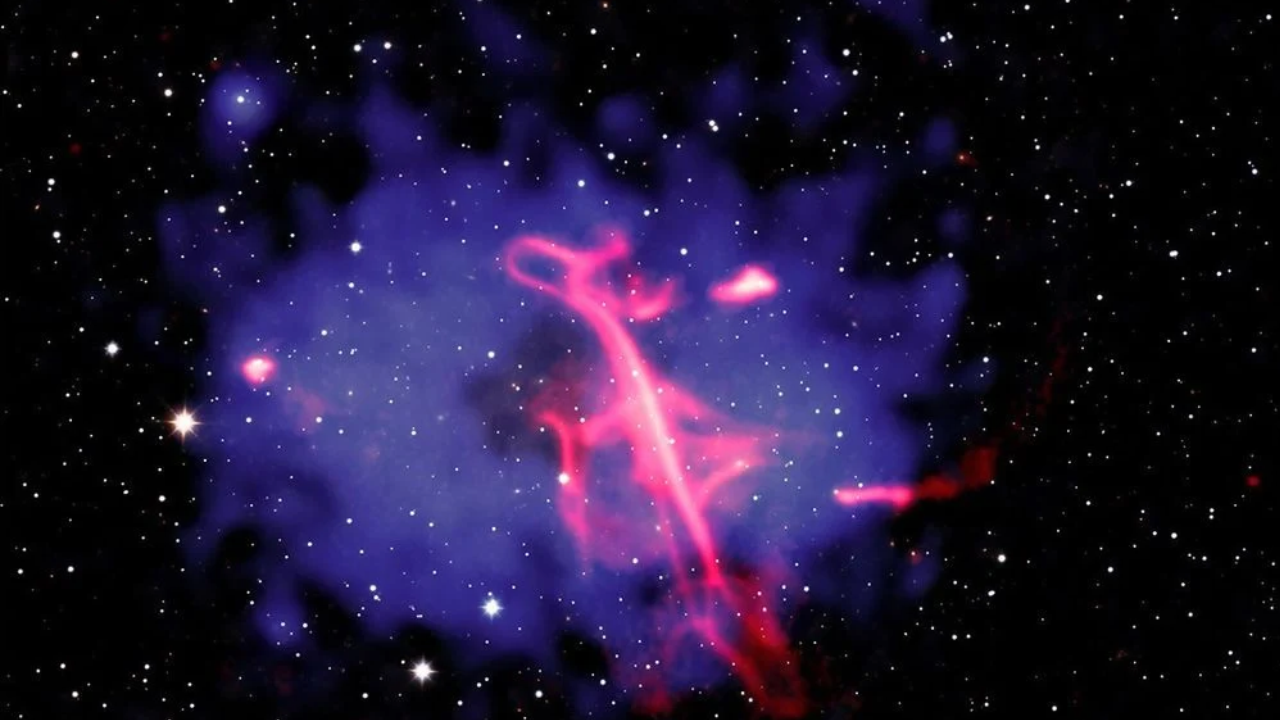
Most people assume black holes only destroy things. They picture cosmic vacuum cleaners swallowing stars, gas, and light, leaving behind a dark void. That's only half the story. Sometimes, a supermassive black hole acts like an architect, blasting out enough energy to sculpt an entire galaxy cluster into bizarre, recognizable shapes—like a musical symbol floating millions of light-years away.
Astronomers recently traced the origins of a strange, looped radio structure nicknamed the Treble Clef inside the galaxy cluster Abell 2597. Located roughly a billion light-years from Earth in the constellation Aquarius, this massive filament of glowing plasma looks remarkably like the musical notation sitting on a sheet of music. By combining radio observations from the Karl G. Jansky Very Large Array (VLA) with X-ray data from NASA's Chandra X-ray Observatory, researchers figured out how it got there. It wasn't a random accident of gravity. A colossal outburst from a central supermassive black hole carved out huge cavities in the surrounding hot gas, and a subsequent cosmic collision re-energized the dying plasma, making it glow brightly in radio waves once again. Meanwhile, you can read related stories here: The Independent Voter Myth And Why US Midterms Still Belong to the Parties.
Why the Treble Clef Structure Confused Astronomers
When radio telescopes first picked up the Treble Clef in Abell 2597, it didn't fit standard models of galactic evolution. Usually, when a supermassive black hole fires off relativistic jets—streams of charged particles moving near the speed of light—you see two symmetrical lobes shooting out in opposite directions. Think of a dumbbell shape. You get a central core, two straight beams, and two puffy clouds at the ends.
The Treble Clef doesn't play by those rules. Instead of straight lines, the radio-emitting plasma twists, loops, and curls back on itself. To explore the bigger picture, we recommend the detailed analysis by USA Today.
For years, astrophysicists debated whether this twisted geometry meant the black hole itself was wobbling like a spinning top—a process called precession—or if violent weather inside the galaxy cluster was bending the jets out of shape. When you look at a galaxy cluster through an X-ray telescope, you don't just see stars. You see the intracluster medium, a vast ocean of superheated gas reaching tens of millions of degrees. This gas isn't static. It sloshes around like water in a shaken fishbowl whenever smaller galaxies fall into the cluster.
Honestly, trying to untangle magnetic fields, relativistic plasma, and sloshing hot gas from a billion light-years away is a nightmare. Radio telescopes show you where the high-energy electrons are spiraling around magnetic fields, while X-ray telescopes show you the thermal gas those electrons are pushing against. Until researchers overlaid the newest, deepest VLA radio maps directly onto Chandra's X-ray images, the full picture remained blurry.
How a Black Hole Blast Sculpted the Gas
The breakthrough came when astronomers realized they were looking at a multi-stage fossil record. Black hole outbursts don't happen overnight; they unfold over tens of millions of years.
Here's what actually happened in Abell 2597. Deep inside the cluster's brightest central galaxy sits a supermassive black hole weighing hundreds of millions of times more than our Sun. Roughly 100 million to 200 million years ago, this giant went through a violent feeding frenzy. As gas spiraled inward, magnetic fields twisted up near the event horizon and launched twin jets of plasma outward at nearly light speed.
Those jets punched straight into the dense, hot X-ray gas surrounding the galaxy. Instead of slicing cleanly through, the jets inflated massive, buoyant bubbles—essentially empty cavities carved out of the surrounding plasma. You can still see these ghost cavities in Chandra X-ray data today as dark regions where the hot gas has been pushed aside.
As those buoyant bubbles rose outward through the cluster's atmosphere, they dragged cooler gas and tangled magnetic fields along in their wake. Think of a hot air balloon rising through smoke. The rising bubbles created swirling eddies and turbulence. Over millions of years, the jets shut off, the high-energy electrons inside the bubbles lost their energy, and the radio glow faded away. The structure went dark, leaving behind an invisible skeleton of tangled magnetic fields and displaced gas.
The Cosmic Collision That Revived the Radio Glow
If the original black hole blast happened over a hundred million years ago, why does the Treble Clef shine so brightly in radio frequencies today? Electrons in space lose energy relatively quickly through synchrotron radiation—the exact process that produces radio waves when electrons spiral along magnetic field lines. Left alone, those radio-emitting bubbles should have gone completely silent tens of millions of years ago.
Something woke them up.
By tracking the movement of the hot X-ray gas across Abell 2597, researchers found unmistakable signs of a galactic merger. A smaller group of galaxies had plunged into the heart of the cluster, slamming into the intracluster medium like a rock dropped into a pond.
This collision sent massive shockwaves and cold fronts rippling through the cluster's gas. When those shockwaves swept over the old, faded plasma bubbles left behind by the black hole, they acted like a cosmic defibrillator. The passing shock compressed the tangled magnetic fields and pumped fresh energy back into the aging electrons, accelerating them once again.
astrophysicists call this process re-acceleration, or "gentle re-energization." Instead of creating new jets from scratch, the merger recycled the old debris. And because the cluster's gas was sloshing back and forth from the impact, those currents bent, stretched, and twisted the newly revived plasma filaments into the looping, musical shape we see today.
It's a wild bit of cosmic timing. Without the initial black hole outburst, there wouldn't have been any magnetic filaments to light up. Without the subsequent galaxy collision, those filaments would have stayed invisible forever.
What Most People Get Wrong About Black Hole Feedback
If you read casual space news, you'll often see black holes described purely as engines of destruction. That framing misses the entire point of modern astrophysics. In massive galaxy clusters like Abell 2597, black holes are actually the primary regulators of life and star formation.
Scientists call this AGN feedback (Active Galactic Nucleus feedback). Here's why it matters so much:
- The cooling flow problem: The hot X-ray gas filling galaxy clusters constantly radiates away energy. According to basic physics, as that gas cools, it should sink toward the center of the cluster, condense into cold molecular clouds, and trigger massive bursts of new star formation. Galaxies at the centers of clusters should be blazing with trillions of young blue stars.
- The reality: When astronomers look at central cluster galaxies, they're mostly "red and dead"—filled with old stars and surprisingly little new star birth. Something is keeping that gas from cooling down.
- The thermostat: That "something" is the central supermassive black hole. Every time the surrounding gas cools just enough to trickle toward the center, the black hole swallows a fraction of it and fires off powerful jets. Those jets pump mechanical energy back into the cluster's atmosphere, heating the gas up and halting star formation.
The Treble Clef isn't just a pretty shape in the sky. It's direct visual proof of this cosmic thermostat at work. By tracing how the black hole's jets carved cavities and how the cluster's shockwaves redistributed that energy, astronomers can measure the exact amount of heat pumped into the system.
Why Multi-Wavelength Astronomy Changes Everything
You can't solve a puzzle like Abell 2597 using a single type of telescope. If you only looked at this cluster with the Hubble Space Telescope or the James Webb Space Telescope in optical or infrared light, you'd see a swarm of elliptical galaxies, some faint dust lanes, and nothing else. The Treble Clef wouldn't even show up.
Radio telescopes and X-ray observatories see completely different universes, and neither tells the full story alone.
Radio arrays like the VLA and the Atacama Large Millimeter/submillimeter Array (ALMA) trace non-thermal physics—relativistic electrons moving at nearly the speed of light, magnetic field orientations, and cold molecular gas clouds. Meanwhile, space-based X-ray telescopes like Chandra and XMM-Newton map thermal physics—million-degree plasma, shockfronts, and pressure gradients.
When research teams align these datasets pixel by pixel, the physics suddenly snaps into focus. In Abell 2597, the bright radio loops of the Treble Clef sit right along the edges of the X-ray cavities and cold fronts. That spatial overlap proves the radio plasma and the hot thermal gas are physically interacting, pushing against one another in a delicate pressure balance.
This combined approach is also revealing that "dead" radio galaxies aren't truly gone. Across the universe, next-generation radio surveys—like those run by the Low-Frequency Array (LOFAR) in Europe and MeerKAT in South Africa—are discovering hundreds of bizarre, ghost-like radio structures called radio phoenixes. These are fossil plasma clouds from ancient black hole blasts that have been squished and re-lit by passing cluster shockwaves. The Treble Clef is one of the clearest, best-studied examples of how a fossil radio source gets a second life.
Where Radio and X-Ray Astronomy Go From Here
The discovery of how Abell 2597's Treble Clef formed highlights a major challenge facing astronomers right now. Ground-based radio astronomy is booming, with massive upgrades to the VLA and construction underway on the Square Kilometre Array (SKA), which will map faint cosmic radio structures with unprecedented sensitivity. We're about to find thousands more twisted, revived plasma filaments across the sky.
X-ray astronomy, however, faces a looming gap. NASA's Chandra X-ray Observatory launched in 1999. While it remains an extraordinary instrument, its thermal insulation is degrading, making it harder to schedule long observations. Without sharp X-ray eyes to map the hot intracluster gas and spot the shockwaves driving these phenomena, radio maps of structures like the Treble Clef become much harder to interpret.
If you want to follow this research as it develops, keep an eye on upcoming data releases from XRISM (the X-Ray Imaging and Spectroscopy Mission, led by JAXA and NASA). Unlike older telescopes that mostly take pictures, XRISM uses a microcalorimeter to measure the exact velocity and turbulence of hot gas in galaxy clusters like Abell 2597. Pairing XRISM's gas-velocity maps with deep radio imaging from MeerKAT and the VLA will let astronomers measure the exact speed of the cosmic winds bending these black hole blasts—turning static pictures of cosmic treble clefs into full-motion weather forecasts of the deep universe.