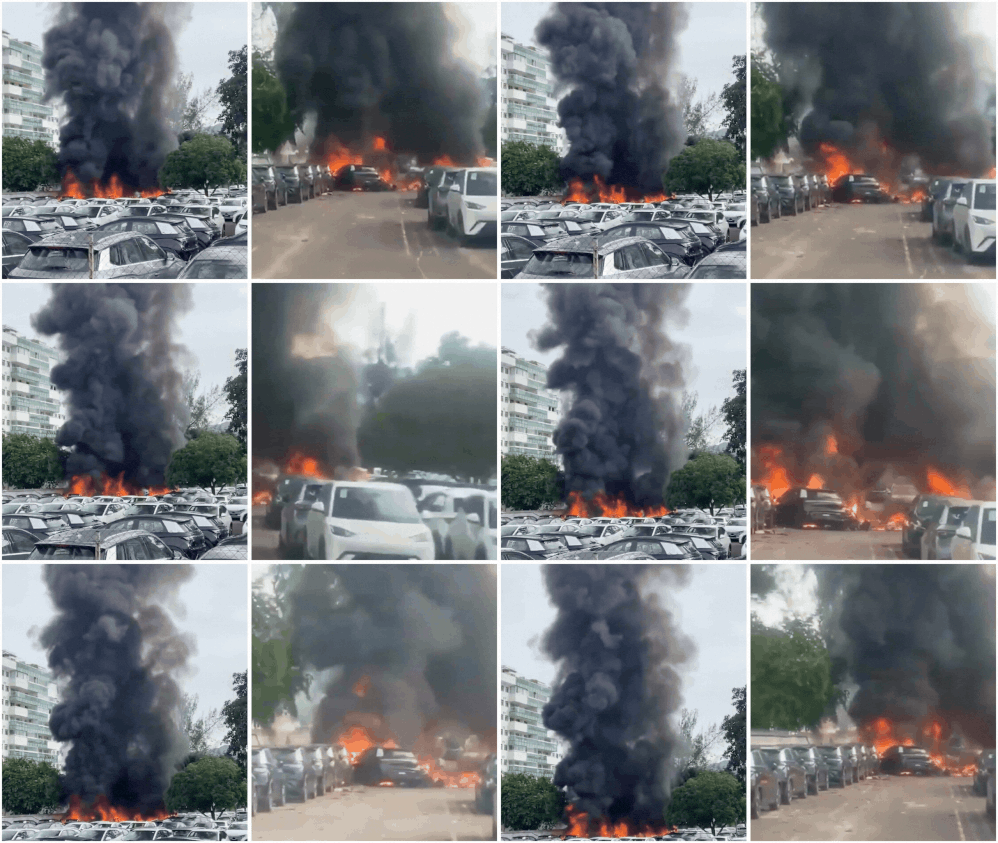
Mid-air collisions in urban low-altitude airspace represent the absolute failure of concurrent tactical separation protocols. When two helicopters collided over the western Rio de Janeiro suburb of Recreio dos Bandeirantes, the resulting six fatalities and the subsequent multi-vehicle blaze highlighted a critical vulnerability at the intersection of dense metropolitan flight paths and ground-level infrastructure hazards. Resolving why these assets occupied the exact same coordinate matrix requires decomposing the event into three operational dimensions: low-altitude spatial tracking failures, post-impact kinetic energy distribution, and the compounding chemical hazards of the ground impact zone.
The incident occurred near Avenida das Américas, where one aircraft carrying five crew members and a secondary aircraft occupied only by the pilot intersected. The structural debris field, spanning a radius of more than 100 meters, indicates a high-energy impact followed by an immediate asymmetric loss of aerodynamic lift. To understand how such an event occurs in a metropolitan area where low-altitude aviation is a standard logistics component, analysts must look past the immediate wreckage and examine the systemic bottlenecks governing urban air traffic management.
The Tri-Centric Failure Framework of Urban Air Traffic
Low-altitude airspace operations depend on a continuous loop of see-and-avoid visual flight rules (VFR) supplemented by onboard transponders and regional air traffic control interfaces. A breakdown in this system typically traces back to three distinct operational vectors.
Human-Machine Interface and Blind Spots
Helicopter airframes possess intrinsic structural design limitations that restrict pilot visibility, particularly during banked turns or changing altitudes. The rotor mast and upper cabin framework create distinct blind zones. If both aircraft are executing maneuvers where their respective blind spots overlap, visual detection becomes mathematically impossible until the closing distance shrinks below the human reaction threshold. This vulnerability is exacerbated in high-density coastal urban corridors where rapid transitions between varying microclimates affect wind vectors and pilot visibility.
Transponder Saturation and Latency
The primary defense against mid-air contact is the Traffic Collision Avoidance System (TCAS) or Automatic Dependent Surveillance-Broadcast (ADS-B) telemetry. In areas with high volumes of low-altitude civil, military, and commercial traffic, the frequency spectrum can experience localized saturation. A latency of even two seconds in position reporting translates to an unmapped spatial displacement of dozens of meters when aircraft are traveling at standard cruise velocities. The structural distribution of the wreckage across neighboring building terraces suggests that neither crew executed a last-second high-G evasive maneuver, pointing directly to a complete absence of tactical conflict alerts prior to impact.
Micro-Turbulence and Separation Buffers
The coastal geography of Rio de Janeiro introduces complex thermal updrafts and mechanical turbulence caused by urban topography. Helicopters generate massive downwash vortices. When two rotary-wing assets operate within tight lateral boundaries, the wake turbulence of the leading or higher aircraft can destabilize the flight path of the trailing or lower aircraft. This interaction reduces the effective separation buffer to zero by inducing uncommanded rolling moments that cross the physical limits of cyclic and collective control inputs.
Post-Impact Kinetics and Ground-Level Escalation
The mechanics of the crash demonstrate how an aerial failure converts into a highly volatile ground-level emergency. The separation of the fuselage sections following the mid-air kinetic transfer dictated two distinct impact profiles.
One helicopter suffered catastrophic structural disintegration and exploded upon ground impact within a commercial parking lot. The second airframe landed upside down roughly 100 meters away without catching fire. The primary explosion was fueled by the sudden release of aviation kerosene (Jet A-1) under extreme pressure. When a helicopter fuel cell ruptures upon high-velocity ground impact, the fuel atomizes instantly, mixing with ambient oxygen to form a highly combustible vapor cloud. Any electrical short circuit or hot engine component serves as an immediate ignition source.
The spatial vector of the crash directed this thermal energy directly into a commercial lot holding at least 20 electric vehicles (EVs). This environment transformed a standard hydrocarbon fire into a complex chemical containment challenge.
[Mid-Air Kinetic Collision]
          │
          ├──> Airframe A: Structural Disintegration ──> Pressurized Fuel Release ──> Vapor Cloud Ignition
          │                                                                                  │
          └──> Airframe B: Asymmetric Lift Loss ──────> 100m Spatial Displacement            └──> EV Lot Impact
                                                                                                      │
                                                                                                      ▼
                                                                                         [Lithium-Ion Thermal Runaway]
The Chemistry of Lithium-Ion Thermal Runaway
The transition of the fire from aviation fuel to parked electric vehicles introduced an exponential scale of thermal severity. Firefighting personnel encountered a phenomenon known as thermal runaway, which alters standard emergency response protocols.
The Exothermic Chain Reaction
Lithium-ion batteries contain flammable organic electrolytes. When subjected to the intense external heat of an aviation fuel explosion, the internal separator membranes within the battery cells degrade. This failure triggers internal short circuits, causing rapid, self-sustaining exothermic reactions. The cell temperature spikes within milliseconds, releasing stored chemical energy as heat, which then propagates to adjacent cells in a destructive feedback loop.
Toxic Gas Generation
Unlike conventional internal combustion engine fires, burning lithium-ion packs generate their own oxygen through the decomposition of cathode materials. This makes starvation-based suppression methods ineffective. The combustion process releases a highly toxic cocktail of gases, including:
- Hydrogen Fluoride ($HF$)
- Carbon Monoxide ($CO$)
- Phosphoryl Fluoride ($POF_3$)
These emissions present immediate respiratory hazards to emergency crews and require specialized self-contained breathing apparatus (SCBA) arrays, limiting the speed of close-range search and recovery operations.
Resource Multipliers in Suppression
Data from the municipal response teams indicates that suppressing a fire involving multiple electric vehicles requires three to four times the volume of water needed for standard internal combustion vehicles. Water acts primarily as a cooling agent rather than a smothering agent in these scenarios. The tactical objective shifts from extinguishing the flame to high-volume thermal deluge, preventing the heat from transferring to unignited vehicle chassis. Fire crews managed to halt the propagation of the fire within approximately 60 minutes, a timeframe that underscores the intense resource allocation required to neutralize localized grid threats.
Systematic Safety Deficiencies in Low-Altitude Infrastructure
Aviation safety statistics maintained by the Center for Investigation and Prevention of Aeronautical Accidents (CENIPA) indicate that the incident represents a broader trend within the region. Prior to this event, the jurisdiction recorded 84 aviation incidents in the current calendar year, resulting in 25 fatalities. The recurring nature of these events exposes structural vulnerabilities in low-altitude traffic coordination frameworks.
| Risk Dimension | Current Vulnerability | Systemic Bottleneck |
|---|---|---|
| Airspace Architecture | Blended commercial, private, and state flight paths without dedicated altitude segregation. | Over-reliance on visual flight rules (VFR) in complex terrain. |
| Telemetry Deployment | Variable adoption rates of active collision avoidance hardware across legacy fleets. | High capital expenditure requirements for mandatory ADS-B retrofitting. |
| Ground-Level Risk Mapping | Flight paths directly overlying high-density zoning and hazardous material storage. | Lack of municipal zoning laws coordinating air corridors with surface vulnerabilities. |
The fact that the aircraft crashed into an open parking lot rather than the adjacent high-density residential structures prevented a substantial escalation in civilian casualties. This spatial outcome was entirely a matter of probability rather than engineering design. Relying on luck to mitigate ground hazards reflects a lack of proactive risk management in urban flight path planning.
Strategic Reconfiguration of Urban Low-Altitude Corridors
To mitigate the risks exposed by the Recreio dos Bandeirantes collision, aviation regulators and municipal planners must transition away from legacy VFR protocols in metropolitan centers. The management of low-altitude urban airspace demands the immediate implementation of a structured, three-tiered risk mitigation protocol.
First, regulatory authorities must mandate the creation of structurally segregated low-altitude transit corridors. These corridors must feature strict altitude-by-heading deconfliction, where eastbound and westbound assets are separated by mandatory vertical buffers of at least 500 feet, eliminating the reliance on visual acquisition in high-density areas.
Second, all aircraft operating within metropolitan boundaries must be retrofitted with mandatory, dual-band ADS-B transponders utilizing localized, ground-based transceiver stations to reduce telemetry latency below 500 milliseconds. This reduces the spatial tracking error loop and ensures real-time conflict detection algorithms can trigger automated cockpit warnings well before human visual acquisition occurs.
Finally, municipal zoning must integrate surface hazard mapping into authorized flight paths. Air corridors must be dynamically routed away from high-density residential zones, critical energy infrastructure, and industrial locations containing volatile materials like lithium-ion storage arrays or chemical processing plants. If an in-flight catastrophic event occurs, the descent profile must be restricted to pre-designated emergency landing zones or low-hazard industrial corridors designed to handle high-energy impacts without triggering cascading ground-level disasters.