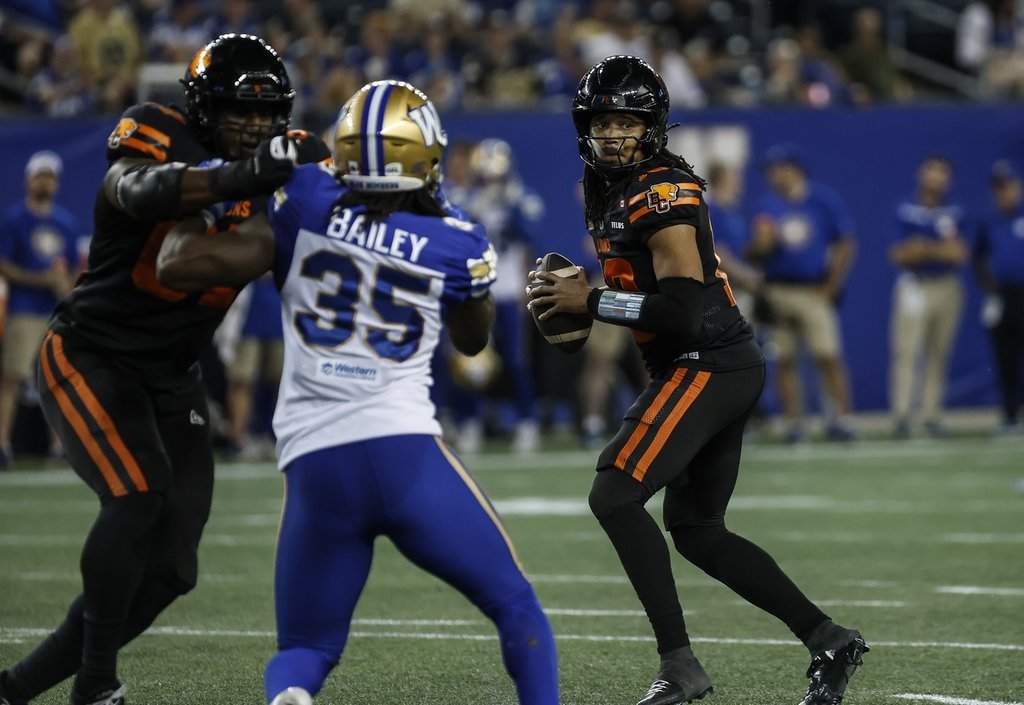
Roster construction in professional football operates on structural margins where the loss of a single elite offensive tackle cascades through every layer of an offensive architecture. When the Winnipeg Blue Bombers placed All-CFL right tackle Jarell Broxton on the one-game injured list due to a knee strain sustained against the Calgary Stampeders, the impact extended far beyond a simple substitution. Evaluating this absence requires moving past surface-level injury reports to analyze the underlying mechanics of pass protection efficiency, interior line stability, and quarterback pressure metrics.
The Cost Function of Elite Trench Personnel
Offensive line performance functions as a non-linear system. Protection quality is dictated by the weakest link rather than the cumulative average of the unit. Broxton commanded a marquee free-agent investment because elite American offensive tackles provide a fixed asset: isolation capability on the boundary. You might also find this related coverage insightful: Why Liverpool Is Going Through Massive Changes Right Now.
When a tackle of Broxton's caliber—who posted a league-best pass-blocking grade of 81.2 with the BC Lions—is removed from the lineup, the offensive coordinator’s operational blueprint shifts immediately.
- Isolation Loss: Without a blindside or strongside anchor capable of neutralizing elite edge rushers in pure one-on-one pass sets, the scheme must allocate additional resources to chip with running backs or slide tight end protection.
- Coordinate Shifts: Protection shifts force alterations in passing routes, systematically eliminating downfield options and shrinking the time-to-throw window for the quarterback.
Positional Ripple Effects Across the Line
The absence of a primary tackle creates structural displacement across the entire five-man front. When Broxton exited mid-game against Calgary, the ripple effects forced multiple interior linemen out of their natural cadence. Shuffling guards to tackle and centers to guard introduces communication friction, which defensive coordinators exploit through simulated pressures and delayed interior blitzes. As reported in latest reports by Sky Sports, the effects are significant.
Winnipeg's substitution strategy inserts Micah Vanterpool into the regular-season lineup. While Vanterpool offers athletic upside and positional versatility, moving from a rotational or depth role into a starting assignment against a complex front introduces variance. Variance in pass protection translates directly to disruption in the pocket.
Quantifying the Pressure Differential
A team's sack total—such as Winnipeg allowing 14 sacks through the early portion of the season—tells only a fraction of the story. The hidden metric lies in the pressure rate per dropback and the pocket collapse velocity.
- Velocity of Collapse: An elite tackle extends the pocket's collapse threshold by consistently resetting the pass-rush arc past the quarterback's launch point.
- Substitute Exposure: Second-tier tackles or players operating out of position frequently surrender inside leverage early in the rush arc, forcing the quarterback to abort the progression before intermediate routes develop.
This dynamic places an acute burden on the offensive backfield. With Dru Brown operating behind a fluctuating line and key weapons like Brady Oliveira managing physical ailments, the offense cannot rely on slow-developing vertical concepts. The playbook must compress horizontally and temporally, relying on quick game execution to bypass the defensive pass rush before structural vulnerabilities manifest in the trenches.
Strategic Operational Adjustments
Mitigating the loss of a foundational lineman demands a calculated shift in play-calling tendencies. Coordinators must manipulate the distribution of risk through specific tactical adjustments.
- Tempo and Cadence Variation: Utilizing fast-tempo snaps prevents defensive fronts from substituting package-specific rushers and limits the complexity of disguised front alignments.
- Launch Point Mobility: Moving the pocket via rollout action and bootlegs alters the geometry of the edge rush, neutralizing the primary advantage of athletic defensive ends.
- Run Game Commitment: Establishing early down efficiency forces linebackers to honor the run fake, slowing the get-off speed of the defensive front and preserving the structural integrity of pass protection sets.
The immediate objective for the coaching staff is containment rather than dominance. By shortening passing progressions and deploying max-protection schemes on critical downs, the offense can insulate its structural deficiencies until personnel equilibrium is restored in the trenches.