Structural Vulnerabilities in Long Distance Coach Operations
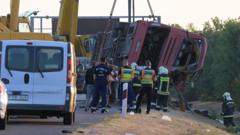
Transit safety is governed by the intersection of mechanical integrity, infrastructure design, and human factors engineering. When a catastrophic collision occurs, such as the fatal crash involving a Polish passenger bus on a Hungarian motorway, media narratives typically reduce the incident to isolated driver error or sudden mechanical failure. This reductionist view obscures the underlying systemic variables that dictate high speed corridor safety. Long distance commercial transport operates under tight operational constraints where risk compounds non-linearly. To understand why a transit system fails, one must analyze the structural mechanics of driver fatigue, corridor risk profiles, and passenger restraint physics.
Commercial passenger transport across international borders involves complex regulatory compliance frameworks, yet enforcement mechanisms remain fragmented. A bus operating on a high speed motorway is subject to kinetic energy loads that scale quadratically with velocity. When structural containment systems fail, the dissipation of this energy relies entirely on vehicle design and immediate roadside topography. Analyzing motorway incidents requires mapping the chain of custody for risk, spanning from fleet scheduling algorithms down to the structural yield strength of roadside guardrails. Meanwhile, you can read similar stories here: Inside the Autocratic Survival Playbook How Brittle Regimes Keep Power.
The Operational Cost Function of Long Distance Transit
The economics of international passenger transport force a rigid trade off between transit time and safety margins. Fleet operators optimize for utilization rates, meaning vehicles and operators are pushed toward maximum allowable capacity thresholds. This creates an operational cost function where downtime is heavily penalized, incentivizing practices that stress operator endurance.
Driver Fatigue and the Circadian Vulnerability Window
Human operational performance degrades predictably under prolonged wakefulness and circadian troughs. In long distance coach operations, scheduling models often utilize dual driver rotations to meet legal distance requirements while maintaining continuous movement. However, sleep quality within a moving commercial vehicle is severely compromised due to vibration, noise, and postural restriction. To see the bigger picture, check out the detailed analysis by NPR.
The physiological cost of night driving manifests as microsleep episodes and delayed reaction times. When a vehicle traveling at motorway speeds experiences a multi second lapse in operator attention, the distance covered unguided is measured in hundreds of meters. Motorway environments offer little margin for error during such events, as high speed velocity vectors leave minimal time for corrective steering inputs once deviation from the travel lane begins.
Infrastructure Safety Margins and Kinetic Energy Dissipation
Motorway design standards assume a baseline level of driver attentiveness and vehicle control. However, when a heavy passenger vehicle loses stability, the physical forces involved exceed the standard containment parameters designed for lighter passenger cars.
- Impact Angle and Barrier Yield: Roadside barriers are engineered to redirect standard passenger vehicles. A fully loaded coach possesses a mass several times greater, resulting in significantly higher momentum vector redirection requirements. If the impact angle exceeds critical thresholds, standard steel or concrete barriers can be breached or fail to prevent rollover events.
- Drainage and Hydroplaning Vectors: Road geometry, including cross slopes and catchment basins, dictates water accumulation risks during precipitation events. Standing water on high speed corridors introduces hydrodynamic lift, compromising tire contact patches and neutralizing steering authority before the driver can implement corrective maneuvers.
Risk Mitigation Protocols and Systemic Redundancies
Mitigating catastrophic failures in passenger transit requires moving past reactive compliance and implementing active safety redundancy. Modern transit management relies on telemetry, proactive fatigue monitoring, and structural reinforcement standards that absorb energy rather than simply deflecting impact forces.
Fleet operators must transition from static scheduling compliance to dynamic workload management. This involves integrating biometric monitoring to detect cognitive fatigue markers before operational errors occur. Furthermore, infrastructure authorities must reevaluate motorway safety barriers on high volume international transit corridors to ensure containment ratings match the kinetic profiles of modern heavy passenger vehicles.
Modernize cross border transit governance by mandating real time telemetric oversight of driving hours, structural upgrades to high risk motorway barriers, and mandatory rest architecture that prioritizes restorative sleep over mere legal compliance.