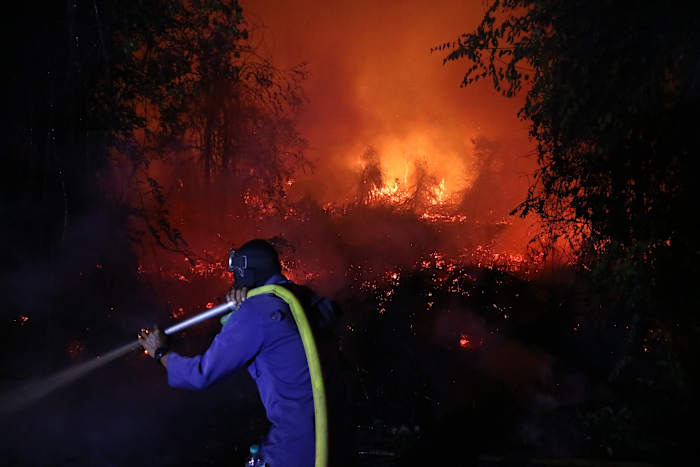
Cross-border environmental crises reveal the structural limits of sovereign disaster response frameworks when ecological conditions outpace logistical throughput. The escalation of peatland and forest fires across Indonesia, driven by intensifying dry phases of the El Niño oscillation, has once again pushed transboundary haze across regional boundaries into Malaysia and Brunei.
To deconstruct this phenomenon, one must look past standard political declarations and examine the economic incentives of land clearance, the physics of underground peat combustion, and the hard limits of aerial suppression logistics.
The Economic Mechanics of Land Clearance Failure
The recurring seasonal haze is not merely an accident of climate; it is the output of an economic cost-minimization strategy practiced by both smallholders and commercial plantation entities. Mechanized land clearing involves significant capital expenditure for heavy machinery, fuel, and labor. Conversely, the application of fire is an exceptionally cheap marginal-cost method to strip biomass and release nutrients into nutrient-poor tropical soils.
When institutional enforcement fails or inspection bandwidth is narrow, the expected value of illegal burning—measured by immediate cost savings—outweighs the expected value of regulatory penalties. Even though Indonesian authorities have initiated criminal investigations against commercial entities and arrested dozens of individual suspects, the deterrent effect remains weak because the probability of detection per hectare cleared via fire is statistically low across millions of hectares of remote terrain.
This dynamic creates a negative externality trap. The private cost of land preparation approaches zero for the bad actor, while the social cost—manifested in respiratory illnesses, grounded aviation, and international diplomatic friction—is distributed across millions of citizens in Indonesia, Malaysia, and Brunei.
The Thermodynamic Reality of Peatland Combustion
Standard firefighting metrics, such as the number of surface hot spots detected by satellite or the volume of water dropped, often mask the underlying operational reality. Tropical peatlands are ancient layers of partially decayed organic matter accumulated over millennia. When drained for agriculture, these soils dry out well below the surface, transforming into subterranean carbon reservoirs.
[Surface Ignition] --> [Drainage & Desiccation] --> [Subsurface Peat Smoldering] --> [Atmospheric Haze Dispersion]
Surface water-bombing via helicopters or fixed-wing aircraft provides high tactical visibility, but it is thermodynamically insufficient for extinguishing deep-seated peat fires. Water dropped from above evaporates before penetrating the canopy or fails to reach combustion zones burning meters underground. Consequently, a hot spot count can decrease following aerial suppression while the smoldering process continues silently beneath the surface, reigniting as soon as winds rise or surface humidity drops.
Resource Allocation Constraints and Airspace Logistics
When thousands of square kilometers burn simultaneously across Sumatra and Indonesian Borneo, disaster management agencies face a severe resource scarcity problem. The National Disaster Management Agency deploys tens of thousands of ground personnel, yet vast sections of remote peatland remain physically inaccessible due to a lack of roads, water sources, and transit infrastructure.
To bridge this operational gap, authorities rely on high-capacity assets, including dozens of domestic and foreign-registered aircraft authorized for water-bombing and aerial patrols. Furthermore, weather-modification initiatives—such as cloud seeding using salt particle dispersal—attempt to force precipitation over target zones. However, cloud seeding is bound by atmospheric chemistry; it fails entirely if requisite moisture-laden cloud formations are absent during peak drought phases.
Diplomatic and operational coordination must adapt to these physical constraints. Recent arrangements allowing cross-border flight clearances for weather modification along shared borders represent a functional pivot toward regional cooperation. Yet, tactical deployment speed remains bottlenecked by bureaucratic clearance procedures and the sheer physical distance between staging airports and remote fire fronts.
Strategic Allocation of Enforcement and Suppression Capital
Mitigating future cycles requires a complete reallocation of state capital away from reactive suppression and toward preemptive structural barriers. First, financial institutions funding agro-forestry expansion must enforce strict zero-burn conditionalities backed by satellite monitoring, cutting off credit to corporate supply chains linked to hot spots. Second, community-level water management infrastructure—such as canal blocking to re-wet drained peat domes—must be treated as critical national security engineering. Unless the water table within peat ecosystems is artificially maintained above critical desiccation thresholds, aerial firefighting will remain a perpetual exercise in managing symptoms rather than altering systemic risk.
Fires In Indonesia, Smoke In Malaysia | Transboundary Haze Returns To Plague Southeast Asia
This video provides an in-depth regional analysis of how recurring transboundary haze impacts air quality and diplomatic relations between Indonesia and Malaysia.