The November 2026 collapse of Ueno Bank and the subsequent impeachment of Paraguayan President Santiago Peña represent a textbook failure of regulatory independence, not an isolated market shock. When a rapid-growth financial institution absorbs roughly $850 million in public-sector liquidity while operating under the oversight of its own former executives, insolvency becomes a structural certainty rather than a tail risk.
Standard political reporting frames Peña’s decision to skip his Senate impeachment proceedings and his subsequent removal from office as a sudden constitutional crisis. This surface-level narrative misses the underlying financial mechanics. The fall of Ueno Bank was the terminal phase of a multi-year feedback loop linking state capital allocation, related-party lending, and regulatory forbearance. Understanding how a digital lender grew to capture 60 percent of Paraguay’s adult population before freezing nearly three million accounts requires mapping the exact mechanisms of institutional capture.
The Three Pillars of Institutional Capture
In functional banking systems, capital allocation is disciplined by market pricing and enforced by independent prudential supervision. In Paraguay between 2023 and 2026, those guardrails were dismantled across three operational vectors.
- State-Directed Liquidity Injection: Rapid balance sheet expansion requires cheap, sticky funding. Ueno Bank bypassed traditional retail customer acquisition costs by securing massive deposits from state-owned enterprises and public pension funds. Total public-sector exposure reached between $800 million and $850 million, including approximately $380 million from public pension entities and $163.8 million transferred from the binational hydroelectric entity Itaipú. In several instances, these allocations breached internal concentration limits designed to prevent single-counterparty risk.
- Circular Regulatory Governance: Prudential oversight fails when the regulator shares financial and career incentives with the regulated entity. Prior to assuming the presidency in 2023, Peña held preferred Class K shares in Credicentro—which merged into Ueno Holding under Grupo Vázquez—retaining roughly a 1.58 percent equity stake until public pressure forced a divestment in April 2025. Simultaneously, Peña appointed former Ueno president Carlos Carvallo Spalding to lead the Central Bank of Paraguay (BCP). This alignment neutralized early supervisory interventions, allowing compliance anomalies to compound unchecked.
- Related-Party Balance Sheet Distortion: With abundant state liquidity and compliant regulators, Ueno’s management deployed capital into insider-linked ventures. Prosecutorial filings and central bank audits later revealed that the lender extended low-interest credit to business partners of CEO Miguel Vázquez and firms receiving state contracts. To mask deteriorating asset quality, the institution engaged in accounting misclassification, booking operational expenses as balance sheet assets and executing agreements signed by identical parties on both sides of the transaction.
This three-part architecture created an artificial growth engine. To outside observers, Ueno appeared to be a fintech success story driving financial inclusion across a growing economy. Internally, the bank functioned as a maturity-transformation vehicle that converted public-sector deposits into illiquid, insider-controlled assets.
The Insolvency Mechanics and Resolution Trigger
Banks rarely fail solely because of bad loans; they fail when liquidity buffers vanish and solvency ratios breach statutory minimums, forcing a regulatory intervention. By early November 2026, Ueno’s accounting maneuvers could no longer conceal its capital deficit.
When BCP investigators finally audited the bank’s true asset base following mounting noncompliance reports, they discovered Ueno’s solvency ratio had fallen below half the legally required minimum. On November 2 and 3, the central bank ordered Ueno into a formal resolution process, triggering an immediate asset freeze across roughly three million retail accounts and halting card and digital payment networks.
The financial fallout immediately exposed the asymmetry between retail and institutional protections:
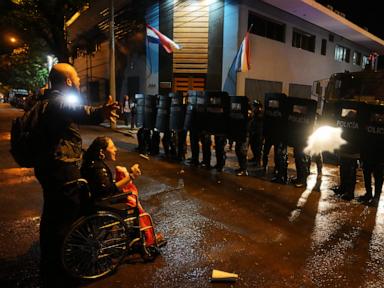
- Retail Deposit Coverage: Paraguay’s National Deposit Guarantee Fund (FGD) insures individual accounts up to 75 times the monthly minimum wage, roughly $38,000 per depositor. While this threshold theoretically covers 97 percent of individual account holders, operational bottlenecks delayed initial disbursements, sparking street protests outside central bank headquarters.
- Uninsured Public Exposure: State deposits and pension funds do not enjoy standard retail deposit insurance protection. With central bank estimates projecting total losses up to $1 billion—and roughly one-third of the bank's $2.8 billion deposit base at risk of non-recovery—public pension funds and state agencies face severe principal haircuts unless absorbed by the national treasury.
- Macroeconomic Contagion: Although officials characterized Ueno’s failure as idiosyncratic, sovereign risk metrics reacted immediately. Paraguayan sovereign bond spreads widened by 30 basis points, the guaraní depreciated by more than 8 percent against the U.S. dollar, and Fitch Ratings placed the country’s investment-grade credit rating on watch for a potential downgrade.
Political Collapse as a Governance Feedback Loop
The speed of Peña’s political demise illustrates how financial insolvency translates directly into constitutional breakdown when executive power is tied to the failed institution. On November 5, facing unanimous opposition in the Chamber of Deputies, Peña attempted to submit his resignation to preempt a formal trial. Lawmakers rejected the maneuver, voting 78–0 to impeach him.
When the Senate reconvened on November 6 and denied Peña’s legal team a 72-hour procedural delay, the president opted to boycott the hearing. In impeachment proceedings, skipping the defense phase is a calculated tactical retreat aimed at delegitimizing the tribunal for future domestic or international legal challenges—a strategy Peña’s defense counsel explicitly signaled. However, in a legislature where the ruling party had fractured under intense public pressure, absence merely accelerated removal.
The Senate convicted Peña of poor performance of duties, stripped him of his lifetime senatorial immunity, and swore in Vice President Pedro Alliana to finish the 2023–2028 term. Within hours, the removal of constitutional immunity converted a political defeat into criminal liability. Prosecutors detained Peña alongside former BCP chief Carlos Carvallo on charges of breach of trust, criminal association, and administration for personal gain, while issuing arrest warrants for 27 executives linked to Ueno and Grupo Vázquez.
The institutional purge quickly expanded beyond the presidency. Over the following two weeks, interim central bank head Liana Caballero Krause was arrested on similar breach-of-trust charges, Attorney General Emiliano Rolón Fernández resigned ahead of an impeachment vote over delayed raids, and Itaipú director Justo Zacarías Irún was dismissed over the unauthorized $163.8 million transfer.
Systemic Risks and Institutional Limitations
Rebuilding market confidence after a state-facilitated bank failure requires more than criminal prosecutions. Interim President Pedro Alliana and newly nominated BCP chief Jorge Schreiner face severe structural constraints that limit the effectiveness of standard crisis-management tools.
First, deposit guarantee funds are not designed for systemic shocks. The FGD relies on contributions from surviving commercial banks. Liquidating reserves to cover nearly three million accounts transfers liquidity strain onto healthy private lenders, tightening domestic credit supply across the broader economy.
Second, financial inclusion metrics suffer permanent hysteresis. Roughly one million of Ueno’s three million customers were first-time users of the formal banking system. Freezing their liquid balances destroys trust in digital banking infrastructure, incentivizing a reversion to cash-based informality that reduces tax collection and monetary policy transmission.
Third, operational governance reforms face political entrenchment. Removing individual actors does not automatically alter the statutory rules governing how state-owned enterprises and pension funds allocate deposits. Without hard statutory caps and automated transparency requirements, public liquidity remains vulnerable to political capture by future administrations.
Strategic Mandate for Sovereign Stabilization
To contain sovereign contagion and prevent a prolonged credit contraction before the 2028 general elections, Paraguay’s interim administration and central bank leadership must execute three sequential stabilization measures:
- Ring-Fence Public Pension Losses: Separate the recovery of uninsured public-sector deposits from the retail FGD payout mechanism. Issue long-dated, non-tradable sovereign recapitalization bonds to cover verified principal shortfalls in public pension funds rather than draining central bank foreign exchange reserves or forcing immediate fiscal austerity.
- Enforce Statutory Public-Deposit Rules: Pass immediate legislation prohibiting state-owned enterprises, binational entities, and pension funds from placing deposits in any commercial bank that does not meet strict, independently audited tier-one capital ratios and concentration limits. Require all public-sector deposit placements to be published in real time on a public ledger.
- Establish an Independent Resolution Trust: Transfer Ueno’s distressed loan portfolio and seized corporate assets to an autonomous liquidation trust overseen by external forensic auditors rather than political appointees. Accelerate asset recovery from related-party borrowers to offset treasury liabilities and demonstrate institutional independence to international rating agencies.