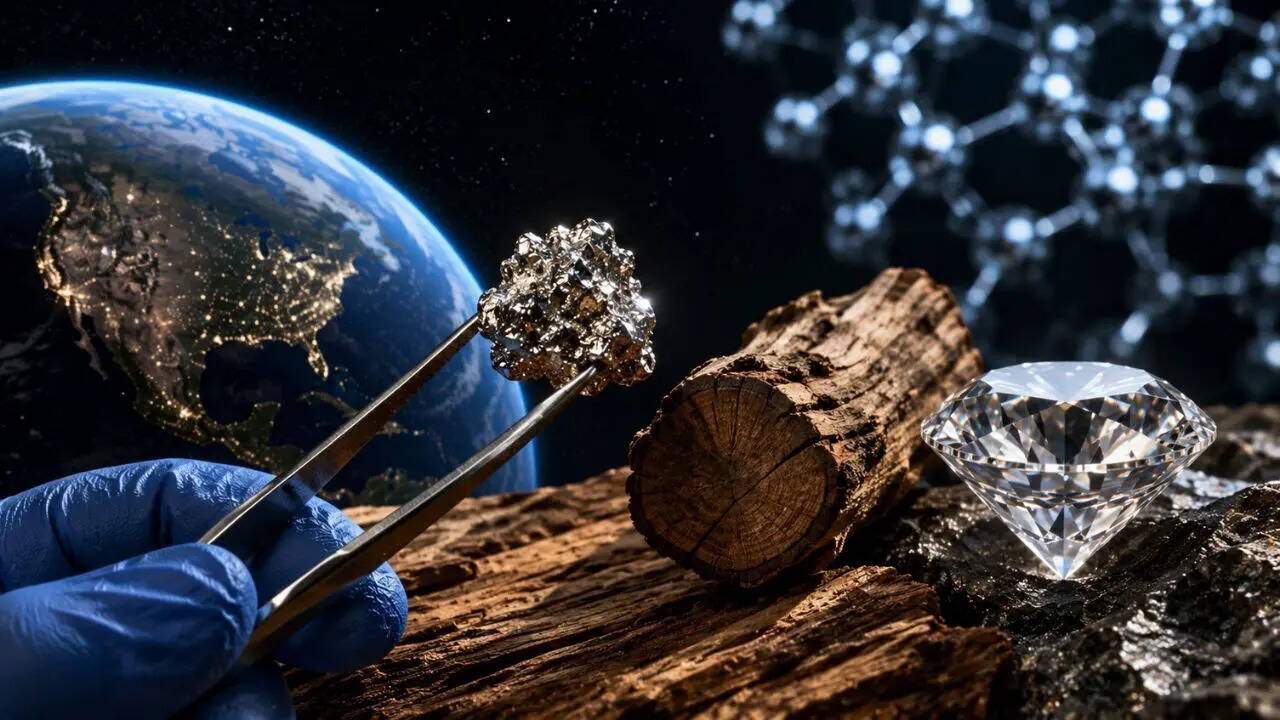
Material scarcity is frequently conflated with consumer value, leading to the erroneous assumption that diamonds represent the pinnacle of structural rarity. This misclassification stems from a fundamental misunderstanding of cosmic thermodynamics versus biological synthesis. When measured against the baseline of universal abundance, the crystalline carbon structures prized by industrial and consumer markets are functionally ubiquitous. The true baseline for physical rarity in the known universe requires a shift in focus from high-pressure geological physics to self-sustaining biological systems.
To systematically evaluate what makes a material genuinely rare, matter must be categorized by the mechanisms that govern its creation. This breakdown reveals why common luxury items fail the metrics of scarcity and how biological structures like wood represent a far more anomalous convergence of cosmic variables.
The Ubiquity of High-Pressure Physics
The baseline assumption that diamonds are rare is dismantled by tracking the cosmic distribution of carbon under mechanical stress. Carbon is one of the most chemically adaptable and abundant elements in the universe. The transition of carbon into a tetrahedral lattice structure demands a specific thermodynamic envelope: pressures exceeding 4.5 gigapascals and temperatures above 1,000°C. While localized to specific depths within Earth's mantle, these conditions are a baseline physical standard across the broader cosmos.
This structural creation can be broken down into three distinct pathways of universal synthesis:
- Planetary Atmospheric Compression: Within the deep, high-density atmospheres of ice giants like Uranus and Neptune, atmospheric methane undergoes thermal decomposition. The liberated carbon atoms, subjected to gravitational compression, organize into crystalline structures. This manifests as a continuous deposition of diamond precipitation migrating toward the planetary cores.
- Interstellar Shockwaves: Supernova remnants supply vast volumes of carbon-rich gas to interstellar dust clouds. The kinetic energy from stellar explosions drives high-velocity collisions among these particles, generating localized shock pressures sufficient to synthesize nanodiamonds without requiring a planetary body.
- Meteoritic Impact Dynamics: When carbon-bearing meteors collide with planetary bodies, the immediate kinetic energy transfer creates localized zones of extreme pressure and temperature. This phase transition bypasses standard geological timelines, instantly restructuring graphite into diamond polymorphs.
Because these three pathways rely entirely on basic kinetic and thermodynamic laws, the resulting crystalline structures occur wherever matter and energy interact under standard cosmic constraints. The existence of these materials requires no specialized historical sequence or systemic organization; it requires only that physics operates uniformly.
The Biological Production Function
The structural complexity of wood presents an entirely different thermodynamic challenge. Wood is not the product of passive geological pressure; it is chemistry organized by active, continuous biological systems. The formation of wood requires an unbroken chain of metabolic energy conversion, genetic compartmentalization, and evolutionary adaptation.
The synthesis of this material relies on a precise internal framework driven by two primary structural polymers:
[Atmospheric CO2 + H2O + Solar Photons]
                  │
                  ▼ (Photosynthetic Reduction)
             [Glucose]
                  │
                  ▼ (Polymerization Pathways)
   ┌──────────────┴──────────────┐
   ▼                             ▼
[Cellulose Chains]       [Lignin Matrix]
 (Tensile Strength)       (Compressive Rigidity)
   │                             │
   └──────────────┬──────────────┘
                  ▼
         [Wood Architecture]
Cellulose provides the material's foundational tensile strength. It consists of linear, unbranched chains of D-glucose units linked by $\beta(1\rightarrow4)$-glycosidic bonds. This molecular arrangement allows parallel chains to form extensive networks of hydrogen bonds, crystalline microfibrils with exceptional mechanical stability.
Lignin acts as the hydrophobic encrusting matrix that fills the interstitial spaces between cellulose microfibrils. It is a highly complex, three-dimensional aromatic polymer synthesized via the oxidative radical coupling of monolignols (specifically $p$-coumaryl, coniferyl, and sinapyl alcohols). Lignin provides the compressive rigidity necessary to prevent structural collapse under gravitational load and seals the vascular highway to enable long-distance water transport.
The production bottleneck for this material is not the availability of its constituent elements. Carbon, hydrogen, and oxygen are universally abundant. The bottleneck is the systemic infrastructure required to assemble them. Wood requires a self-replicating organism capable of harvesting solar photons, splitting water molecules, reducing atmospheric carbon dioxide, and precisely depositing polymers over decades-long horizons.
Systemic Constraints and Creation Mechanics
To quantify why biological architectures outclass mineral structures in scarcity, the mechanisms of their formation must be analyzed through a system-level constraint framework.
Minerals form via closed or open thermodynamic systems tending toward minimum free energy. When a magma body cools or a tectonic plate shifts, atoms settle into predictable crystal lattices governed by their ionic radii and valencies. This process is passive, inevitable, and mathematically deterministic. If the required pressure ($P$), temperature ($T$), and elemental concentration ($X$) variables are satisfied, the mineral will form:
$$f(P, T, X) \rightarrow \text{Mineral Structure}$$
Biological synthesis operates on an entirely different paradigm. It requires a system that actively resists entropy by consuming external energy. A tree maintains an internal microenvironment far removed from external thermodynamic equilibrium. This process demands a continuous, uninterrupted flow of energy and an inherited genetic blueprint capable of managing complex chemical reactions across multiple cell layers.
The structural variance between these two regimes highlights the fundamental difference in their creation mechanics:
- Timeline Dependencies: Mineral crystallization can occur in isolated bursts—such as an impact event—or over prolonged, static geological eras. Biological synthesis demands absolute continuity. If the metabolic energy flux of a living system is interrupted for even a brief period, the production function fails entirely, and the existing material undergoes immediate degradation.
- Environmental Sensitivity: Mineral formation is highly resilient to broad fluctuations in localized environments, provided the core thermodynamic parameters remain intact. Biological polymer assembly is fragile, requiring narrow, highly regulated ranges of ambient temperature, liquid water availability, and atmospheric composition.
- Structural Information Density: A diamond crystal contains low informational density; its structure is a simple, repeating three-dimensional pattern of carbon atoms. Wood possesses immense informational density, featuring organized hierarchies of growth rings, xylem conduits, cell walls, and fiber matrices that record environmental variations and evolutionary adaptations over time.
Mineral Scarcity on a Planetary Scale
While cosmic comparisons demonstrate the absolute rarity of biological matter over physical minerals, a separate structural breakdown must be applied when analyzing rarity strictly within Earth's crust. Even on a purely geological scale, diamonds fail the metric of scarcity. They are found across multiple continents and processed by the ton annually.
True mineralogical rarity is defined by severe elemental incompatibility, where the constituent parts of a crystal lattice actively resist bonding under standard geological conditions. This phenomenon is perfectly illustrated by Earth's rarest recognized mineral species: kyawthuite and painite.
       [Tectonic Collision Zone: Indian & Asian Plates]
                             │
            ┌────────────────┴────────────────┐
            ▼                                 ▼
   [High-Bi/Sb Pegmatites]           [Boron-Rich Shallow Seas]
            │                                 │
   (Extreme Hydrothermal Fluid)      (Zirconium-Bearing Magmas)
            │                                 │
            ▼                                 ▼
     [Kyawthuite]                      [Painite]
    (Bi3+ Sb5+ O4)                 (CaZrAl9O15(BO3))
  *Single Sample Specimen*       *Extreme Lattice Strain*
Kyawthuite: The Single-Specimen Threshold
Kyawthuite ($\text{Bi}^{3+}\text{Sb}^{5+}\text{O}_4$) represents the absolute limit of mineralogical scarcity, known from only a single 1.61-carat specimen recovered from the Mogok region of Myanmar. Its rarity is driven by a profound geochemical bottleneck: the co-localization and co-crystallization of bismuth ($\text{Bi}$) and antimony ($\text{Sb}$) in an asymmetrical oxide structure.
Bismuth and antimony are heavy metals that typically segregate into distinct mineral phases during the late stages of magmatic differentiation. For kyawthuite to form, an exceptionally specific hydrothermal fluid must emerge where both elements are concentrated simultaneously in a highly oxidized state, devoid of preferential binding partners like sulfur. The internal architecture consists of checkerboard-like sheets of antimony and oxygen coordinated with bismuth atoms, resulting in an extraordinarily dense structure (eight times the density of water) that is highly unstable outside its ultra-specific formation envelope.
Painite: The Incompatible Lattice Barrier
Painite ($\text{CaZrAl}9\text{O}{15}(\text{BO}_3)$) was long regarded as the world's second-rarest mineral, with only three known specimens existing prior to the early 21st century. The constraint vector for painite is a direct violation of standard mineralogical compatibility: it forces boron ($\text{B}$) and zirconium ($\text{Zr}$) into the same crystal lattice.
In planetary geochemistry, boron is an incompatible light element that concentrates almost exclusively in continental crustal fluids and shallow marine evaporite sequences. Zirconium, conversely, is a heavy transition metal that preferentially locks into early-stage magmatic minerals like zircon. These two elements rarely interact.
The formation of painite requires a cataclysmic geological event, such as the collision of the Indian subcontinent with South Asia. This tectonic event forced boron-rich shallow marine sediments beneath zirconium-bearing magmatic rocks under intense metamorphic pressures. Even when these elements meet, the immense lattice strain caused by forcing vastly different ionic sizes into a single hexagonal structure makes painite formation a statistical anomaly.
Redefining the Metrics of Rarity
The evaluation of material scarcity requires an analytical shift from localized market value to systemic creation mechanics. This analytical paradigm can be summarized through three structural realities:
- Thermodynamic Classifications: Materials must be appraised based on the complexity of their production functions rather than consumer perception. Diamonds represent basic thermodynamic inevitabilities, whereas biological structures require active energy systems to defy entropy.
- Geochemical Constraints: True crustal rarity is dictated by elemental incompatibility and localized tectonic anomalies, as observed in the extreme structural bottlenecks that yield specimens like kyawthuite and painite.
- The Information Baseline: The ultimate metric of scarcity is the density of structural information within a material. A repeating mineral lattice can be replicated by simple kinetic inputs; a complex biological polymer requires an unbroken, historical lineage of systemic organization.
When evaluating assets or materials for strategic, industrial, or scientific allocation, organizations must look past artificial market controls and focus on these foundational mechanics. True scarcity is not a function of mining depth or marketing campaigns; it is determined by the complexity of the system required to assemble the matter.