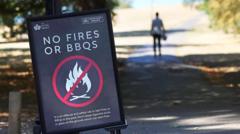
Emergency interventions targeting consumer goods during environmental crises reveal a fundamental tension between regulatory speed and operational reality. When the British government utilized the General Product Safety Regulations to mandate an immediate, temporary halt on the retail and online supply of single-use barbecues, the move was framed as a direct countermeasure against escalating wildfire hazards.
Yet, treating a complex ecological and behavioral phenomenon through the narrow lens of retail product availability introduces severe structural limitations. The underlying mechanisms driving catastrophic ignition events during extreme weather extend far beyond a single product category. Deconstructing this policy reveals a cascade of unintended economic substitutions, enforcement bottlenecks, and misallocated mitigation priorities. You might also find this related article useful: The Map That Bleeds And The Silence We Mistake For Peace.
The Three Failure Points of Retail-Level Product Bans
Regulators often rely on supply-side prohibitions because Point-of-Sale restrictions offer a centralized target. However, banning a product at the checkout counter fails to address the underlying behavioral and physical drivers of fire ignition.
1. The Substitution Loop and Alternative Ignition Vectors
When a specific convenience item is abruptly removed from shelves, consumer demand does not evaporate; it redirects. The elimination of single-use grills accelerates the adoption of substitute hardware, such as cheap portable folding charcoal units or hastily modified reusable setups. As highlighted in latest coverage by The New York Times, the effects are significant.
These alternatives often feature higher thermal retention capacities or less stable frames than standard single-use trays. If a consumer transitions to a sub-standard portable grill and leaves it unattended on desiccated turf, the probability of ignition remains functionally identical or increases. The regulatory restriction targets the medium while leaving the behavioral hazard intact.
2. The Enforcement Vacuum and Supply Chain Friction
Enforcing a sudden retail prohibition via product safety legislation places an immediate burden on local Trading Standards authorities and compliance officers. Large supermarket chains can execute inventory pulls rapidly through automated logistics networks, but independent convenience stores and forecourt retailers operate on fragmented supply chains.
This creates an uneven compliance landscape. Furthermore, online marketplaces host cross-border or third-party vendors capable of circumventing regional stop-sale notices before algorithmic moderation flags the listings. The resulting friction punishes compliant domestic retailers while underground or grey-market distribution channels temporarily absorb the unmet demand.
3. Inventory Stockpiling and the Acceleration Effect
Announcing an impending or immediate temporary prohibition triggers a well-documented consumer response: preemptive hoarding. During the operational window between policy announcement and absolute enforcement, retail sales velocity often spikes. Consumers anticipate scarcity and purchase multiple units to store at home or in vehicles.
Consequently, the immediate aftermath of a ban announcement can saturate the market with distributed hazard units stored in residential garages, ready to be deployed into high-risk rural environments precisely when drought conditions peak.
The Thermodynamics of Ignition and Environmental Vulnerability
To understand why single-use cooking devices became the focal point of emergency measures, one must examine the physical properties of extreme heat events. During prolonged droughts, ambient relative humidity drops, and the moisture content of surface biomass falls below critical thresholds.
A standard single-use foil grill utilizes compressed charcoal briquettes layered over a thin metal base. These units are engineered for high thermal output relative to their mass. When operated on unpaved surfaces, radiant heat transfers directly through the shallow base into dry root structures and peat layers.
Crucially, the danger persists long after active cooking ceases. Residual heat can be retained within dense ash and charcoal beds for hours. If a user attempts to extinguish the unit with insufficient water or buries it under dry organic matter to conceal litter, an oxygen-starved smoldering state transitions rapidly into an open flame once ambient winds increase.
However, attributing systemic landscape vulnerability solely to commercial design ignores the broader matrix of ignition sources. Discarded glass bottles acting as convex lenses, carelessly flicked cigarettes, agricultural machinery sparks, and unauthorized campfires all operate within the same high-risk vector space. Restricting one specific retail artifact does not insulate a landscape characterized by low fuel moisture and high public access.
Economic Externalities and the Cost Function of Emergency Regulation
The application of product safety laws to address environmental emergencies imposes distinct economic costs that rarely appear in emergency legislative calculus.
- Inventory Write-Downs: Retailers absorb direct financial losses from unsellable seasonal stock, which must be stored, returned, or destroyed.
- Margin Compression: Seasonal outdoor categories carry high margins for convenience and grocery operators. Sudden prohibitions eliminate profitable revenue streams during peak utilization periods.
- Administrative Overhead: Compliance verification, legal consultation regarding statutory definitions of disposability, and customer service friction consume operational resources.
When these costs are weighed against the marginal reduction in active ignition sources, the efficiency of the intervention diminishes. If determined individuals can substitute the banned item with open campfires or alternative cooking devices, the net reduction in wildfire incidence approaches zero, while the administrative and economic drag reaches maximum capacity.
Strategic Resource Allocation for Wildfire Mitigation
Mitigating landscape-scale fire risk requires moving away from reactive point-of-sale bans and toward systemic environmental management frameworks.
First, authorities must invest in predictive spatial modeling that dynamically restricts public access to high-risk zones based on real-time meteorological data, mirroring wildfire management protocols utilized in arid continental climates. Closing access tracks and deploying visible enforcement patrols in vulnerable forestry yields higher deterrence value than retail prohibitions.
Second, public communication must transition from moral appeals to explicit consequence signaling. Clear messaging regarding civil liability, property damage recovery costs, and criminal negligence changes the risk calculation for the end-user far more effectively than removing a specific cooking apparatus from a supermarket shelf.
Finally, emergency response infrastructure requires structural scaling rather than tactical diversion. As prolonged heatwaves increase in frequency, relying on municipal fire services designed for structural blazes to manage wide-area grassland and moorland fires exposes a structural capacity deficit. Capital deployment must prioritize dedicated aerial suppression assets and localized rapid-response forestry units capable of containing ignitions before exponential spread occurs.