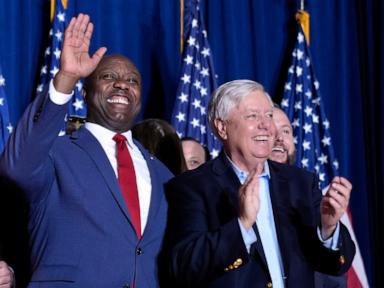
The sudden passing of South Carolina Senator Lindsey Graham at age 71 exposes an immediate and structural deficit within the Republican Party’s institutional architecture. While public memorials focus on personal legacy, a cold strategic assessment reveals a quantifiable disruption in legislative mechanics, judicial processing, and executive branch mediation. Senator Tim Scott’s assertion that Graham is "irreplaceable" is not merely an expression of grief; it is an accurate diagnosis of a sudden depletion of specialized political capital.
To understand why this vacancy cannot be seamlessly filled by a generic replacement, one must analyze the distinct mechanisms through which Graham operated. He managed a complex political portfolio that balanced hawkish internationalism, judicial conservatism, and unparalleled access to the executive branch. Replacing this presence requires solving a multi-variable optimization problem that few sitting lawmakers are equipped to handle. Read more on a similar topic: this related article.
The Tri-Centric Model of Graham’s Political Capital
Graham’s utility within the Senate and the broader conservative movement relied on three structural pillars. The loss of these capabilities creates distinct operational friction points.
                  [ Pillar 1: Executive Mediation ]
                       /                     \
                      /                       \
                     /                         \
[ Pillar 2: Judicial Velocity ] --------- [ Pillar 3: Transnational Security Coalition ]
1. Executive Mediation and the Golf Course Channel
The first pillar is the informal communication channel Graham maintained with President Donald Trump. As Scott noted, Graham’s daily telephonic consultations and frequent collaborative sessions on the golf course functioned as an essential feedback loop between the populist executive branch and the institutionalist legislative branch. More journalism by Reuters delves into related views on this issue.
This mechanism reduced transaction costs in governance. In a highly factionalized party, formal leadership channels can become bottlenecks. Graham functioned as an external arbitrageur who could bypass leadership hierarchies to deliver unvarnished Senate consensus directly to the President, or conversely, interpret presidential intent to skeletal legislative factions before positions hardened. The loss of this informal mediation channel increases the probability of strategic misalignments between the White House and Senate Republicans.
2. Judicial Velocity and Committee Management
The second pillar is Graham’s mastery of the Senate Judiciary Committee apparatus. Having previously served as chairman, his institutional knowledge regarding executive and judicial confirmations directly dictated the velocity of legal appointments.
The confirmation of conservative judges requires a precise combination of procedural discipline and partisan discipline. Graham possessed the tactical capacity to advance controversial nominees through narrow majorities by enforcing strict adherence to committee rules while maintaining enough cross-partisan rapport to defuse procedural filibusters. With the Republican Senate majority sitting at a vulnerable 53 seats, the loss of a senior strategist introduces systemic friction into the judicial pipeline, threatening to slow down confirmations at a time when judicial vacancies require rapid processing.
3. The Transnational Security Coalition
The third pillar is Graham’s unique positioning within international relations. Unlike the isolationist or strictly transactionalist wings of the modern Republican Party, Graham maintained a classical interventionist framework. This posture earned him direct, structural relationships with foreign heads of state, exemplified by Ukrainian President Volodymyr Zelenskyy's immediate acknowledgment of Graham’s role as a primary defender of foreign aid allocation.
Graham operated as a legislative foreign policy entrepreneur. He utilized his position on the Senate Appropriations and Foreign Relations apparatus to build bipartisan defense coalitions. His presence assured international allies of continuity in American security commitments, functioning as an institutional counterweight to populist shifts in domestic foreign policy sentiment.
The Strategic Bottlenecks of Succession
The process of filling Graham’s seat introduces short-term volatility and long-term structural realignments. Under the 17th Amendment, South Carolina Governor Henry McMaster holds the authority to appoint a temporary replacement. However, reproducing Graham’s systemic output involves compounding limitations.
- The Seniority Deficit: A newly appointed senator begins with zero institutional seniority. This creates an immediate degradation of committee leverage for South Carolina. Graham’s senior seats on the Appropriations, Judiciary, and Budget Committees cannot be inherited by a freshman appointee. The immediate reallocation of these committee assignments will spark internal caucus competition, diverting focus from active legislative priorities like the SAVE America Act.
- The Primary-General Special Election Cycle: Because Graham had recently won his June primary, his sudden vacancy forces an emergency adaptation of state electoral machinery. The legal and logistical timeline to establish a special election creates prolonged political exposure for the Republican party in what would otherwise be a secure seat.
- The Bipartisan Arbitrage Deficit: Contemporary political incentives heavily penalize cross-factional negotiation. Graham was an anomaly; he could aggressively champion conservative judicial nominees while simultaneously collaborating with Democrats like Dick Durbin on immigration frameworks or supporting targeted bipartisan rail legislation. His replacement will likely face acute primary pressures that disincentivize the very cross-aisle bridge-building that Scott highlighted as essential to Graham's efficacy.
The Legislative Forecast
The immediate consequence of this structural vacancy is an increase in legislative variance. In a 53-seat majority, the removal of a reliable, high-output vote who can whip uncommitted colleagues creates an immediate bottleneck. This challenge is exacerbated by the ongoing medical absence of Senate institutionalists like Mitch McConnell, further thinning the ranks of senior legislative tacticians.
The strategic play for Senate Leadership is not to find a singular clone of Lindsey Graham—an operational impossibility. Instead, the leadership structure must distribute his portfolio across a decentralized matrix: assigning judicial velocity management to procedural purists, allocating foreign policy mediation to established defense hawks, and establishing a formalized surrogate network to maintain direct communication lines with the White House. Until this structural distribution is complete, the legislative efficiency of the Senate majority will remain significantly compromised.