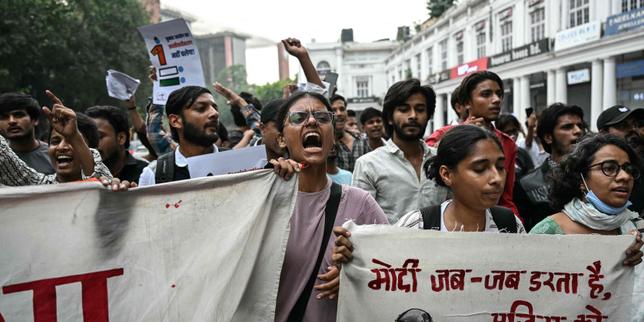
Young Indians contesting the political establishment of Prime Minister Narendra Modi do not form a monolithic ideological bloc or an organized street vanguard; they represent a fragmented cohort responding to sharp mismatches between credential inflation, labor-market absorption, and digital media incentives. Standard commentary—exemplified by sensationalist framing that casts young dissenters as pest-like "cockroaches" or treats viral grievances as a unified anti-regime uprising—misreads the underlying mechanics. To analyze this phenomenon accurately requires separating three interlocking structures: the Credential-Employment Mismatch, the Attention-to-Dissent Funnel, and the Political Coalition Constraint.
Deconstructing Sensationalist Framing vs. Structural Reality
Framing young challengers with derogatory metaphors such as "cockroaches" serves a specific rhetorical function rather than an analytical one. In political discourse, pest imagery implies nuisance, swarm behavior, and lack of coherent agency. That framing collapses under basic structural scrutiny. Dissent among Indians born roughly between the late 1990s and early 2010s is neither uniform nor centrally coordinated. A graduate in Tier-2 Uttar Pradesh waiting on a delayed state exam result operates inside a very different incentive structure than a bilingual university student in Delhi or a gig-economy worker in Bengaluru.
Where superficial coverage treats every sharp online critique or campus protest as evidence of a generational revolt against Modi's rule, a rigorous breakdown looks at friction points. Friction occurs when an institutional promise—such as upward mobility through education, meritocratic public recruitment, or frictionless digital entrepreneurship—collides with rigid supply-and-demand realities. Labeling the actors dismissively obscures the mechanics generating their discontent in the first place.
The Three Pillars of Youth Discontent
Rather than treating grievances as a single grievance-list, we can organize the structural pressures driving young political pushback into three distinct pillars.
1. The Credential-Employment Mismatch
India possesses one of the world's largest youth cohorts, creating a massive demographic supply of degree-holders and exam-takers. Yet formal salaried job creation has historically lagged behind the expansion of higher education and aspirational expectations. This gap produces what labor economists recognize as underemployment and queuing behavior: educated youths spend years preparing for competitive government posts or entry-level white-collar roles because perceived alternatives offer lower job security or social status.
When exam cancellations, administrative delays, or alleged recruitment irregularities occur, the cost is not merely procedural. For an applicant who has invested years of family savings and opportunity cost into a single selection track, a stalled process functions as a direct shock to household mobility. Even when broad macroeconomic indicators show growth, localized bottlenecks in quality job absorption remain visible to young entrants at the bottom of the career ladder.
2. The Algorithmic Amplification Loop
Young Indians are native participants in low-cost mobile data and short-form video ecosystems. In an attention-driven media environment, nuanced policy debates lose out to high-emotion clips, stark moral contrasts, and rapid-fire mockery. Dissenting voices gain traction when they compress complex frustrations—such as living costs, exam anxiety, or local governance failures—into easily repeatable formats.
However, viral visibility does not automatically equal electoral organization. Social media algorithms reward novelty and outrage over sustained coalition building. A post criticizing an authority figure or mocking a public campaign can travel across millions of screens in hours, while the hard work of registering voters, holding local meetings, and sustaining pressure across election cycles remains slow and unglamorous.
3. Ideological Cross-Currents Within the Cohort
A critical error in simplistic coverage is assuming that young Indians who question the current government automatically reject cultural nationalism or embrace a single opposition platform. Surveys and political observation across recent Indian election cycles indicate that youth preferences are cross-cut by caste, region, language, economic class, and cultural identity.
One segment of young citizens may back welfare delivery and cultural assertion while criticizing local corruption or unemployment; another may lean toward opposition parties or regional movements; a third may remain largely disengaged from formal party politics altogether. Treating "Gen Z" as a single voting block or a unified protest movement imposes false symmetry onto a deeply stratified population.
Cause-and-Effect Chains Most Commentary Misses
Surface-level reporting often lists symptoms side by side without tracing how one variable alters another. Several causal chains deserve explicit mapping.
- Education expansion without matching high-productivity job scaling leads to prolonged job-search queues, which raises the political sensitivity of public-sector recruitment rules and exam integrity.
- High smartphone penetration combined with fragmented vernacular and English media accelerates rapid rumor spread and rapid counter-narratives, shortening the half-life of individual protest cycles while increasing polarization.
- Strong national-level leadership branding can insulate top-level support even when voters—including young voters—punish local incumbents or express frustration over state-level administration, creating a split between national sentiment and local dissatisfaction.
- High-decibel online mobilization can raise awareness among urban and connected cohorts without translating into proportional turnout or consolidated opposition votes in rural and semi-urban constituencies where local patronage and caste arithmetic still weigh heavily.
Consider a conceptual example: a cohort of engineering or commerce graduates in a mid-sized city spends two years preparing for recruitment tests. When a test is postponed or mired in controversy, frustration spikes sharply online. Yet if opposition parties fail to offer a credible, locally resonant alternative—or if voters still prefer the incumbent's broader welfare or cultural pitch over fragmented challengers—online anger may produce vocal dissent without producing a regime shift.
Known Facts vs. Educated Hypotheses
Maintaining strict analytical hygiene requires separating established structural realities from interpretive hypotheses where granular, real-time data is incomplete or contested.
Known structural facts include the sheer size of India's young demographic profile, widespread mobile internet access among youth, recurring public debates around youth unemployment, underemployment, and competitive examination administration, and the enduring multi-party, federal nature of Indian elections in which state-level dynamics interact with national leadership.
Educated hypotheses include the claim that viral youth pushback is steadily eroding the core electoral foundation of Modi's political project, or conversely, that algorithmic friction and state communication strategies can permanently neutralize youth discontent. Both claims go beyond what is settled: electoral outcomes depend on turnout, opposition coordination, economic trajectories, and state-specific issues that shift from one election cycle to the next. Similarly, attributing dissent to a single label like "cafards" or "Gen Z rebels" is an interpretive shorthand rather than an empirical measurement of actual political behavior.
Practical Evaluation Framework for Analysts and Strategists
Anyone tracking youth politics and regime contestation in India—whether an investor, policy researcher, or political strategist—can avoid narrative traps by auditing claims against four operational steps.
- Disaggregate the cohort by geography and economic track. Separate urban formal-sector aspirants, rural and semi-urban exam-takers, informal/gig workers, and students. Never treat a viral clip from one segment as representative of the entire age bracket.
- Track institutional bottlenecks rather than rhetoric alone. Monitor concrete friction points—exam calendars, hiring notifications, fee structures, local infrastructure, and cost-of-living pressures—because tangible material friction sustains grievance far longer than online memes.
- Measure conversion from attention to organizational capacity. Distinguish between likes, views, and trending hashtags on one side, and sustained offline mobilization, organizational endurance, and cross-caste/regional alliance building on the other.
- Test narratives against counter-incentives. Ask what keeps a dissatisfied young citizen from switching allegiance: fear of economic instability, attachment to welfare schemes, cultural alignment, lack of a trusted alternative candidate, or sheer political apathy.
Limitations of This Analytical Approach
Even a disciplined structural framework has boundaries. First, measurement lag and definition disputes surround youth employment and underemployment figures, making precision difficult when commentators argue over competing datasets. Second, media-selection bias skews external perception: English-language and social-media-centric commentary disproportionately highlights English-speaking or hyper-connected urban voices while under-weighting regional-language dynamics in heartland districts. Third, non-linear political shocks—such as sudden economic shifts, major policy announcements, or unexpected opposition realignments—can rapidly alter incentives in ways static models cannot predict.
Strategic Play
For organizations and analysts evaluating political stability and youth sentiment around Narendra Modi's government, the highest-leverage move is to replace sentiment-chasing with bottleneck-and-coalition tracking. Stop treating viral youth outrage or derogatory media labels as a direct barometer of imminent political collapse. Instead, build a continuous tracker focused on two variables: concrete employment and administrative friction affecting entry-level cohorts, and whether opposition forces can convert scattered youth frustration into durable, multi-group electoral coalitions. Whoever tracks the conversion rate from grievance to organized power—rather than the volume of online noise—will read the next phase of Indian youth politics accurately.



