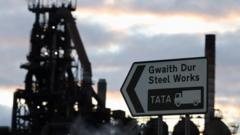
Industrial decarbonization requires matching the speed of physical plant construction with the capacity scaling of public infrastructure. When these timelines diverge, capital efficiency drops. Tata Steel’s £1.25 billion transition at its Port Talbot facility in South Wales highlights this issue. While the asset owner completed major demolition of the redundant blast furnaces and maintained equipment fabrication schedules, the National Energy System Operator (NESO) and National Grid formally signaled a six-to-eight-month delay—and potentially up to 12 months—in delivering the high-voltage transmission connection. This structural mismatch delays the commissioning of a 3.2 million-tonne capacity Electric Arc Furnace (EAF), exposing a failure in infrastructure synchronicity.
Understanding this bottleneck requires analyzing the capital expenditure framework, the energy demands of heavy metallurgy, and the logistical dependencies governing modern grid connections.
The Dual-Timeline Mismatch Framework
Large-scale industrial transformations operate on two distinct, independent critical paths. The primary breakdown in the Port Talbot execution strategy stems from treating these paths as a single integrated timeline rather than two separate risk profiles.
+-----------------------------------------------------------------------+
| INTERNAL ASSET TIMELINE                                               |
| [Demolition] ---> [Site Preparation] ---> [EAF Fabrication & Delivery]|
+-----------------------------------------------------------------------+

+-----------------------------------------------------------------------+
| EXTERNAL INFRASTRUCTURE TIMELINE (The Bottleneck)                     |
| [Substation Expansion] ---> [Civils & Ground Works] ---> [Energization]|
+-----------------------------------------------------------------------+
1. The Internal Asset Timeline
Controlled directly by Tata Steel and its engineering, procurement, and construction (EPC) partners. This path covers asset decommissioning, civil site preparation, and EAF procurement. As reported by Executive Director and Chief Financial Officer Koushik Chatterjee, this internal vector remains on track. Demolition of the legacy blast furnaces—which officially ended ironmaking operations at the site in October 2024—is complete, and equipment delivery continues. Capital deployment on-site is progressing as budgeted.
2. The External Infrastructure Timeline
Controlled by third-party regulated utilities and public bodies, specifically National Grid and NESO. This path governs the high-voltage electrical grid connection needed to supply the site with power. The underlying cause of the project delay rests entirely within this vector. National Grid's connectivity project has slipped past its initial late-2027 target. This creates an immediate project bottleneck: a fully fabricated, mechanically complete 3.2 million-tonne EAF unable to run due to a lack of power transmission.
The financial cost of this mismatch is severe. The project represents a £1.25 billion capital deployment, backed by £500 million in UK government taxpayer support. A six-to-twelve-month idle period between mechanical completion and plant energization locks up capital without generating revenue, lowering the project's net present value (NPV) and internal rate of return (IRR).
The Mass-to-Electron Conversion Function
The transition from a coal-fired blast furnace to an Electric Arc Furnace changes the underlying physics of the plant's energy supply chain. The structural scale of National Grid’s infrastructure delays reflects the massive scale of this energy shift.
Legacy Blast Furnace Model:
[ metallurgical coal / coke ] ===> Chemical Reductions ===> [ Liquid Iron ]

Electric Arc Furnace Model:
[ 100% Recycled Scrap Steel ] + [ Massive High-Voltage Grid Feed ] ===> Thermal Fusion ===> [ Liquid Steel ]
Legacy blast furnaces rely on the chemical energy of metallurgical coal and coke to reduce iron ore into liquid iron. This is anオンサイト, carbon-heavy thermal reaction that generates substantial greenhouse gas emissions. The Port Talbot conversion aims to eliminate these emissions by replacing chemical reduction with direct electrical thermal fusion. The new 3.2 million-tonne EAF will melt recycled scrap steel using high-intensity electric arcs.
This shift transfers the energy source from global bulk commodity shipping directly to the domestic high-voltage electrical grid.
To maintain a capacity of 3.2 million tonnes of crude steel per year, an EAF of this scale requires a continuous, highly stable electrical demand, often exceeding hundreds of megawatts. This concentrated power draw cannot be supported by standard regional distribution networks. It demands a direct connection to the 400 kilovolt (kV) National Grid transmission backbone, requiring:
- Substation Expansion: Significant upgrades to regional switching stations to handle the high electrical current without dropping voltage across the network.
- Civil and Underground Grid Works: Upgrading underground cable routes through complex urban and industrial corridors to handle the heavy electrical load.
- Grid Stability Systems: Installing static synchronous compensators (STATCOMs) or large synchronous condensers to counter the voltage flickers and electrical noise caused by EAF arc ignition.
National Grid and local planning authorities have confirmed that challenging ground conditions, along with environmental and planning hurdles during these civil upgrades, are the main reasons for the connectivity delays. The physics of heavy electrical engineering mean these network upgrades cannot be bypassed or accelerated through software updates; they require physical excavation, structural reinforcement, and high-voltage testing.
Macro-Economic Cascades and Operational Risk
A delay in energizing the Port Talbot EAF creates operational and commercial vulnerabilities across both local and international markets.
The Downstream Supply Chain Gap
Since halting ironmaking operations in October 2024, Port Talbot has not produced primary liquid steel. The site operates as a downstream processing hub, using imported slabs and coils to feed its hot rolling and cold rolling mills. A processing line fire on June 3, 2026, caused a brief temporary halt to a section of the cold mill, showing how vulnerable a site becomes when it relies purely on downstream processing during a major structural rebuild.
A six-to-twelve-month delay in EAF commissioning extends this reliance on external steel slabs. This leaves Tata Steel's UK operations exposed to global shipping disruptions, currency fluctuations, and import tariffs, while weakening its ability to guarantee a reliable, domestic supply of high-grade steel to UK automotive and aerospace buyers.
Emissions Trajectory and Compliance Penalties
The primary goal of this £1.25 billion investment is to cut site-level carbon dioxide emissions by 90%, which equals an annual reduction of 5 million tonnes of $CO_2$.
Every month the EAF delivery slips past its late-2027 targets, the UK industrial sector misses out on its largest single decarbonization opportunity. For Tata Steel, this delay extends its exposure to carbon compliance costs and carbon pricing mechanisms, altering the financial assumptions built into the project's initial business case.
Strategic Alternatives for Complex Infrastructure
To prevent future grid-connection bottlenecks from stalling large industrial transitions, project developers and state planners must shift from linear execution models to more flexible engineering strategies.
Front-Loading Interconnection Agreements
Industrial operators often delay locking in firm grid connection agreements until final equipment specifications are set. This approach is no longer viable given the high demand on today's electrical grids. Interconnection applications must be treated as long-lead capital items, executed ahead of core plant procurement. Financial commitments to grid operators should be made early in the pre-front-end engineering design (pre-FEED) stage to ensure network reinforcement happens at the same time as site preparation.
Dual-Fuel and Phase-One Hybrid Configurations
When transitioning heavy industrial assets, engineering firms should evaluate hybrid designs that allow for partial operations during grid constraints. For example, incorporating medium-voltage modular systems or securing temporary gas-fired co-generation assets on-site can allow for early component testing and low-power commissioning before the main high-voltage grid connection is energized. This decouples early-stage testing from the timeline of the primary utility provider.
Shared Infrastructure Risk Contracts
Future public-private industrial funding models should include clear infrastructure delivery guarantees. When the state provides significant capital support—such as the £500 million committed to Port Talbot—the funding agreement should tie grid infrastructure delivery to clear financial benchmarks. If state-backed grid operators miss connection deadlines, mechanisms should be in place to offset the industrial operator’s unabsorbed fixed costs and capital drag.
Tata Steel’s leadership is working with NESO, National Grid, and the UK government to mitigate the current delay and compress the remaining timeline. However, the structural reality remains: the facility cannot produce green steel until the external grid is ready to deliver the power. This situation serves as a clear warning for future mega-projects. True industrial decarbonization is not just about building clean plants on-site; it requires the systematic, timely expansion of the electrical grid that powers them.