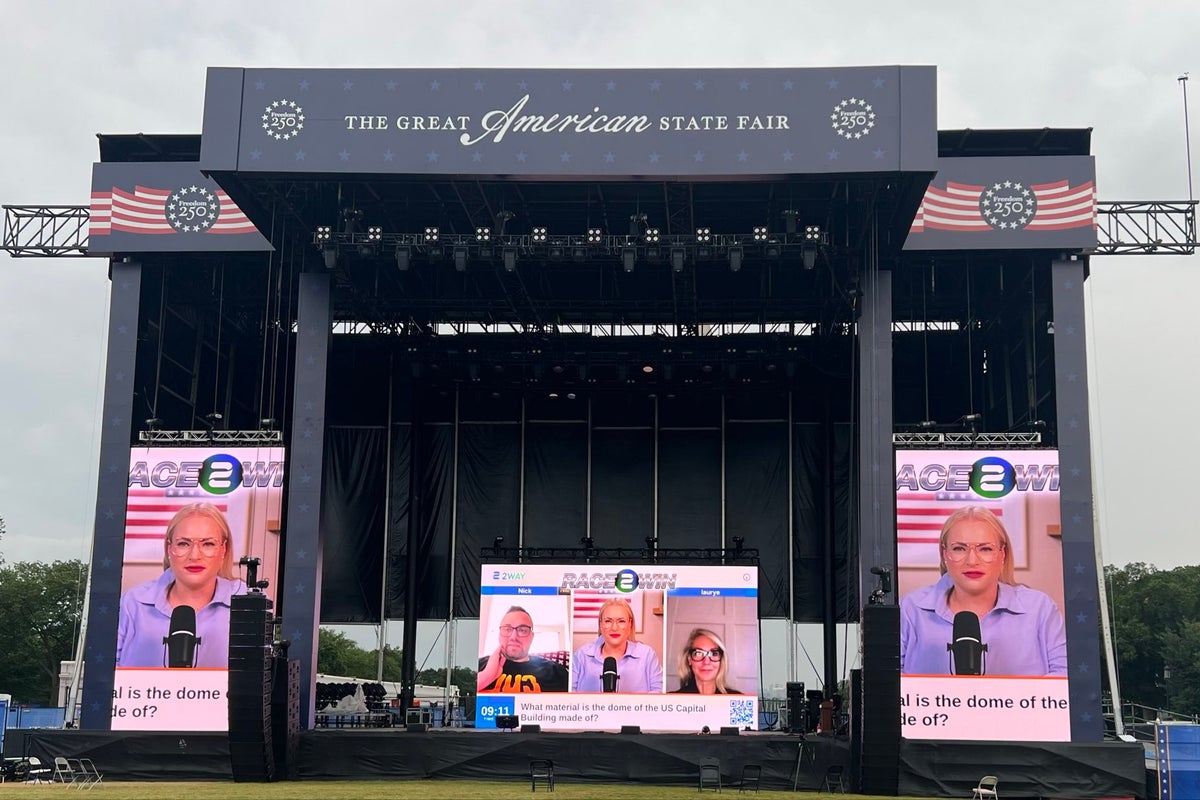
The failure of a high-profile public activation is rarely the result of a single tactical error. Instead, it is the predictable outcome of an alignment of negative operational and structural variables. The recent execution of the "Race2Win" quiz show, hosted by media personality Meghan McCain at the Trump administration’s Great American State Fair on the National Mall, serves as an ideal case study in structural failure. While popular commentary attributes the empty fields and absent audiences to superficial political narratives or simple bad luck, a rigorous analysis reveals a deeper failure of execution across three specific dimensions: the fragmentation of the audience value proposition, acute operational and technical friction, and severe environmental externalities.
To evaluate why an event backed by significant federal ambition and celebrity branding failed to capture physical foot traffic, we must deconstruct the mechanics of live media consumption and structural event management.
The Fragmented Value Proposition: The Remote-Host Disconnect
Every successful live activation relies on an unspoken contract between the presenter and the audience: physical presence in exchange for physical attention. When this contract is broken, the core asset of the live experience is compromised.
The Physicality Arbitrage
The primary breakdown of the "Race2Win" event lay in the structural decision to format the hosting duties via a remote Zoom feed. McCain, operating from a distant location, was projected onto large vertical screens at the National Mall. This configuration created a severe asymmetry in the audience value proposition.
- The Attention Penalty: A physical crowd requires local engagement feedback loops. A host operating via a video link cannot read micro-expressions, adjust pacing to real-time crowd dynamics, or generate localized urgency.
- The Medium Paradox: By turning a live main-stage event into a one-way digital broadcast, organizers forced a physical audience to consume a medium that they could more comfortably access from a personal device. The necessity for an individual to stand in an open field to watch a Zoom stream is non-existent.
The Content-Venue Mismatch
The second structural limitation was the misalignment of content and context. The event featured a trivia matrix focused on federal history and architectural queries, such as the building materials of the Capitol dome. While theoretically aligned with a semiquincentennial celebration, the intellectualized, text-heavy nature of a quiz show requires prolonged cognitive engagement. A transient, outdoor fair environment inherently demands low-barrier, high-sensory stimulation. Expecting passing foot traffic to freeze in place to read small text on a screen is a fundamental misunderstanding of crowd psychology and event flow.
Technical Friction and Asset Disregard
Operational execution must be flawless to sustain an audience when the core value proposition is weak. At the National Mall, the technical execution introduced friction that actively repelled potential viewers.
Aspect Ratio Distortion and Information Loss
The event technicians committed a critical operational error by streaming a standard horizontal video feed onto two massive vertical monitors bordering the stage. This created a destructive formatting bottleneck:
$$\text{Visible Information} = \text{Total Broadcast Content} - \text{Aspect Ratio Crop Margin}$$
Because the text of the trivia questions was cut off due to the altered aspect ratio, the product became mechanically unusable. An audience cannot participate in a trivia show if they cannot read the questions. This technical oversight transformed the stage from an attraction into a source of visual confusion.
Infrastructural Instability
The failure of the "Race2Win" broadcast did not occur in isolation. It was symptomatic of a wider infrastructural collapse across the entire Great American State Fair ecosystem. Reports indicated:
- Power Grid Failures: Repeated electrical outages disrupted scheduled programming and destroyed the predictability required to build crowd density.
- Mechanical Hazards: Heavy stage equipment fell behind performers during rehearsals, signaling a compromised safety environment that introduces immediate operational liability.
When the macro infrastructure of a venue fails, individual micro-events within that venue suffer an immediate drop in baseline foot traffic, as visitors prioritize safety and comfort over exploration.
Environmental Externalities and Heat Index Thresholds
Even a perfectly executed event with a compelling value proposition can be neutralized by extreme macroenvironmental variables. In the context of an outdoor summer activation in Washington, D.C., weather is not an inconvenience; it is a hard operational ceiling.
[Extreme Heat Index (Macroenvironmental Variable)]
                       │
                       ▼
         [Altered Human Behavior Risk]
                       │
                       ▼
[Hyperthermia Avoidance > Cultural Engagement]
                       │
                       ▼
   [Zero Foot Traffic Comfort Equilibrium]
The Thermal Comfort Equilibrium
During the week of the activation, an intense heat wave gripped the region, triggering unprecedented weather advisories that forced even dedicated attendees away from the National Mall. Human behavior in outdoor environments is governed by a strict utility function: the desire for cultural engagement must outweigh the physiological cost of hyperthermia avoidance.
Once the heat index crosses a specific threshold, the utility of standing in an unshaded field drops to zero. McCain’s decision to remain in a climate-controlled room highlighted this exact dynamic. The audience simply made the same rational calculation she did—they chose a conditioned environment over an open field.
Strategic Play: Optimizing Future Civic Activations
To prevent multi-million-dollar civic activations from degenerating into empty-field broadcasts, future organizers must abandon top-down programmatic mandates and apply a strict, tri-party operational framework.
First, enforce absolute host synchronicity. If a public figure cannot or will not physically occupy the stage, the event must be formatted as a pure digital broadcast or a decentralized interactive app. Do not waste physical capital on a virtual presence that carries no local gravity.
Second, design for information redundancy and mechanical resilience. Technical setups must undergo rigorous configuration audits. Aspect ratios must be locked during the pre-production phase, and primary power sources must be backed up by independent, secondary generators to eliminate structural downtime.
Finally, integrate dynamic climate contingencies. Outdoor summer events must feature modular cooling infrastructure, mandatory shade canopies, and localized hydration stations directly integrated into the viewing areas. If the environmental friction is not minimized, the audience will choose comfort over content every single time.


