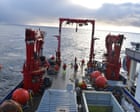
The decommissioning of the Ocean Observatories Initiative (OOI) by the National Science Foundation (NSF) marks the structural dismantlement of a $370 million sub-surface telemetry asset. While public discourse frames this executive action purely through a political lens, an objective evaluation requires a systems-engineering approach. The removal of over 900 deep-sea instruments from the Atlantic and Pacific oceans represents a permanent degradation of a high-capital data asset, yielding immediate bottlenecks in predictive macro-economics, risk underwriting, and maritime supply chain logistics.
To evaluate the long-term impact of this infrastructure reduction, we must move past rhetorical arguments and analyze the system through a formal capital valuation and structural dependency framework.
The Three Pillars of Sub-Surface Telemetry Dominance
The OOI network cannot be replicated by orbital remote sensing assets. Satellite telemetry operates on a structural limitation: it is bounded by the skin depth of electromagnetic radiation in salt water. Satellites measure exclusively the top few millimeters of the ocean surface ($Z \approx 0$). In contrast, the OOI architecture was built on three unique capabilities that established the baseline for deep-ocean observation.
- Continuous Temporal Sampling vs. Synoptic Overflights: Orbital paths introduce temporal gaps. Sensors fixed to the benthic floor or suspended via deep-sea moorings capture continuous time-series data at high frequencies (hz to minutes). This resolves fast-moving boundary-layer phenomena and localized physical transformations that are smoothed out by satellite interpolations.
- The In-Situ Volumetric Water Column: Tracking the transport of heat, dissolved inorganic carbon, and salinity requires measuring the ocean along a vertical coordinate system down to depths of 2,800 meters. The OOI infrastructure targeted structural zones such as the Irminger Sea between Greenland and Iceland, and the Coastal Endurance Array off the Pacific Northwest.
- Real-Time Sub-Surface Data Telemetry: By linking deep-sea moorings directly to fiber-optic benthic cables or acoustic modems communicating with surface telemetry buoys, the network delivered low-latency data directly to global terrestrial ingestion hubs.
The Asymmetrical Cost Function of Ocean Asset Recovery
The NSF justification for the operational reduction relies on "smart lifecycle management" and shifting resources toward emerging technologies. However, the decision functions as a negative return on investment when viewed through an infrastructure cost framework.
[Initial Capital Expenditure: $370M] ---> [Annual Operational Cost: $48M]
                                                |
                                                v
                                   [Forced Decommissioning]
                                                |
                                                v
                         [Sunk Capital Cost + High Retrieval Costs]
                                                +
                           [Permanent Loss of Human Expertise Asset]
The system cost structure is governed by an asymmetrical economic equation:
$$C_{\text{total}} = C_{\text{capex}} + \sum_{t=1}^{n} C_{\text{opex}}(t) + C_{\text{decom}}$$
Where $C_{\text{capex}}$ is the initial $370 million build cost, and $C_{\text{opex}}$ represents the annual maintenance cost of approximately $48 million. The core inefficiency of the current strategy is that the decommissioning cost ($C_{\text{decom}}$)—which requires chartering deep-sea research vessels and operating remotely operated vehicles (ROVs) over a 15-month timeline—presents a high upfront cash outflow without generating any future asset value.
The strategy treats a highly capital-intensive fixed asset as an adjustable operational line item. Re-establishing these nodes in the future will not scale linearly; it will require absorbing the initial design-and-build capital expenditures a second time.
Furthermore, the operational expertise needed to deploy these platforms is a highly perishable asset. Deep-sea engineering relies on specialized institutional knowledge. When arrays are pulled, the engineering teams dissolve, creating a permanent structural barrier to future redeployment.
Structural Downstream Bottlenecks and Economic Feedback Loops
The termination of real-time data streams erodes predictability across three critical economic and industrial sectors.
1. Macro-Climate Volatility and Risk Underwriting
The Irminger Sea array serves as a primary verification node for the Atlantic Meridional Overturning Circulation (AMOC). The AMOC functions as a planetary heat-distribution engine; its deceleration alters precipitation patterns, agricultural outputs, and sea-level baselines along the eastern United States.
By removing the in-situ monitoring infrastructure, climate projection models lose their primary subsurface validation dataset. The direct result is an expansion of the uncertainty bounds within predictive climate models.
[Loss of In-Situ Subsurface Data]
       │
       ▼
[Widened Uncertainty Bounds in Predictive Models]
       │
       ▼
[Risk Invariance / Information Asymmetry]
       │
       ▼
[Capital Flight / Structural Insurance Market Failure]
When the variance of an asset's risk profile increases, reinsurance markets price this information asymmetry by charging higher risk premiums or completely exiting exposed markets, such as coastal real estate and municipal infrastructure bonds.
2. Commercial Fishery Management and Bio-Economic Modeling
The Coastal Endurance Array off Oregon and Washington monitored real-time upwelling events, localized ocean acidification ($\text{pH}$ drops), and hypoxic (low-oxygen) water masses.
Commercial fisheries use this data as an early-warning infrastructure. Hypoxic zones can wipe out near-shore crab and shellfish populations within days. Without real-time data on vertical oxygen distributions, regulatory bodies must manage fisheries using lagging indicators, such as catch-per-unit-effort data. This lack of visibility introduces a dangerous dynamic: either over-allocating quotas and risking ecosystem collapse, or under-allocating quotas and creating artificial economic scarcity for commercial fleets.
3. Immediate Tactical Data Deficits
The decommissioning schedule directly conflicts with the projected arrival of an intense El Niño event. El Niño variations originate as subsurface heat anomalies that propagate eastward across the Pacific basin.
Dismantling the Pacific arrays at this exact point eliminates the primary instruments capable of tracking the vertical distribution of this heat. Marine operations, agricultural planning, and localized emergency services are left to rely on lower-resolution statistical forecasting models right when precision data is needed most.
The Strategic Redirection
The justification that ending the OOI allows for a shift toward "nimbler" systems ignores how environmental intelligence assets actually work. Autonomous underwater gliders and uncrewed surface vehicles are highly capable systems, but their operational utility depends on a framework of fixed, high-power, high-bandwidth baseline stations to anchor their data streams.
The removal of the OOI infrastructure leaves a structural void in ocean telemetry. The smart strategic move for the scientific and industrial sectors is clear: rather than attempting to save the physical hardware through political appeals, resources must be immediately shifted toward a distributed, privately or internationally funded data-capture model.
Commercial maritime entities, multinational aquaculture firms, and global reinsurance consortiums must establish a decentralized observation network. By deploying smaller, targeted sensor packages directly onto commercial shipping fleets and deep-sea industrial platforms, private entities can safeguard the high-resolution data streams required to underwrite global risk and manage supply-chain volatility in an increasingly unpredictable environment.