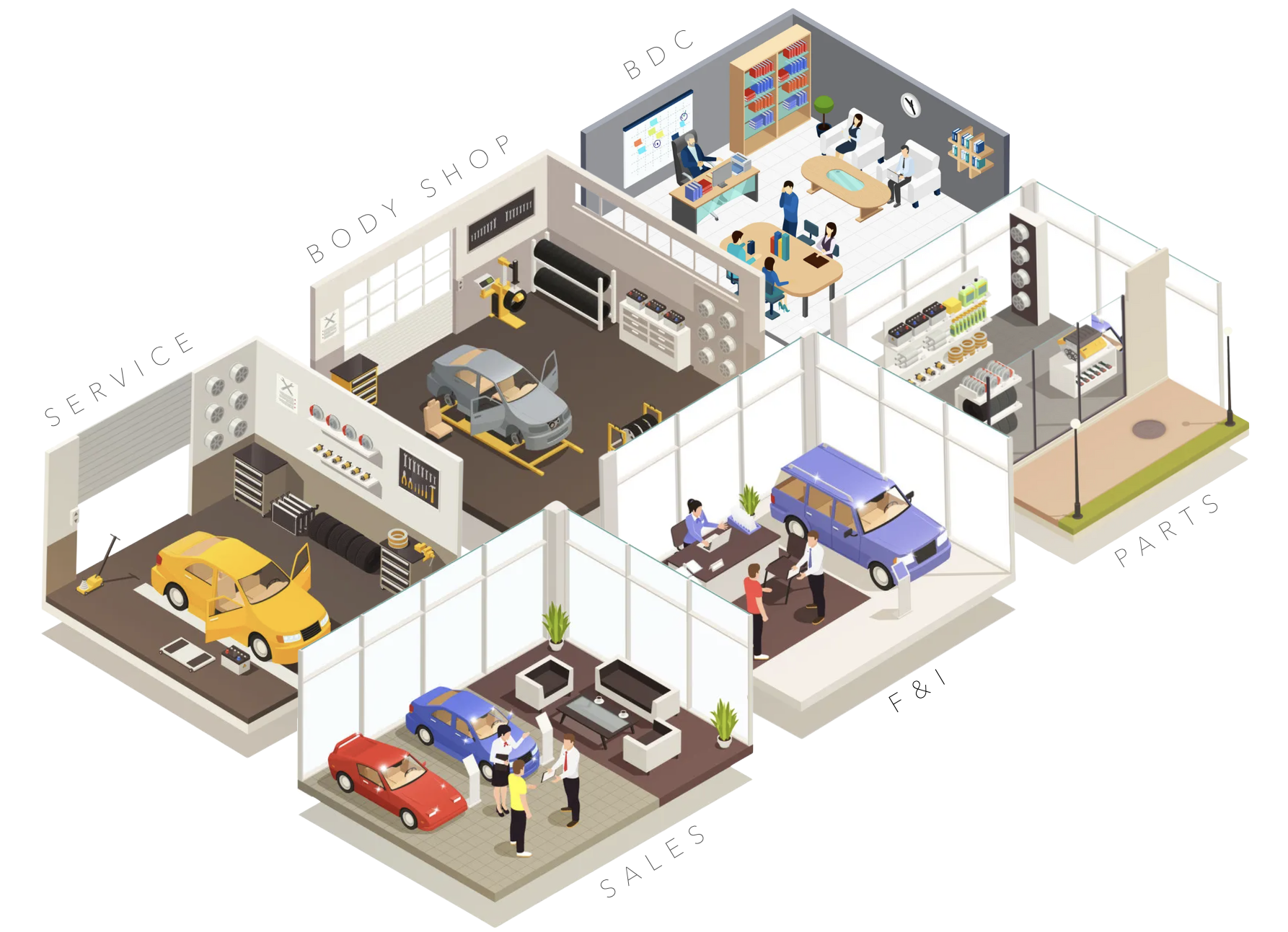
Automotive retail economics are undergoing a structural reallocation. For decades, franchise dealerships treated the variable operations department—specifically new and used vehicle sales—as the primary engine of top-line revenue and gross profit. Showroom volume dictated financial health. Fixed operations, comprising customer-pay service, warranty work, and internal reconditioning, operated largely as a cost center designed to support vehicle transactions or capture secondary service retention. That dynamic has inverted. Dealership margins now depend heavily on the resilience of fixed operations to offset volatility in new vehicle pricing and margin compression driven by supply chain normalization, digital retail transparency, and shifting manufacturer incentives.
Analyzing this shift requires dissecting the economic mechanisms driving dealership profitability. Vehicle sales carry high gross revenue but volatile, often razor-thin gross profit margins per unit. Fixed operations, by contrast, exhibit lower top-line volume relative to a vehicle sale but deliver significantly higher gross margin percentages. When macroeconomic headwinds compress new car grosses, service departments act as the primary financial shock absorber. Understanding how dealership profitability relies on parts and service requires examining throughput efficiency, labor rate realization, warranty reimbursement rate optimization, and the lifecycle economics of vehicle retention.
The Margin Differential Between New Units and Fixed Operations
To understand why dealership capital allocation is shifting toward fixed operations, one must analyze the stark contrast in gross profit composition between vehicle sales and service departments. A new vehicle transaction is subject to transparent digital pricing, invoice-to-MSRP compression, and regional competition. While the transaction price might exceed forty thousand dollars, the front-end gross profit is frequently measured in hundreds of dollars rather than thousands.
Fixed operations operate on entirely different financial mechanics. Labor sales carry gross margins often exceeding seventy percent, while parts sales routinely yield gross margins between forty and fifty percent. The primary variable cost in fixed operations is technician compensation, which is typically structured on a production basis (flat-rate pay) rather than a fixed hourly wage. This variable cost structure protects dealership profitability during demand contractions. If vehicle sales volume drops by twenty percent, fixed overhead costs remain sticky, directly eroding net profit. If repair order volume drops, technician payroll scales down automatically alongside labor sales.
Furthermore, customer-pay service is insulated from the pricing transparency that plagues new car sales. Consumers shopping for a vehicle can compare identical inventory across a fifty-mile radius via aggregators in seconds. Consumers seeking complex diagnostics or specialized mechanical repairs evaluate convenience, trust, and proximity. This friction allows established service departments to maintain pricing power, particularly as vehicle complexity increases. Modern powertrains, advanced driver-assistance systems, and integrated electrical architecture require specialized diagnostic equipment and manufacturer-trained technicians, raising barriers to entry for independent aftermarket competitors and reinforcing the dealership service monopoly.
The Mechanics of Throughput and Effective Labor Rate Optimization
Maximizing fixed operations profitability is not merely a function of raising labor rates; it is an exercise in capacity utilization and process efficiency. A dealership service department is a fixed-capacity asset. Every stall that sits empty or every technician hour that goes unbilled represents lost revenue that can never be recovered.
The primary metric governing service department efficiency is Effective Labor Rate. Dealerships often track their posted customer-pay labor rate, but the true financial health of the department depends on the effective blended rate realized across customer-pay, warranty, and internal repair orders. Optimization requires balancing three interdependent variables:
- Technician Productivity: The ratio of hours a technician clocks on repair orders compared to the total hours they are punched into the building. Top-performing operations maintain productivity metrics above one hundred percent by overlapping diagnostic and repair phases.
- Technician Efficiency: The ratio of actual labor hours billed to the customer (flat-rate hours) versus the clock hours spent performing the work. Efficient technicians complete book-time tasks faster, increasing the total volume of billable hours processed through a limited number of service stalls.
- Repair Order Mix: The strategic distribution of labor between high-margin customer-pay mechanical work, lower-margin manufacturer warranty repairs, and internal reconditioning for the used car lot.
When dealerships experience margin compression in new vehicle sales, they often attempt to drive fixed operations revenue by increasing repair order volume without first auditing shop capacity. This creates bottlenecks in the service drive, increases turnaround times, and degrades customer satisfaction scores. Sustainable revenue expansion in parts and service requires re-engineering the workflow from appointment scheduling to parts picking and final quality control, ensuring that every technician hour is fully monetized.
Regulatory and Legislative Tailwinds in Warranty Reimbursement
A critical catalyst for the increased financial reliance on parts and service is the evolution of manufacturer warranty reimbursement laws. Historically, original equipment manufacturers reimbursed dealerships for warranty repairs at arbitrary rates that were significantly lower than the dealership's prevailing customer-pay labor and parts rates. This forced dealerships to subsidize warranty work, dampening fixed operations profitability.
State-level legislation has fundamentally altered this equation. A growing number of jurisdictions have enacted laws allowing dealerships to periodically petition manufacturers for retail-rate parity on warranty parts and labor. By proving that a statistically significant sample of customer-pay repair orders commands a specific higher rate, dealerships can compel manufacturers to reimburse warranty work at that same retail level.
This transformation turns warranty administration from a low-margin compliance obligation into a high-margin revenue driver. As vehicle complexity increases and manufacturers issue a higher frequency of technical service bulletins and recalls, the volume of warranty work flowing through franchise service departments has expanded. Capturing true retail rates on this volume injects high-margin cash flow directly into the dealership P&L, independent of retail sales cycles.
The Lifecycle Economics of Vehicle Retention
The long-term financial stability of a dealership group depends on maximizing customer lifetime value rather than optimizing isolated transactions. The economic bridge between vehicle sales and fixed operations is customer retention. A customer who purchases a vehicle from a dealership and subsequently returns for routine maintenance, warranty work, and mechanical repairs generates cumulative gross profit over a multi-year lifecycle that dwarfs the initial front-end vehicle gross.
The financial leakage in most retail automotive operations occurs at the handoff between the sales floor and the service drive. When a customer purchases a vehicle, their propensity to return for service declines precipitously if they are not introduced to the service department prior to delivery. Dealerships that systematically integrate service appointments into the delivery process—often by pre-scheduling the first complimentary maintenance visit before the customer leaves the showroom—drastically improve retention rates.
Retention directly impacts parts department profitability through wholesale and retail throughput. High service retention guarantees a predictable baseline of routine maintenance demand, such as oil changes, brake replacements, and fluid flushes. These routine touchpoints serve as diagnostic opportunities for high-dollar, high-margin mechanical repairs. When a vehicle enters the service bay for a routine inspection, trained technicians identify deferred maintenance items, converting low-margin traffic into substantial repair orders.
Strategic Operational Architecture for Service-Led Growth
Navigating the shift toward fixed-operations-driven profitability requires a departure from traditional dealership management silos. Historically, the General Manager, New Car Sales Manager, and Service Director operated as independent fiefdoms with competing incentives. Maximizing the modern dealership model requires aligning operational metrics around enterprise-wide profitability rather than departmental volume.
Management teams must implement continuous tracking of customer acquisition costs against lifetime service value. If new vehicle sales operate near breakeven, their primary strategic purpose is customer acquisition for the service portfolio. This realization redefines how dealership marketing budgets are deployed. Advertising expenditure should not solely target immediate vehicle buyers; it must capture out-of-warranty conquest service customers who generate high-margin repair volume and eventually serve as prime trade-in prospects for the pre-owned vehicle inventory.
Resource allocation must prioritize technician recruitment, retention, and continuous training over physical showroom expansions. The physical footprint of a dealership is expensive to scale, but the throughput of a service department can be multiplied significantly through digital workflow optimization, streamlined parts inventory management, and structured career pathways for technical staff. Dealerships that treat fixed operations as the primary engine of financial resilience will maintain stability through economic cycles, while those dependent on volatile vehicle margins remain exposed to structural market shifts.