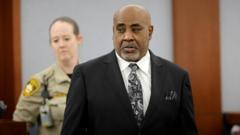
The mechanics of prosecuting a decades-old murder rely entirely on converting historical self-incrimination into admissible courtroom evidence. When the state presented audio recordings from a 2008 police interview involving Duane "Keffe D" Davis, it exposed the fundamental operational blueprint behind the legal strategy targeting the lone defendant charged in the 1996 killing of Tupac Shakur. Deconstructing this case requires moving past sensational headlines to analyze the core vectors of the prosecution: custodial admissions, transactional immunity failures, and the spatial dynamics of a targeted vehicular ambush.
The Architecture of Custodial Disclosure
To understand how a cold case reaches a courtroom nearly thirty years later, one must analyze the cost function of police interviews conducted under informal agreements. In 2008, Los Angeles police detectives brought Davis in under the premise of discussing an entirely separate homicide investigation involving the 1997 killing of Christopher Wallace, known as the Notorious B.I.G. Expanding on this idea, you can find more in: The Political Viability of Dan Greaney An Analytical Breakdown.
During this session, investigators offered verbal assurances of confidentiality. Law enforcement officers frequently utilize conversational framing to lower a subject's risk assessment threshold. The structural flaw in Davis's defense strategy emerged years later when those verbal parameters were breached by his own commercial choices.
The state did not rely exclusively on the sealed 2008 recordings. The evidentiary framework expanded because Davis subsequently monetized the narrative. By participating in public true-crime podcasts, documentary interviews, and co-authoring a 2019 memoir titled Compton Street Legend, Davis shifted his legal exposure from protected law enforcement cooperation to public dissemination. Prosecutors successfully argued that voluntary public repetition of the crime's details nullified any implied protections of the original confidential dialogue. Analysts at The New York Times have also weighed in on this trend.
The Spatial Mechanics of the Las Vegas Drive-By
The physical layout of the September 7, 1996, shooting in Las Vegas remains a primary point of evidentiary scrutiny. According to the audio transcripts introduced in court, the mechanics of the event unfolded through a rigid sequence of tactical failures and reactive adjustments within a white Cadillac.
- The Retaliatory Catalyst: Hours before the shooting, a physical altercation occurred in the MGM Grand lobby following a Mike Tyson boxing match, involving Shakur's entourage and Davis's nephew, Orlando "Baby Lane" Anderson. This established the motive of retributive violence.
- The Positional Constraint: The white Cadillac containing Davis, Anderson, and two other associates pulled alongside the vehicle carrying Shakur and Death Row Records CEO Marion "Suge" Knight. Davis noted that the target vehicle was positioned on the opposite side of the car from his seating position.
- The Weapon Transfer Failure: Davis stated that he initially intended to execute the shooting himself, but because Knight's vehicle was positioned on the driver's opposite side, he attempted to pass a .40-caliber handgun to Deandre "Big Dre" Smith in the back seat.
- The Execution Vector: Following Smith's refusal to take the weapon, Anderson—seated in the rear—reached across, rolled down the window, and discharged multiple rounds toward the adjacent vehicle.
This sequence answers a central question often raised by observers: Why did command-level orchestration shift into decentralized execution? The spatial arrangement of the vehicles dictated tactical improvisation. Davis functioned as the strategic coordinator who procured and introduced the firearm into the vehicle, while physical execution defaulted to the occupant with line-of-sight geometry.
The Defense Counter-Strategy and Evidentiary Vulnerabilities
The defense relies on attacking the credibility of the primary witness: the defendant himself. Defense counsel has characterized the state's entire narrative as fiction, arguing that Davis fabricated elaborate involvement stories to build a lucrative persona as a notorious street figure.
This creates an analytical paradox for the defense. To insulate Davis from a murder conviction, his legal team must convince jurors that when Davis confessed to law enforcement, wrote a memoir detailing the crime, and discussed it on camera, he was entirely "full of crap".
However, undermining one's own client's documented history of statements introduces high variance into a jury trial. The prosecution leverages corroborating timelines, matching ballistic types, and the logical consistency between the physical damage to the vehicle in 1996 and the mechanics described in the 2008 audio files.
Strategic Outlook of the Trial
The progression of the case rests on whether the jury separates commercial posturing from verifiable confession. If the state proves that the details divulged in the 2008 interview match physical evidence unknown to the public at the time, the defense claim of wholesale fabrication collapses under structural scrutiny. The outcome depends less on forensic DNA—largely absent or degraded after three decades—and entirely on the reliability metrics applied to historical admissions made by the orchestrator himself.


