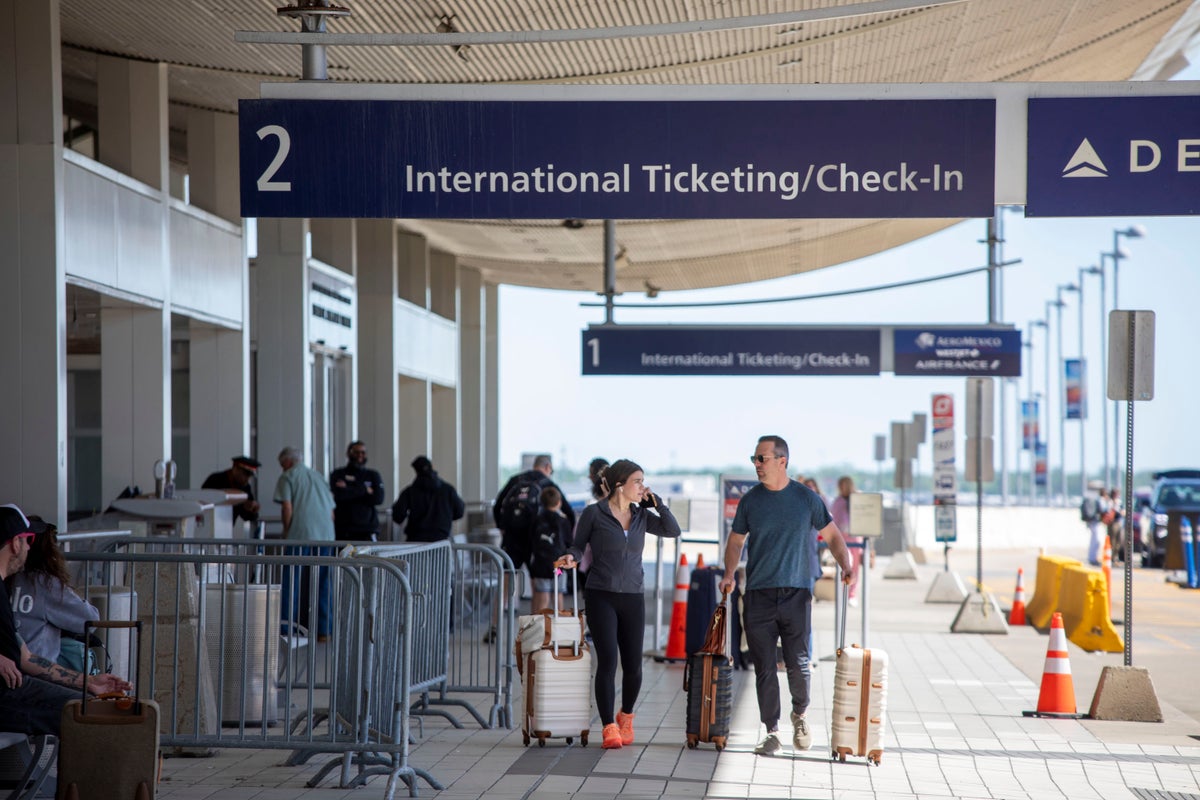
The physical perimeter of the modern aviation terminal is broken. When a secondary vehicular breach occurred at Detroit Metropolitan Wayne County Airport (DTW) on May 29, 2026—less than four months after a similar intrusion at a separate terminal—it exposed a fundamental, systemic flaw in transit infrastructure design. The security architecture of major transit hubs relies on an obsolete assumption: that perimeter defenses only need to withstand passive errors rather than dynamic, active evasion.
When a driver circumvented concrete perimeter barriers to breach the glass facade of DTW’s Evans Terminal, the failure was not a freak occurrence. It was a predictable failure of systemic vector control. To prevent the weaponization or accidental intrusion of multi-ton passenger vehicles into high-density pedestrian zones, infrastructure must shift from reactive aesthetic engineering to a strict kinetic energy containment framework.
The Kinetic Energy Equations of Perimeter Defense
The primary structural failure in typical terminal curb designs is an over-reliance on architectural glass and low-rated cosmetic bollards. Evaluating these breaches requires analyzing the physical forces at play. The kinetic energy ($E_k$) of an incoming vehicle is governed by the standard formula:
$$E_k = \frac{1}{2}mv^2$$
Because velocity ($v$) is squared, a standard 4,000-pound (approx. 1,814 kg) passenger vehicle traveling at a modest rate of 35 miles per hour (approx. 15.6 m/s) generates roughly 220 kilojoules of kinetic energy. Standard commercial storefront glass provides near-zero structural resistance to these forces. The glass functions merely as an environmental barrier, not a physical one.
When a vehicle breaches this outer skin, the energy dissipation relies entirely on secondary interior impacts—such as striking ticketing counters, structural pillars, or pedestrians. To quantify the vulnerability of a terminal facade, engineers look at the Resistance Efficiency Profile (REP), which balances structural impedance against architectural transparency.
[Vehicle Vector] ---> [Sidewalk/Curb Bypass] ---> [Glass Facade (0kJ Resistance)] ---> [Terminal Interior]
In the baseline infrastructure model seen in many legacy airports, the transition from the drop-off lane to the interior ticketing floor contains a critical bottleneck: the curb line. If the curb line lacks continuous, crash-rated containment mechanisms, the entire interior of the terminal becomes an extension of the roadway.
The Breakdown of Spatial Segregation at the Curb
Airport arrival and departure configurations are fundamentally dual-use zones where high-velocity logistics directly intersect with vulnerable pedestrian flows. This spatial configuration creates three distinct operational zones that must be isolated:
- The Transit Vector: The asphalt multi-lane roadway dedicated to commercial and private vehicle movement.
- The Dissipation Buffer: The sidewalk and immediate outdoor median designed for passenger unloading and baggage handling.
- The Secure Envelope: The interior terminal space housing critical infrastructure, retail, and security checkpoints.
The systemic breakdown occurs in the transition between the Transit Vector and the Dissipation Buffer. During the January 23, 2026 incident at DTW’s McNamara Terminal, a vehicle executed a sharp perpendicular turn from the far-left lane, slicing across traffic and penetrating the glass facade near the Delta Air Lines check-in counter. In the May 29 breach at the Evans Terminal, the driver mounted the sidewalk explicitly to bypass the yellow 9,000-pound temporary concrete Jersey barriers that had been deployed following the January event.
This secondary breach highlights the flaw of localized, non-continuous barrier deployment. Placing heavy barriers in a piecemeal fashion merely alters the vehicle’s angle of approach without neutralizing its kinetic energy potential. By driving onto the sidewalk prior to the barrier line, the vehicle exploited an unprotected access point in the Dissipation Buffer, demonstrating that partial perimeters are functionally equivalent to no perimeters at all.
Systemic Cost Functions of Infrastructure Failures
Evaluating the impact of terminal breaches requires assessing both immediate operational disruptions and broader system-wide costs. The economic consequences extend far beyond shattered glass and damaged check-in desks. The true cost function of an airport perimeter breach ($C_{total}$) can be modeled as:
$$C_{total} = C_{repair} + C_{operational} + C_{downstream} + C_{reputational}$$
The component variables reveal the full scale of structural vulnerability:
| Cost Component | Operational Impact Metrics |
|---|---|
| Direct Repair ($C_{repair}$) | Facade replacement, structural evaluation, internal infrastructure reconstruction. |
| Operational Stoppage ($C_{operational}$) | Flight delays, terminal closures, TSA checkpoint re-routing, employee displacement. |
| Downstream Delays ($C_{downstream}$) | Network-wide airline scheduling cascades, missed passenger connections, baggage sorting backlogs. |
| Reputational Degradation ($C_{reputational}$) | Increased consumer friction due to emergency security posture, loss of transit hub efficiency status. |
While the Evans Terminal managed to reopen within an hour of the May 29 incident, the immediate grounding of pedestrian traffic and the deployment of emergency responders triggered an operational bottleneck. When a terminal is forced into an un-planned lockdown, the immediate labor costs of security personnel, airline agents, and airport authority staff spike exponentially as they attempt to stabilize the zone and manage passenger backlogs.
The Passive vs. Active Mitigation Framework
The recurring nature of these incidents exposes a critical gap in risk mitigation strategies. Following the January incident, the airport authority introduced temporary concrete barriers outside the terminals. These barriers are effective passive tools for blocking direct, linear vectors. However, they lack the systemic integration required to stop a motivated or erratic driver who maneuvers around them.
Effective infrastructure defense requires a shift from passive, static obstacles to an active, tiered containment architecture. This framework relies on a multi-layer defense-in-depth model:
1. Geomorphic Deflection Layers
Instead of relying solely on vertical concrete blocks, the perimeter topography should utilize continuous engineered changes in elevation. Deep-set planter boxes, reinforced retaining walls, and stepped architectural terraces can disrupt a vehicle's undercarriage and stop its momentum before it ever approaches the pedestrian sidewalk. These structures redirect kinetic energy downward and inward, utilizing the vehicle's own mass to halt its forward progress.
2. Continuous High-Rating Bollard Arrays
Bollards must not be deployed as isolated clusters near entrance doors. They must form an unbroken perimeter line along the entire length of the terminal face. These systems must be certified to ASTM F2656 or M-rating standards, which guarantee the capacity to stop a 15,000-pound medium-duty truck traveling at 30, 40, or 50 miles per hour. A continuous array eliminates the gaps that drivers exploit when mounting sidewalks from the periphery.
[Roadway] ---> [Continuous ASTM-Rated Bollard Line] ---> [Pedestrian Sidewalk] ---> [Reinforced Facade]
3. Energy-Absorbing Storefront Substructures
The framing surrounding the terminal glass must be structurally tied to the building’s primary steel or concrete foundation. By utilizing energy-absorbing glazing systems and heavy-gauge structural steel tubes behind the architectural facade, the building envelope itself can act as a secondary catch-net capable of stopping vehicles that slip past initial defenses.
Real-World Constraints of Perimeter Hardening
Implementing a comprehensive perimeter overhaul introduces significant engineering and logistical challenges. Airport authorities operate within rigid structural and spatial constraints that prevent simple solutions.
The most critical limitation is structural weight load limits. The drop-off zones and elevated roadways servicing modern airport terminals are frequently built as bridge decks over lower-level baggage handling areas or lower-level arrival lanes. Deploying continuous lines of 9,000-pound concrete blocks or deep-set, heavily reinforced steel bollards can exceed the engineered weight capacity of the underlying deck. Adding massive structural dead loads to an aging elevated roadway risks catastrophic structural failure of the transit platform itself.
Furthermore, perimeter design must maintain high throughput capacity. An airport terminal is primarily a logistics hub designed to move thousands of passengers and pieces of luggage per hour. Hardening a perimeter to the level of a military installation creates severe physical bottlenecks. Deep security gates, high fences, and restrictive vehicle access lanes slow down passenger drop-offs, causing massive traffic backups that spill onto airport access highways. The core challenge for engineers is balancing maximum kinetic resistance with the fluid, high-volume movement of people and vehicles.
The Required Strategic Transition
The recurring breaches at Detroit Metropolitan Airport demonstrate that treating vehicular terminal impacts as isolated, erratic anomalies is an unviable security posture. Temporary fixes like un-anchored concrete blocks alter the aesthetics of a terminal without solving its underlying vulnerability to non-linear vehicle approaches.
The immediate tactical move for transit hubs requires a full engineering reassessment of curb-side weight capacities to maximize the installation of continuous, crash-rated bollard infrastructure. Where weight limits prevent heavy static installations, airports must deploy engineered energy-dissipating barriers that pivot on impact to catch and redirect runaway vehicles. Failing to implement an unbroken physical barrier system guarantees that the architectural glass of the modern terminal will remain a highly vulnerable point of failure.