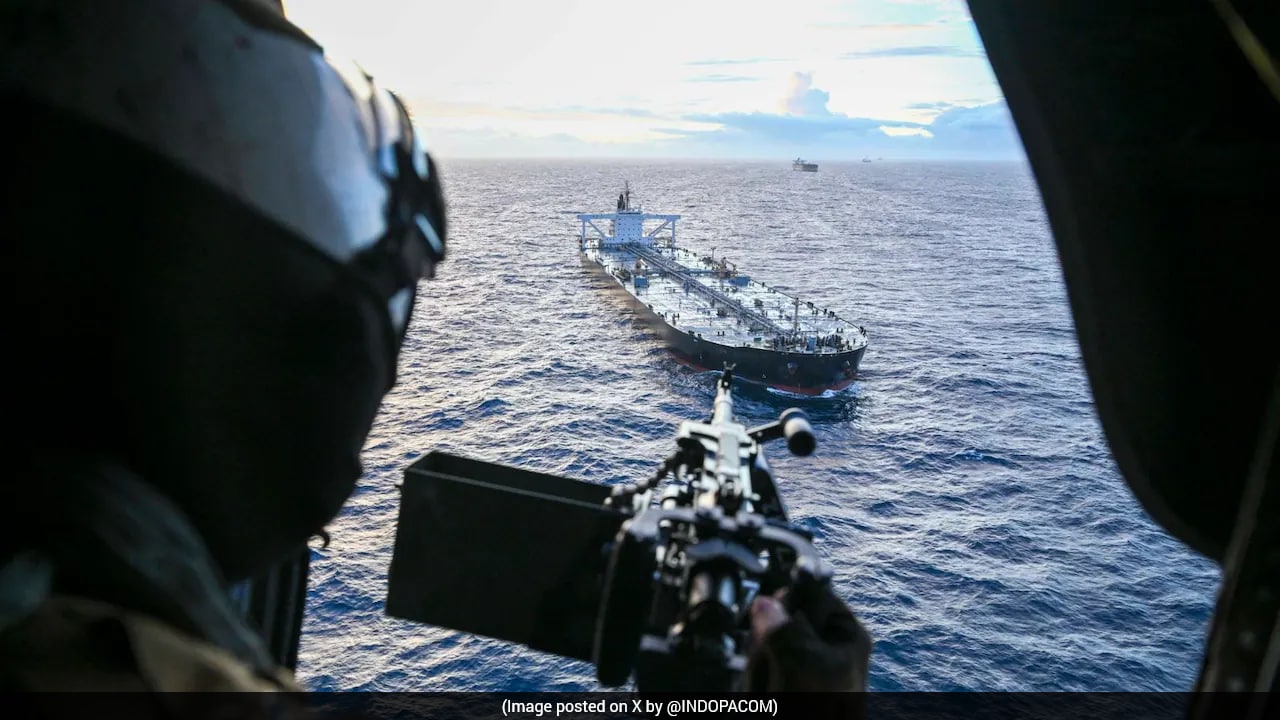
The Pentagon just staged another late-night photo-op in the middle of the Indian Ocean, and the corporate press swallowed the narrative whole. Overnight, U.S. forces under Indo-Pacific Command intercepted and boarded the MT Davina, a stateless supertanker fully laden with up to two million barrels of sanctioned Iranian crude oil. The headlines read like an unambiguous triumph of Western maritime hegemony: another blow against illicit networks, another successful interdiction under the ongoing blockade, and another reminder that Uncle Sam rules the waves.
It is a comforting illusion. It is also completely wrong.
The lazy consensus dominating defense journalism treats these dramatic high-seas boardings as proof of an effective strategy. They point to the MT Davina—or the MT Tifani intercepted weeks ago in the Bay of Bengal—as evidence that the U.S. counter-blockade is squeezing Tehran into submission following the fragile April ceasefire. But if you look past the curated military press releases and examine the raw mechanics of global shipping, you realize these operations do not reveal American strength. They expose the absolute failure of modern Western economic warfare.
The High-Seas Boarding Theater
To understand why the MT Davina operation is a strategic defeat masquerading as a tactical win, you have to look at where and when it happened. The vessel was boarded off the southern coast of Sri Lanka. That is thousands of miles away from the Strait of Hormuz, the primary chokepoint Iran has attempted to shut down.
When the U.S. Indo-Pacific Command boasts about global maritime enforcement "wherever they operate," they are inadvertently admitting a devastating truth: the ghost fleet carrying sanctioned oil is no longer hiding in dark regional corners. It is operating comfortably across the entire expanse of the Indian Ocean.
I have watched maritime security infrastructure handle gray-market shipping for over a decade. The industry playbook is simple, and the Pentagon is playing right into it. A single supertanker seizure requires massive asset allocation—destroyers, aerial surveillance, specialized boarding teams, and days of legal and logistical coordination to determine what to do with millions of barrels of seized crude. While the U.S. Navy spends millions of dollars to halt two million barrels on a single stateless vessel, dozens of other shadow-fleet tankers quietly slip through to ports across Asia.
The math simply does not work. You cannot solve a macro-scale systemic supply chain problem with micro-scale tactical interventions.
The Myth of the Automated Blockade
A common counter-argument from Washington think tanks is that high-tech tracking and targeted sanctions make the shadow fleet non-viable over time. The MT Davina was slapped with U.S. sanctions back in October 2024. Yet, here we are in 2026, and the ship was still sailing completely laden with oil.
Why? Because the international shipping ecosystem adapts faster than the bureaucratic mechanisms of Western enforcement. The moment a tanker is blacklisted, it undergoes a transformation:
- It drops its flag, becoming "stateless."
- It alters its MarineTraffic transponder data.
- It changes its registered name (the Davina also operated as the Lenore).
- Ownership is transferred to a shell company registered in a jurisdiction outside Western legal reach.
The premise that a naval blockade can dry up a nation's export revenue in the 21st century is fundamentally flawed. When the U.S. Navy disables an Iranian-flagged ship or boards a rogue tanker, it does not stop the trade; it merely increases the risk premium. This premium drives up the profit margins for the illicit syndicates operating these vessels, making the trade even more lucrative for those willing to take the risk.
The Ceasefire Delusion
The broader context of the MT Davina boarding reveals an even deeper strategic disconnect. We are currently operating under a highly volatile ceasefire negotiated through Pakistan. The Pentagon insists that enforcing a trade blockade does not violate the suspension of hostilities, arguing that "stopping bombs" is the only metric that matters. Meanwhile, Tehran claims it fired warning missiles at U.S. destroyers in the Gulf of Oman just hours ago to protest this exact "maritime misconduct."
The U.S. is trying to maintain a contradictory status quo: treating the conflict as simultaneously paused and active. Washington wants the diplomatic benefits of a ceasefire to avoid a catastrophic spike in global energy prices, yet it wants to use active wartime measures like high-seas interdictions to cripple Iran's economy.
This hybrid approach carries severe downsides that the current administration refuses to acknowledge. By extending naval enforcement actions deep into the INDOPACOM area of responsibility—far beyond the waters of U.S. Central Command—the U.S. is stretching its naval assets thin at a time when maritime tensions are escalating globally.
Dismantling the Premise of Naval Dominance
If you ask the average defense analyst how to fix the current maritime crisis, they will tell you the U.S. needs to deploy more ships, conduct more boardings, and tighten sanctions. They are asking the wrong question. They are assuming the objective is to win a game of whack-a-mole.
The real question we should be asking is this: Why is the world’s most powerful navy playing a game where the cost of enforcement vastly exceeds the cost of evasion?
Consider the reality of the global energy market. Despite the deployment of advanced naval strike groups, regional allies are already looking for exits from the American enforcement umbrella. Oman is openly resisting U.S. pressure to sever its ties with Tehran, choosing instead to negotiate a management framework for the Strait of Hormuz that bypasses Washington’s unilateral blockade entirely.
When long-standing regional allies prefer to negotiate with an adversary rather than back your naval strategy, your strategy is dead in the water. The MT Davina interception wasn't a show of force; it was a desperate attempt to project control over an ocean that is rapidly slipping out of Washington's hands.
The Pentagon can post all the night-vision boarding videos it wants on social media. But as long as the global demand for discounted crude exists, and as long as the shadow fleet can out-maneuver international law by simply changing a ship's name, the U.S. Navy is just rearranging deck chairs on a sinking geopolitical strategy.