The air inside the Renton factory does not smell like oil or fire. It smells like clean metal and cool Puget Sound rain, trapped under a roof large enough to swallow thirty football fields.
If you stand on the metal catwalks suspended high above the concrete floor, you do not immediately hear the thunder of industry. You hear a steady, rhythmic clicking. It sounds like a chorus of distant pocket watches or an army of beetles chewing through timber. Look closer, and you see them: hundreds of mechanics draped in white aprons, leaning over curving ribs of aluminum with pneumatic drills no larger than a doctor’s reflex hammer.
They are building the spine of a machine that will carry two hundred sleeping strangers across five miles of empty sky by tomorrow night.
Most people think of an airplane as an object. A finished thing that rolls out of a showroom with fresh paint and glossy corporate logos. But down here, tucked against the southern shore of Lake Washington where Bill Boeing once dragged his fragile wooden pontoons into the water, a commercial jetliner is not an object. It is a biological organism taking shape bone by bone, wire by wire, breath by breath.
Consider Sarah. (She is a composite of the men and women who have worked these shifts through three decades of economic storms and engineering redesigns.) Sarah is thirty-eight years old. Her hands are permanently stained with sealant, the kind of grey grime that no industrial soap quite chases from the cuticles. At 4:15 AM, while the highway over I-405 is still slick with midnight mist, she is already clipping her badge to her collar and walking past the security turnstiles.
Her station today is Section 41, just forward of the wing root. Her job is to torque three thousand titanium fasteners that hold the cabin pressure hull together. If she misses one by a fraction of a millimeter, or if her torque wrench clicks two pounds shy of the threshold, the microscopic expansion and contraction of flight—the brutal, breath-stealing drop from seventy degrees below zero at thirty-five thousand feet to the warm tarmac of Miami—will eventually find the weakness.
The stakes are invisible. That is the haunting part of Renton.
When you walk down the aisles of the Boeing 737 final assembly line, you are walking through a monument to human anxiety translated into geometry. Every single rivet is an argument against gravity. Every sheet of skin is a shield against the vacuum.
For decades, this floor has been the heart of global mobility. The 737 is not merely an airplane; it is the commuter train of the modern planet. On any given Tuesday, nearly five thousand of these narrow-body tubes are aloft at the exact same moment, carrying grandparents to weddings, college students to their first semesters, and organ transplants across state lines. They hum along invisible corridors mapped across the troposphere, connecting isolated towns in Montana to megacities in Tokyo. And every single one of them—from the classic 200s that flew through the seventies to the modern MAX variants humming off the line today—was born right here, in this damp valley where the cedar trees used to grow.
The factory floor moves. This is the strangest optical illusion for a first-time visitor.
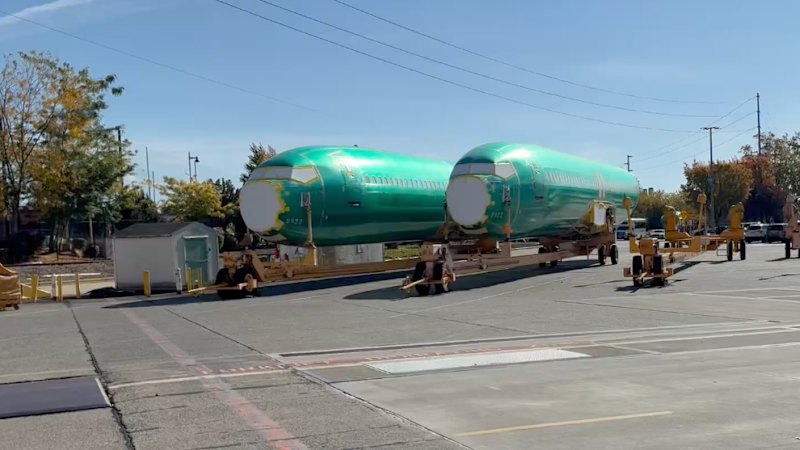
You expect static assembly bays, like an automotive plant where the chassis sits still while robotic arms dance around it. But Renton uses a moving line. Slowly, almost imperceptibly—about two inches a minute—the entire fuselage creeps forward on automated guided vehicles. It is a glacier of metal.
As the fuselage slides past station after station, different trades descend upon it. Electricians thread miles of braided copper wire through the ceiling channels like gardeners laying irrigation pipe. Interior specialists snap overhead baggage bins into place, turning a bare, echoing aluminum cave into a tidy, carpeted corridor with reading lights and air vents.
It is a dance of synchronization that defies the chaos of the outside world. Supply chain disruptions, global pandemics, regulatory reckonings, and boardroom panics all swirl outside the chain-link fence. But inside, under the amber glow of high-bay sodium lamps, the dance continues. The beat must go on. The rhythm of the line dictates human breathing.
To understand why this place matters—why thousands of people pour into these hangars through rain and snow—you have to look past the corporate earnings reports and the dry logistical data sheets. You have to look at the human need to touch the other side of the horizon.
Before the jet age, distance was a tragedy. It meant months at sea, goodbye letters that arrived after the funeral, and families permanently fractured by oceans. The assembly line at Renton is the physical machinery that ended that era of geographic isolation. It turned the globe into a neighborhood, for better and for worse. It made the world small enough to visit for a long weekend, yet fragile enough to be reached by conflict or crisis in hours.
Yet, walking these catwalks today, the atmosphere is heavy with a different kind of gravity. The ghosts of recent history linger in the rafters. The factory has weathered groundings, safety crises, and fierce public reckonings that shook the company's century-old foundation. The workers know this. You can see it in the way they double-check their inspection sheets, the way supervisors linger over blue-inked blueprints with a magnifying glass, the quiet intensity in the breakroom over lukewarm coffee.
They are not just building planes anymore. They are rebuilding trust. One fastener at a time. One inspection stamp at a time.
By mid-afternoon, the shift changes. The parking lot floods with headlights and the low rumble of pickup trucks heading back toward Bellevue, Renton, and Seattle. Inside the cavernous hangar, the next fuselage inches forward into the shadows. The titanium ribs catch the amber light, shining like the skeleton of a prehistoric leviathan washed ashore in the Pacific Northwest, waiting for the breath to enter its lungs.