The smell of aviation fuel is different from gasoline. It has a heavy, oily density that clings to the back of your throat long before it ever catches fire. On a Tuesday afternoon, under a sky so clear it looked painted, that smell suddenly dominated a four-lane stretch of Interstate 95.
Commuters were thinking about dinner. They were thinking about daycare pickups, a rattle in the left front tire, or the email they forgot to send before leaving the office. Then, the shadow fell. Not the shadow of a cloud, but the swift, terrifying belly of a twin-engine light aircraft coming down entirely too fast, its engines coughing a rhythmic, dying sputter.
We treat highways like rivers. We flow along them in our insulated metal bubbles, locked in our own private worlds, carefully ignoring the strangers swimming in the lanes beside us. We assume the system will hold. But when a fuselage slams into the center divider, tearing through concrete and sending a geyser of sparks forty feet into the air, the illusion of isolation shatters.
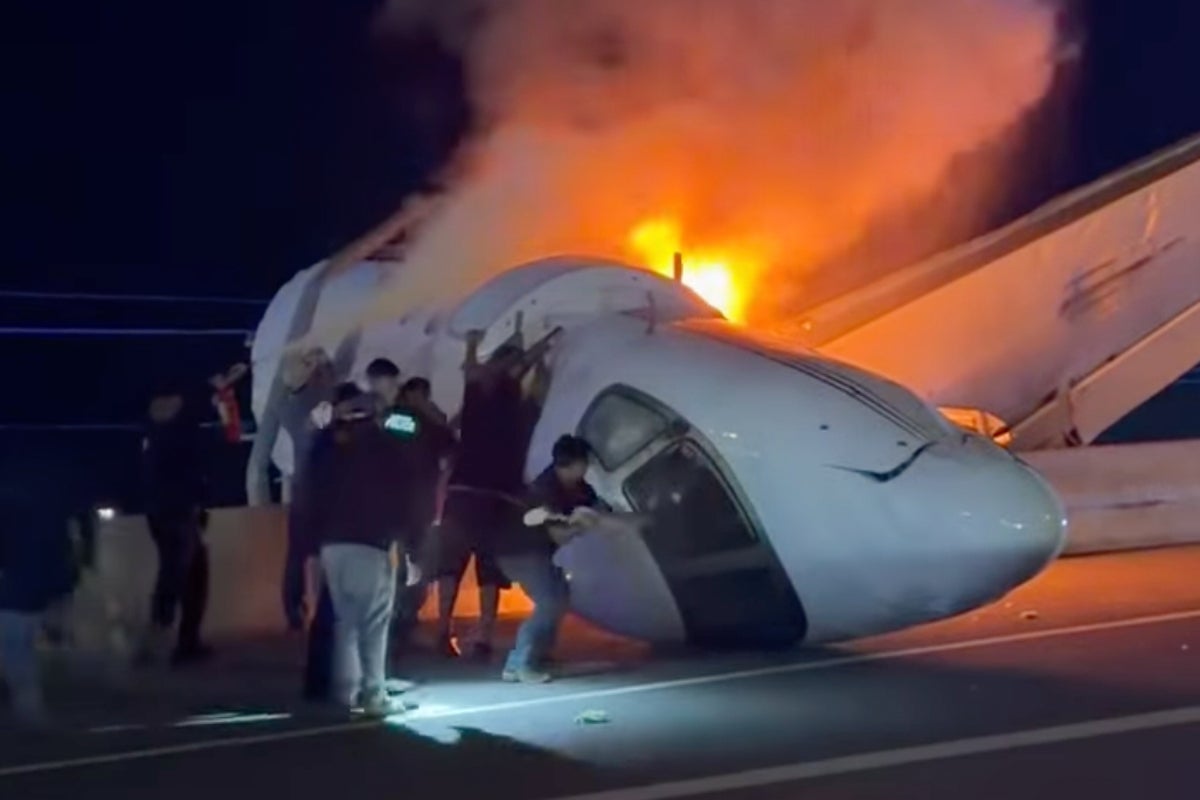
The plane did not slide gracefully. It crumpled, spun, and came to a halt across two lanes, nose down, pinned against the guardrail. Almost instantly, a thick, greasy black plume of smoke began to choke the afternoon sun.
The Anatomy of an Instinct
Psychologists talk about the bystander effect. It is a well-documented phenomenon where the presence of others cushions our sense of individual responsibility. We wait for someone else to move first. We look around to see if anyone more qualified—a doctor, a cop, a soldier—is going to step up.
But fire changes the math. Fire introduces a ticking clock that everyone can hear.
Inside the burning cockpit, two people were trapped. The impact had jammed the main cabin door, warping the aluminum frame into a lock that no human hand could turn. The pilot, a man in his fifties with blood pooling over his left eyebrow, was kicking at the windshield. It would not give. The heat outside was already distorting the air, turning the hood of the nearest sedan into a mirror of shimmering waves.
Consider what happens next.
A silver minivan slammed into park fifty yards back. A construction truck veered onto the shoulder, its tires kicking up gravel. Doors opened. People did not run away from the wreckage; they ran toward it.
There was no committee. No one elected a leader. A grocery store manager, an IT consultant who had been listening to a podcast on productivity, and a woman wearing a high-vis vest from a nearby road crew arrived at the fuselage at the exact same moment.
The heat was already intense enough to singe eyebrows. The air tasted like pennies and burning rubber.
Breaking the Glass
The IT consultant, a guy named Marcus who later admitted he had never even been in a fistfight, did not think about the physics of an exploding fuel tank. He saw a hand pressed against the cracked side window of the plane. A small, pale hand.
"Get back!" someone yelled.
Nobody did.
The woman in the high-vis vest had a crowbar from the bed of her truck. She did not swing it like a tool; she swung it like a weapon against the reinforced Plexiglas. It bounced off twice, sending a jarring vibration up her arms that she felt in her teeth. On the third strike, the window spiderwebbed. Marcus reached into the fracture, his fingers catching on the jagged edges, ignoring the sharp slice across his palms, and pulled.
They worked with a desperate, chaotic synchronization. Two men grabbed the pilot by his armpits as he scrambled through the broken frame. He was heavy, dead weight from shock, his clothes soaked in fuel. They dragged him ten feet, twenty feet, his boots scraping against the asphalt.
But there was someone else inside. A passenger, slumped in the rear seat, unconscious.
The smoke inside the cabin was a solid wall now. To reach back was to put your arms into a furnace. The road worker did not hesitate. She dropped to her knees, crawled halfway into the shattered window, and felt around blindly until her hands caught the strap of a seatbelt. She tugged. It was locked.
"Knife!" she screamed. "Anyone got a knife?"
A trucker, who had just managed to halt his eighteen-wheeler across the lanes to block oncoming traffic from the zone, dropped a heavy folding blade into her palm. One swipe. The nylon parted.
The Weight of Two Minutes
From the moment the plane touched down to the moment the entire fuselage became a single, roaring fireball, exactly two minutes and fourteen seconds elapsed.
Two minutes is nothing. It is the time it takes for a pot to boil, for a red light to cycle through to green, for a computer to install an update. Yet, within those one hundred and thirty-four seconds, seven strangers who did not know each other’s names formed a human chain. They pulled the passenger clear just as the left wing tank ruptured with a dull, concussive thud that pushed everyone back by five paces.
They lay on the grassy embankment beside the highway, coughing, covered in soot, watching the plane dissolve into a black skeleton.
When the sirens finally wailed in the distance—the official rescue, the flashing lights, the organized authority—the highway was completely still. The commuters who had stopped were standing in groups, looking at their own hands, looking at each other. The grocery manager was applying pressure to Marcus’s bleeding palm with a clean dish towel from his trunk.
The Invisible Threads
We live in an era defined by friction. We are told, constantly, that the fabric of society is fraying, that we are more divided, more hostile, and more isolated from our neighbors than at any point in modern history. We look at screens and see a world of irreconcilable differences.
But the asphalt tells a different story.
When the veneer of daily routine is stripped away by an extraordinary emergency, the underlying machinery of human empathy is revealed to be remarkably intact. The people who stopped on that highway did not check political affiliations before reaching into the smoke. They did not ask for credentials. They did not calculate the risk to their own lives versus the value of a stranger's survival.
The true miracle on that highway was not the survival of the aircraft's occupants, though against the laws of probability, both walked away with injuries that would heal. The miracle was the immediate, unhesitating refusal of ordinary people to let those passengers die alone.
Eventually, the tow trucks arrived. The charred metal was hauled away. The fire hoses washed the soot into the drainage ditches, leaving only a dark, scarred patch on the lane divider to mark where the sky had met the road. By midnight, cars were rolling over the same spot at sixty-five miles per hour, their headlights cutting through the dark, their drivers entirely unaware of the ground they were crossing.
The world closes over gaps quickly. But for those who stood on the embankment, the highway will never be just a road again. It is the place where they discovered exactly who they are when the world catches fire.